
When to Blanket a Horse: Temperatures, Fill Weights and the Exceptions
When to blanket a horse: which horses need one, an extension chart of fill weight by temperature for full-coated and clipped horses, and when to take it off.
Affiliate disclosure: product links on this page go to Amazon or to the maker's own store. As an Amazon Associate we earn from qualifying purchases, at no extra cost to you; links to makers' own stores earn us nothing. No retailer or brand sees our picks before they are published or has any say in them. How we choose.
A healthy adult horse with a full, dry winter coat, a body condition score above 4, shelter from wind and plenty of hay usually does not need a blanket until temperatures drop below about 25°F. The University of Maine's blanketing bulletin calls for none on a full-coated horse at 25°F and above (a rain sheet if it is raining) and a light or midweight from 15 to 24°F, and Penn State's threshold for a horse with no shelter is 5°F. The horses that do need one sooner are the exceptions: clipped, thin, very young or very old, recently moved from a warm climate, without shelter, or facing cold rain and wind.
This guide sets out who needs a blanket, the extension-service chart of fill weights by temperature, how it compares with a tack retailer's chart, and how to tell when a blanket is too much.
Which horses need a blanket
Penn State Extension and the University of Maine (UMaine) list the same situations. A blanket is the right call when the horse:
- Has been clipped. Clipping removes the coat that does the insulating. UMaine says clipped horses need blankets from 40°F down.
- Has no shelter and the temperature or wind chill drops below 5°F (Penn State's threshold).
- Is likely to get wet. Rain, sleet and freezing rain soak the coat; Penn State says even about 0.1 inch of rain can cause cold stress, and that snow is less of a problem than rain or ice.
- Is thin or unwell. Penn State names a body condition score of 3 or less; UMaine says horses at 4 or below may struggle to stay warm, especially hard keepers.
- Is very young or very old. Both sources list age at either end.
- Has not adapted to cold. A horse moved from a southern climate, or one that has not grown a winter coat, should be blanketed like a clipped horse; UMaine says full adaptation can take 1 to 2 winters.
UMaine also lists two signs from the horse itself: shivering, and refusing to leave shelter.
Why a dry winter coat goes so far
A winter coat insulates by trapping air in the hair. Rutgers' Equine Science Center gives the lowest temperature at which an animal with a full, dry winter coat stays comfortable as 18°F, and 59°F if the animal is wet, clipped or in a summer coat. Those numbers come from beef cattle studies, and Rutgers says horses are likely similar. Below that point, Rutgers says energy needs rise about 1% for each degree of cold.
Two things follow. A dry, fluffy coat on a well-fed horse handles a lot of cold; a wet or flattened coat handles far less. And feed is the horse's furnace: extra cold means extra hay, which our hay calculator helps you budget. Shelter counts too: Rutgers says horses in a shelter conserve up to 20% more body heat than fully exposed horses.
Temperature chart: the extension guide
Rutgers states plainly that there are no scientific rules about what temperature calls for a particular blanket. UMaine's Bulletin #1038 is the most specific extension chart we found, and it is a starting point, not a rule:
| Temperature | Full winter coat | Clipped |
|---|---|---|
| 40 to 50°F | No blanket | Rain sheet or lightweight |
| 25 to 39°F | No blanket, or a rain sheet if raining | Light or midweight |
| 15 to 24°F | Light or midweight | Heavyweight |
| 0 to 14°F | Heavyweight | Heavyweight, liner and hood |
| Below 0°F | Heavyweight, liner and hood | Heavyweight, liner and hood |
The same bulletin defines the weights by fill:
| Blanket type | Fill |
|---|---|
| Rain sheet, stable sheet or liner | 0 g |
| Lightweight | 60 to 100 g |
| Medium weight | 150 to 300 g |
| Heavyweight | 300 g and up |
| Quilted liner | 100 to 300 g |
Read the chart against wind and wet. A 30°F day with sleet and wind can call for more cover than a still, dry day that is colder on the thermometer; UMaine lists wind chill and wet coats alongside air temperature.
A retailer chart, for comparison
Tack retailers publish their own charts, and they tend to blanket earlier. Schneider Saddlery's temperature guide (a retailer chart, January 2026) recommends:
| Blanket | Full winter coat or trace clipped | Fully clipped |
|---|---|---|
| Turnout sheet, no fill | As needed for rain or wind | 50 to 65°F |
| Lightweight, 80 to 180 g | 30 to 50°F | 40 to 60°F |
| Medium weight, 200 to 300 g | 30 to 45°F | 35 to 50°F |
| Heavyweight, 380 g and up | 15 to 30°F | 20 to 40°F |
| Extra heavyweight | Below 15°F | Below 20°F |
The gap is large for an unclipped horse: at 35°F, UMaine says no blanket while Schneiders suggests a lightweight or medium. Schneiders itself calls its ranges guidelines to weigh against wind, rain, shelter, body condition and how the horse feels under the blanket. If your horse is full-coated, in good weight and has a run-in shed, the extension chart is the better default, and the horse's own signs (below) settle the rest.
How to tell a blanket is too much, or not enough
Rutgers' rule: check the horse shortly after blanketing. Sweating calls for a lighter blanket; shivering calls for more warmth. Slide a hand under the blanket at the shoulder and behind the withers: damp hair there means the blanket is too heavy for the day.
Penn State says to take the blanket off on warm days so the horse does not sweat and end up wet underneath, then put it back on once the coat is dry. Rutgers adds that sweating under a blanket is as undesirable as putting a blanket on a wet horse.
Blanketing checklist
- Start dry. Never blanket a wet horse (Penn State and UMaine). Dry it with towels, a cooler or a blower first.
- Check the fit. UMaine's test: a hand should slide under the blanket at the point of the shoulder and at the withers. Our blanket size calculator turns a tape measurement into the size to order.
- Look daily. Check for rubs at the shoulders and withers, twisted straps and wet patches. Rutgers ties rubs and sores to blankets that are too big or too small.
- Strip it weekly. Rutgers says to remove the blanket at least once a week to groom and check weight, because a blanket hides weight loss and skin problems.
- Swap a soaked blanket. Pull a saturated blanket and dry it, and keep a second one if your winters are wet.
- Commit for the season. Rutgers notes constant blanketing flattens the coat so it insulates less; once you start, plan to blanket all season.
What to buy
A practical kit for many barns is two pieces: a 0 g waterproof turnout sheet for cold rain, and a medium-weight turnout of about 200 g for the cold snaps. Add a heavyweight, or a liner and hood, if you clip or your winters reach the single digits for weeks. Our turnout blanket picks cover the 100 to 300 g range, and our rain sheet picks cover the 0 g sheets.
Frequently asked questions
At what temperature should I blanket my horse?
There is no single number. The University of Maine's chart suggests no blanket for a full-coated horse at 25°F and above (a rain sheet if it rains), a light or midweight at 15 to 24°F and a heavyweight from 0 to 14°F. A clipped horse moves up one weight at each step.
Do horses need blankets in winter?
Most healthy adult horses with a full winter coat, shelter and enough hay do not. Penn State Extension lists the exceptions: clipped horses, very young or old horses, thin horses, horses moved from warm climates, and horses without shelter when the temperature or wind chill is below 5°F or when they may get wet.
Is it better for a horse to be too warm or too cold?
Neither. Rutgers' Equine Science Center says sweating under a blanket is as undesirable as blanketing a wet horse, because the damp coat then chills. Check under the blanket soon after putting it on: sweating means go lighter, shivering means add warmth.
Should I blanket my horse in the rain?
A wet coat loses its insulation, and Penn State notes about 0.1 inch of rain can cause cold stress. For a full-coated horse between 25 and 39°F, the University of Maine suggests a 0 g rain sheet if it is raining rather than a filled blanket.
What does a clipped horse need?
More cover, sooner. The University of Maine's chart gives a clipped horse a rain sheet or lightweight from 40 to 50°F, a light or midweight from 25 to 39°F, a heavyweight from 15 to 24°F, and a heavyweight with a liner and hood below 15°F.
How long does a horse take to adapt to a cold climate?
The University of Maine says a horse moved from a warmer climate can take 1 to 2 winters to adapt fully. Until it has grown a full winter coat, blanket it like a clipped horse.
Sources
- Bulletin #1038, Winter Blanketing Guide for Equines in Maine, University of Maine Cooperative Extension
- When to Blanket a Horse, Penn State Extension
- To Blanket or Not To Blanket?, Rutgers Equine Science Center
- How to Know When to Blanket Your Horse: A Temperature Guide, Schneider Saddlery
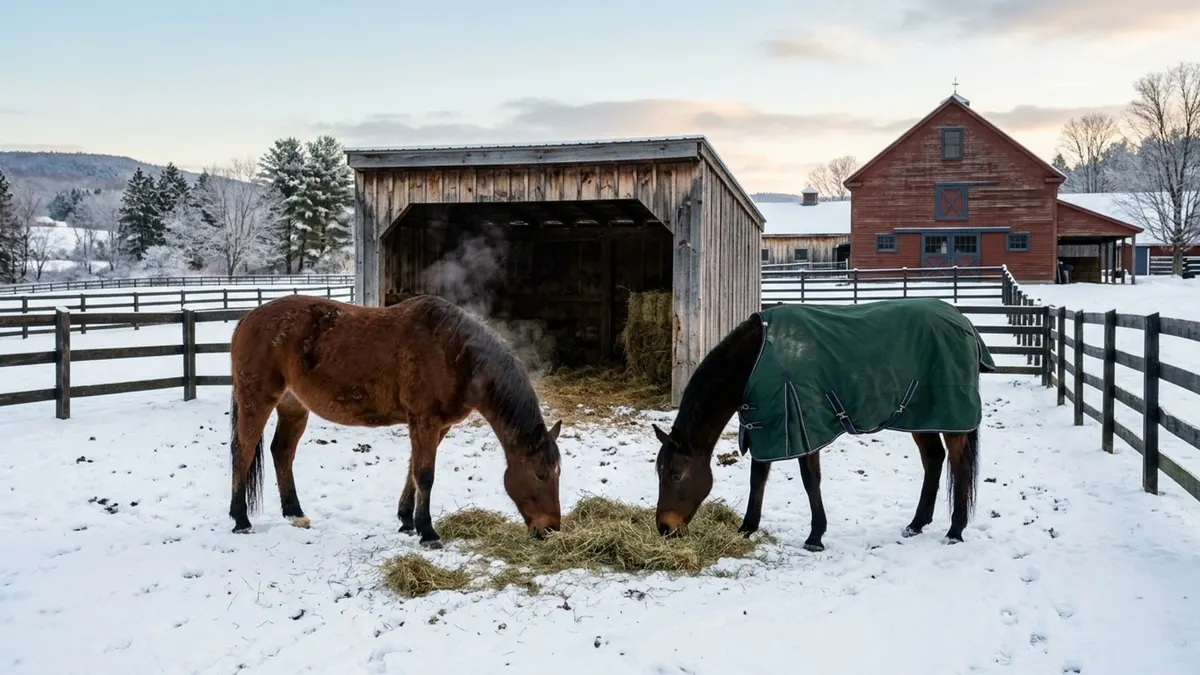
Cover image: Illustration: Barn Gear Review (AI-generated)
Related guides
Best Fly Masks for Horses (2026): Ears, Nose Covers, UV and Fit
From a no-ears classic with a double-latch closure to a fine-mesh mask with ears, nose and a stated 60%+ UV block.
Best Fly Sheets for Horses (2026): Mesh, UV, Belly Wraps and Necks
Mesh sheets for summer turnout, from a 75%+ UV sheet with a removable neck and belly wrap to a light scrim for show days.
Best Fly Sprays for Horses (2026): Active Ingredients and Labels Compared
Four labeled horse fly sprays compared on what is in the bottle, how often the label says to apply it and who it is not for.