
How Much Hay Does a Horse Eat? Daily and Winter Hay Calculator
How much hay a horse eats a day (about 2% of body weight, 20 lb for a 1,000 lb horse) and how many bales to buy for winter, with a calculator.
Affiliate disclosure: product links on this page go to Amazon or to the maker's own store. As an Amazon Associate we earn from qualifying purchases, at no extra cost to you; links to makers' own stores earn us nothing. No retailer or brand sees our picks before they are published or has any say in them. How we choose.
A horse eats about 2% of its body weight in hay a day: 20 lb for a 1,000 lb horse, 24 lb for a 1,200 lb horse. That 2% figure is the target Penn State Extension, the University of Maryland Extension and Alabama Extension all give, and Alabama puts the floor at 1% and free-choice eating at 2 to 2.5%. The calculator below turns your horse's weight into pounds a day, pounds for the whole hay season with storage and feeding waste added, and the number of bales to buy.
It is a planning tool, not a diet. A horse that is too thin or too heavy, growing, pregnant, nursing or in hard work needs a feeding plan from your vet or an equine nutritionist.
How much hay will your horses eat?
A weight tape or your vet's scale
121 = Dec 1 to Mar 31
The sources use 40 and 50 lb: weigh one of yours
5% for hay stored indoors
5% from a hay rack; more off the ground
Per horse per day
20.0 lb
9.1 kg
All horses per day
20.0 lb
1 horse
Hay for 121 days
2,668 lb
1.33 tons with waste
Bales to buy
54
at 50 lb a bale
Figures are pounds of hay as fed. Extension services give the daily rate as a share of body weight; weigh a few of your own bales and flakes with a bathroom or luggage scale, because bale and flake weights vary a lot. A horse that is losing or gaining weight, pregnant, nursing, growing or in hard work needs a feeding plan from your vet or an equine nutritionist.
The rule the calculator uses
Penn State Extension says horses should ideally receive at least about 2% of their body weight in forage a day to keep the gut healthy, and that horses put on a weight-loss diet are limited to about 1% of body weight in hay. Alabama Extension's ANR-3153 says the average horse eats 2 to 2.5% of its body weight in dry matter a day when left to itself, sets about 2% as the target, and 1% as the minimum. Its table for common weights:
| Horse weight | Minimum (1%) | Recommended (2%) |
|---|---|---|
| 900 lb | 9 lb | 18 lb |
| 1,000 lb | 10 lb | 20 lb |
| 1,100 lb | 11 lb | 22 lb |
| 1,200 lb | 12 lb | 24 lb |
The calculator multiplies body weight by the rate you pick, then by the number of horses and days. It then adds storage waste and feeding waste the way the University of Maryland Extension's worked example does (each as its own multiplier), and divides by your bale weight, rounding up to whole bales.
How the defaults were chosen
- 2% of body weight: the target in all three extension sources above.
- 121 days: December 1 to March 31, the season in Maryland's example. Use your own: count the days your horses live on hay rather than pasture.
- 5% storage waste and 5% feeding waste: Maryland's figures for bales stored indoors and fed in a hay rack. Hay stored outside or fed on the ground loses more; raise the numbers to match your barn.
- 50 lb bales: the small square bale in Alabama's Table 2. Maryland's example uses 40 lb. Penn State notes that flake weight varies greatly with how tightly the baler packed the bale, so weigh a few of yours.
Alabama states its 2% as dry matter. Its infographic puts hay at about 90% dry matter, so a horse eating 20 lb of dry matter gets it from about 22 lb of hay as fed. Maryland and Penn State state their 2% as hay. The difference is about 10%; if you want the Alabama figure, add 10% to the daily number.
Worked examples
| Horses | Weight each | Daily rate | Per horse per day | Hay for the winter | 50 lb bales |
|---|---|---|---|---|---|
| 1 | 1,000 lb | 2% | 20 lb | 2,668 lb | 54 |
| 1 | 1,000 lb | 1.5% | 15 lb | 2,001 lb | 41 |
| 1 | 800 lb | 2% | 16 lb | 2,134 lb | 43 |
| 1 | 1,200 lb | 2% | 24 lb | 3,202 lb | 65 |
| 2 | 1,100 lb | 2% | 22 lb | 5,870 lb | 118 |
The first row matches Maryland's own example: 20 lb a day for 121 days is 2,420 lb, and with both waste allowances it is 2,668 lb, which Maryland divides into about 67 bales of 40 lb. At 50 lb a bale it is 54.
Round bales
Alabama's Table 2 gives the share of a 1,000 lb round bale one horse eats in 30 days on free choice: 75% for a 1,000 lb horse, which is 25 lb a day, the 2.5% end of the range. At that rate a 1,000 lb bale is 40 days of eating for one 1,000 lb horse before any waste. Round bales fed without a feeder lose far more to trampling and bedding down; a round bale feeder or a round bale net is how most owners cut that loss.
Weigh the horse, then weigh the hay
If you do not know your horse's weight, the University of Arkansas Extension gives this estimate: heart girth times heart girth times body length, divided by 330, gives pounds. Measure the heart girth around the horse at the highest part of the withers, and the body length from the point of the shoulder to the point of the buttock. A horse with a 70 in girth and a 66 in body length works out to 70 x 70 x 66 / 330 = 980 lb. Arkansas says the estimate may not be very accurate for pregnant mares or horses with unusual conformation, and suggests checking it against a scale at your vet's clinic.
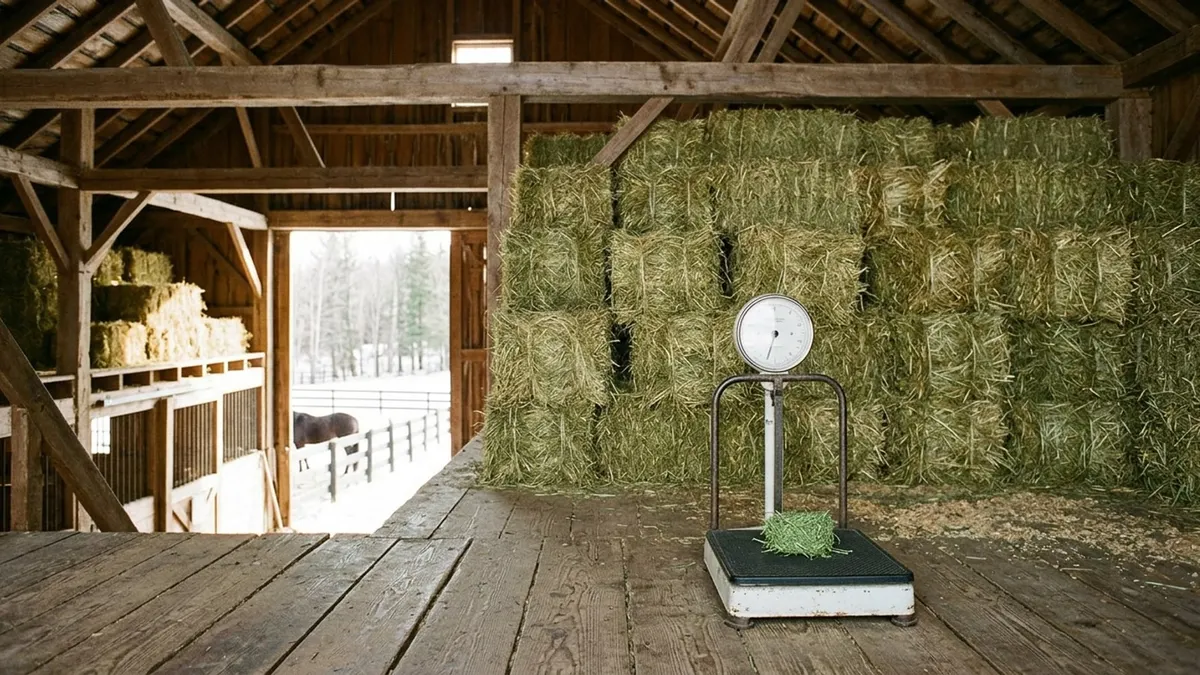
Then weigh what you feed. Penn State suggests a trash can on a bathroom scale (tare the can first), or a filled hay net on a luggage scale. Once you know what one flake of your hay weighs, you can feed by the flake.
Feeding it with less waste
The waste figures in the calculator assume a rack. A slow feeder hay net slows a horse down so a day's ration lasts longer, and a hay rack or feeder keeps hay off the stall floor. Our guides to each compare hole sizes, capacity and the makers' own fitting instructions.
Frequently asked questions
How much hay does a 1,000 lb horse eat a day?
About 20 lb, which is 2% of its body weight, the target Penn State, Maryland and Alabama extension services give. Alabama puts the minimum at 1% (10 lb) and free-choice eating at 2 to 2.5% (20 to 25 lb).
How many bales of hay does a horse need for winter?
For a 1,000 lb horse fed 20 lb a day from December 1 to March 31, about 2,668 lb with 5% storage and 5% feeding waste. That is 54 bales of 50 lb or 67 bales of 40 lb. Weigh your own bales, since they vary.
How many flakes of hay should I feed a horse?
Feed by weight, not by flakes. Penn State notes that flake weight varies greatly from bale to bale and even within one bale. Weigh a few flakes of your hay, then work out how many make your horse's daily pounds.
Can a horse eat too little hay?
Alabama Extension sets 1% of body weight as the minimum, and Penn State uses 1% only for horses on a weight-loss diet. Below that, talk to your vet before cutting further.
How long does a round bale last one horse?
At free choice, Alabama's table has a 1,000 lb horse eating 75% of a 1,000 lb round bale in 30 days, about 25 lb a day. That is roughly 40 days per bale before waste, and less if the bale sits on the ground without a feeder.
How do I estimate my horse's weight without a scale?
The University of Arkansas Extension formula is heart girth times heart girth times body length, divided by 330, in inches and pounds. It is an estimate; a scale at your vet's clinic is more accurate.
Sources
- The Importance of Weighing Horse Feed, Penn State Extension
- Estimating & Supplying Equine Forage Requirements (ANR-3153), Alabama Cooperative Extension System
- Calculating Your Horse's Winter Hay Needs, University of Maryland Extension
- Estimating a Horse's Body Weight, University of Arkansas Cooperative Extension Service
Cover image: Illustration: Barn Gear Review (AI-generated)
Related guides
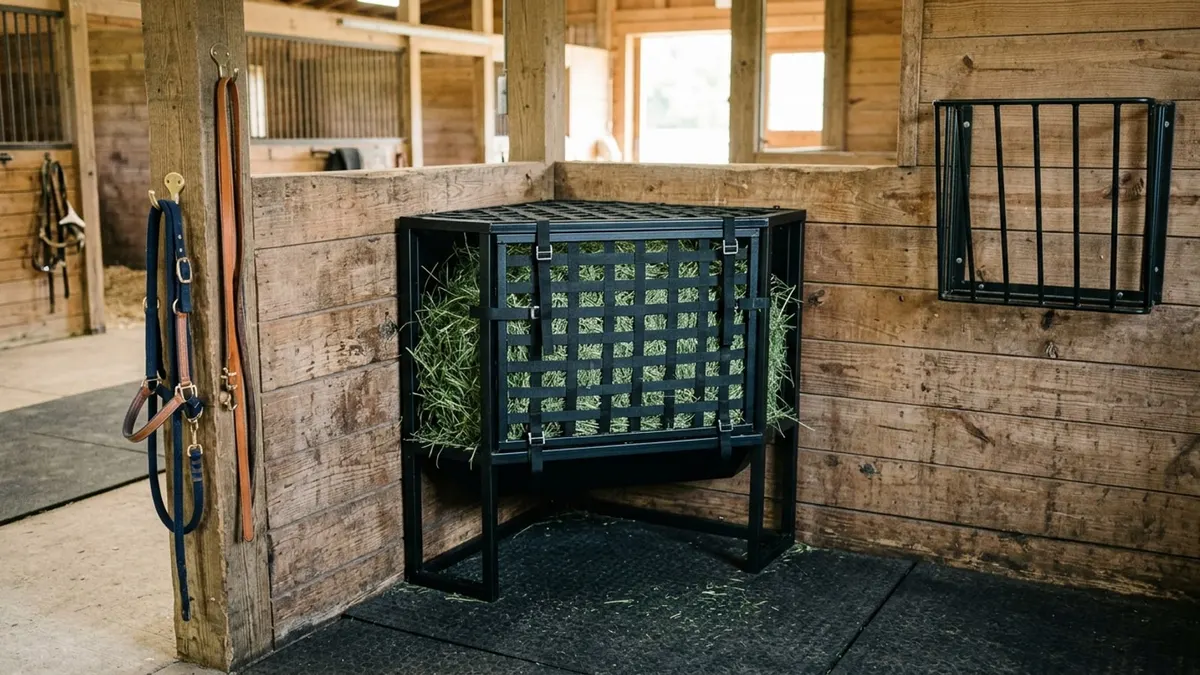
Best Hay Feeders for Horses: Wall Racks, Corner Feeders and Floor Slow Feeders
Five ways to feed flakes off the stall floor, from a steel corner floor feeder with a netted lid to a 2-pack of corner racks, with the waste figures from extension research.
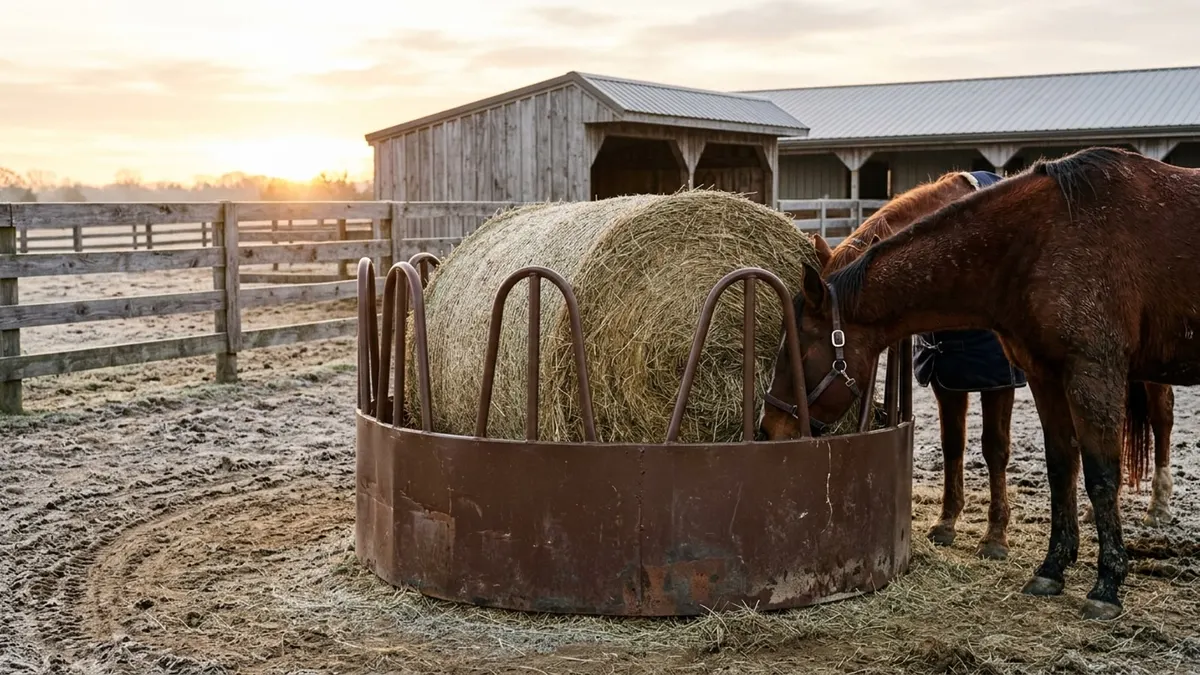
Best Round Bale Feeders for Horses (2026): Horse-Rated Rings and Nets
Four horse-rated round bale feeders from Tarter, Behlen Country and Priefert, plus a net that cuts waste further, with the Minnesota study's waste and payback numbers.
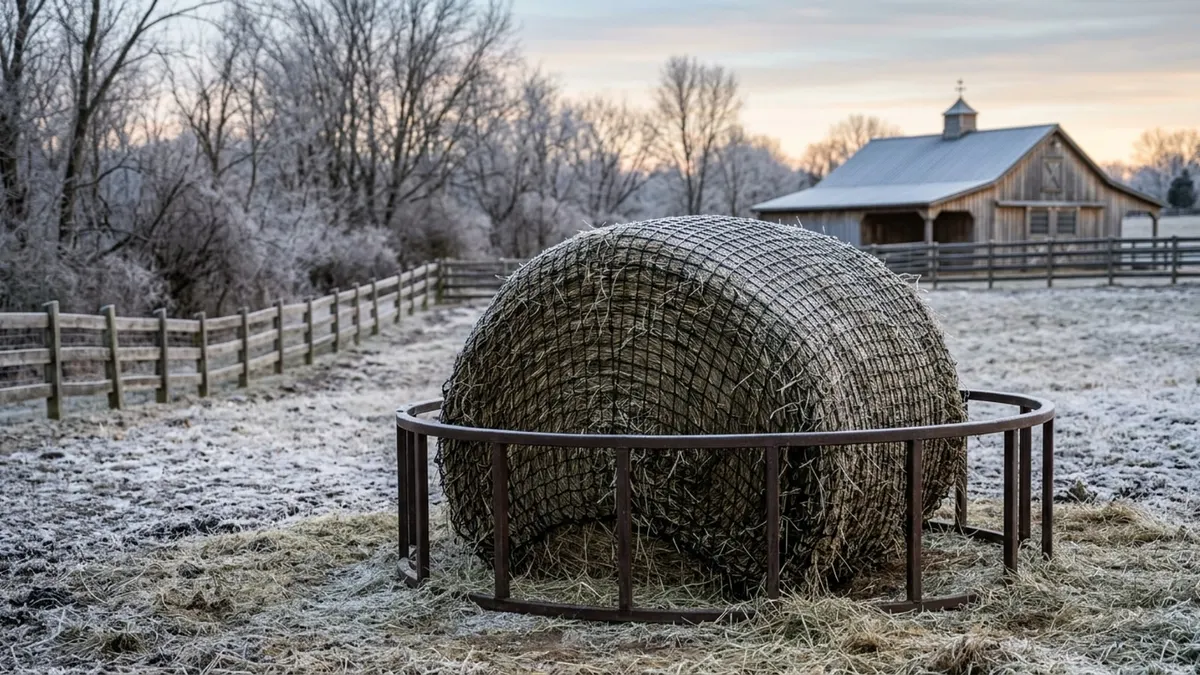
Best Round Bale Hay Nets for Horses (2026): Sized by Bale and Hole
Five round bale nets, from a hand-tied 6 ft Hay Chix to a 4 ft knotless net, sized by bale and by hole, with how to use them with a ring.