
Best Round Bale Feeders for Horses (2026): Horse-Rated Rings and Nets
The best round bale feeder for horses: four rings their makers rate for horses, a slow feed net, and the Minnesota hay waste figures for each feeder style.
Affiliate disclosure: product links on this page go to Amazon or to the maker's own store. As an Amazon Associate we earn from qualifying purchases, at no extra cost to you; links to makers' own stores earn us nothing. No retailer or brand sees our picks before they are published or has any say in them. How we choose.
The round bale feeder for horses we would buy is the Tarter Equine Pro Hay Feeder with Hay Saver. Tarter builds it for horses and says it is not recommended for cattle: an 8 foot ring, 50 inches tall, with a 17 inch solid hay saver around the bottom and rounded dividers. Putting a slow feed net such as the Hay Chix 6 ft round bale net over the bale inside the ring follows the University of Minnesota researchers' advice to use a net together with a feeder; on its own, the net in their study wasted 6% of the hay, against 19% for open rings.
The rule that matters most: buy a feeder its maker rates for horses. Ontario's agriculture ministry warns that round bale feeders meant for cattle can be dangerous when used with horses, and makers split their own lines the same way. The steel feeders are sold through farm stores and dealers, so the links below go to each maker's page.
Our top picks at a glance
- Tarter Equine Pro Hay Feeder with Hay Saver
Diameter: 96 in · Height: 50 in · Rated for: Horses ("Not recommended for cattle")
- Tarter Equine Flex Hay Feeder
Diameter: 96 in wide; 144 in long fully flexed · Height: 59 in · Rated for: Horses (described as equine friendly)
- Behlen Country Open Top Horse Bale Feeder
Diameter: 96 in (8 ft) · Height: 50 in · Rated for: Horses (sold as Behlen's horse model)
- Priefert Round Bale Feeder for Horses (RBFH)
Diameter: Not given in Priefert's catalog · Height: Not given in Priefert's catalog · Rated for: Horses or horned cattle
- Hay Chix 6 ft Round Bale Net (1 3/4 in holes)
Diameter: Fits round bales up to 6 x 6 ft (per the Amazon listing) · Height: Covers the whole bale · Rated for: Horses, mules, donkeys, ponies (per the Amazon listing)
| Pick | Diameter | Height | Rated for | Buy |
|---|---|---|---|---|
| Tarter Equine Pro Hay Feeder with Hay SaverBest overall | 96 in | 50 in | Horses ("Not recommended for cattle") | Tarter |
| Tarter Equine Flex Hay FeederBest for a larger herd | 96 in wide; 144 in long fully flexed | 59 in | Horses (described as equine friendly) | Tarter |
| Behlen Country Open Top Horse Bale FeederBest open-top design | 96 in (8 ft) | 50 in | Horses (sold as Behlen's horse model) | Behlen Country |
| Priefert Round Bale Feeder for Horses (RBFH)Best solid-skirted feeder | Not given in Priefert's catalog | Not given in Priefert's catalog | Horses or horned cattle | Priefert |
| Hay Chix 6 ft Round Bale Net (1 3/4 in holes)Best add-on to cut waste | Fits round bales up to 6 x 6 ft (per the Amazon listing) | Covers the whole bale | Horses, mules, donkeys, ponies (per the Amazon listing) | Amazon |
Best overall
Tarter Equine Pro Hay Feeder with Hay Saver
A horse-only 8 foot ring with a 17 inch solid hay saver: the feeder for most owners with two to a handful of horses on round bales.
- Diameter
- 96 in
- Height
- 50 in
- Rated for
- Horses ("Not recommended for cattle")
- Hay saver
- 17 in
- Weight
- 163 lb, 3 pieces
Pros
- Tarter rates it for horses and says it is not recommended for cattle
- The 17 inch hay saver skirt catches hay that would otherwise be pulled out and trampled
- Three bolt-together pieces, all hardware included, per Tarter
Cons
- A ring lets horses bury their heads in the bale; in the Minnesota study, ring feeders wasted 19% of the hay
- 1 year warranty only
Tarter's spec sheet lists the Equine Pro (part RHF) at 96 inches across and 50 inches tall, with a 17 inch hay saver panel, 163 pounds in three pieces, and a 1 year warranty. Tarter describes the dividers as rounded with no sharp edges and states the feeder is not recommended for cattle, which is the clearest sign a maker designed a feeder around horses rather than adapting a cow ring.
An 8 foot ring takes a full-size round bale. In the University of Minnesota study, open ring feeders wasted 19% of the hay against 57% with no feeder, because horses pushed their heads into the bale and dropped what they pulled out. A solid lower skirt like this one keeps some of that inside the ring. To get waste down further, put a slow feed net over the bale inside the ring; see the Hay Chix pick below.
Tarter sells through farm stores, so check its where-to-buy page for a local dealer. If you keep a larger herd and want the feeder to tighten around the bale as it is eaten, look at the Equine Flex.
Best for a larger herd
Tarter Equine Flex Hay Feeder
A four-piece feeder that narrows as the bale is eaten, so horses keep reaching hay until it is gone.
- Diameter
- 96 in wide; 144 in long fully flexed
- Height
- 59 in
- Rated for
- Horses (described as equine friendly)
- Hay saver
- 17 in
- Weight
- 294 lb, 4 pieces
Pros
- Compresses in diameter as horses eat, per Tarter, so the bale stays within reach
- 1.75 inch steel tubing with a hay saver panel and loop legs that resist sinking
- At 12 feet long fully flexed, it is longer than an 8 foot ring
Cons
- 294 pounds and 59 inches tall: harder to move and to load than a fixed ring
- Tarter does not list the bale sizes it fits
Tarter's Equine Flex (part FF) is 96 inches wide, 59 inches tall and 12 feet long when fully flexed, built from 1.75 inch steel tubing in four pieces joined by loop connections, with a 17 inch hay saver and a 1 year warranty. Tarter says it compresses in diameter as horses eat, keeping hay within reach until the bale is gone, and describes it as equine friendly with no sharp edges.
The appeal is for groups. New Mexico State University notes that dominant horses can guard small feeders, and a longer feeder gives more places to eat. It is heavier than a ring, so plan on a tractor for both the bale and the feeder.
Best open-top design
Behlen Country Open Top Horse Bale Feeder
An 8 foot horse bale feeder with no top bar, which Behlen Country builds for horses as a separate model from its cattle feeders.
- Diameter
- 96 in (8 ft)
- Height
- 50 in
- Rated for
- Horses (sold as Behlen's horse model)
- Weight
- 176 lb
- Tube
- 1.625 in
Pros
- Behlen sells it as a horse feeder, separate from cattle models it says are not recommended for horses
- Open top design, which Behlen says is what makes it a horse feeder
- Premium powder coat finish, per Behlen
Cons
- No solid hay saver skirt is listed, so expect more hay pulled out than with a skirted feeder
- Behlen's page gives no bale size or warranty term
Behlen Country lists the Open Top Horse Bale Feeder (part 26121157) at 8 feet in diameter and 50 inches tall, 176 pounds, in 1.625 inch tube with a powder coat, and describes the open top as creating, in its words, a "horse safe feeder." On the same site, Behlen's Hay Guard round bale feeder carries the note "Not recommended for horses or horned animals," which shows why the model matters more than the brand.
Choose it if your horses are likely to throw their heads up while eating and you want nothing overhead. Pair it with a slow feed net if waste is the bigger worry.
Best solid-skirted feeder
Priefert Round Bale Feeder for Horses (RBFH)
Priefert's horse round bale feeder, which the maker says is designed to be free of head and foot traps, with a solid skirt.
- Diameter
- Not given in Priefert's catalog
- Height
- Not given in Priefert's catalog
- Rated for
- Horses or horned cattle
- Design
- Solid skirt, free of head and foot traps (Priefert)
Pros
- Priefert's catalog says it is designed to be free of head and foot traps
- Solid skirted design to decrease hay loss and prevent leg injuries, per Priefert
- Also rated for horned cattle if you run both
Cons
- Priefert's catalog does not give dimensions; ask the dealer for diameter and height
- Sold through Priefert dealers only
Priefert's equine catalog describes the Round Bale Feeder for Horses (RBFH) as "designed to be free of head and foot traps," with "a solid skirted design to decrease hay loss and prevent leg injuries," for feeding round bales to horses or horned cattle. Ontario's ministry lists the same two features for a horse feeder: enough overall height that horses cannot reach over, and enough chest height that a pawing foot cannot get caught.
The catalog we read did not list a diameter or height, so confirm those with a Priefert dealer before you buy, and check that the bale you buy fits inside.
Best add-on to cut waste
Hay Chix 6 ft Round Bale Net (1 3/4 in holes)
A 1 3/4 inch net that goes over the bale inside your feeder; nets were among the lowest-waste options in the Minnesota study.
- Diameter
- Fits round bales up to 6 x 6 ft (per the Amazon listing)
- Height
- Covers the whole bale
- Rated for
- Horses, mules, donkeys, ponies (per the Amazon listing)
- Hole size
- 1 3/4 in
Pros
- In the Minnesota study, the net feeder tested wasted 6% of the hay and paid for itself in under a month
- Hay Chix says it works inside feeders such as the Hay Hut and other round bale feeders
- Also fits large square bales, per the listing
Cons
- Hay Chix says shod horses need a ring that sits flush with the ground or the net placed high enough that they cannot paw at it
- Fitting a 6 foot net over a big bale takes some handling, as Hay Chix itself notes
The University of Minnesota tested a round bale net (the Cinch Net) alongside steel and poly feeders. It wasted 6% of the hay, close to the best feeder's 5%, and paid for itself in under a month, but the bale collapsed after two days and horses stood on the remaining hay, so the researchers recommended using a net together with another feeder. That is the setup this pick is for.
Hay Chix's 6 ft net fits round bales up to 6 by 6 feet and has 1 3/4 inch openings (per the Amazon listing). For shod horses, Hay Chix says to use it in a ring that sits flush with the ground or to position it high enough that the horse cannot paw at it, and not to use it with horned animals or non-breakaway halters. Our round bale hay net guide compares nets by bale size and hole size.
How we chose
The first test was simple: does the maker rate the feeder for horses? Many round bale feeders are built for cattle, and makers say so. We then compared diameter, height, whether there is a solid skirt or hay saver, weight and warranty from each maker's own spec page or catalog. Steel round bale feeders are sold through farm stores and dealers, so these picks link to the makers.
Cattle feeders and horses
Ontario's Ministry of Agriculture, Food and Agribusiness puts it plainly in its round bale feeder plans for horses: the design of round bale feeders meant for cattle can be dangerous when used with horses. Its plans call for:
- enough overall height that horses cannot reach over and pull hay off the top of the bale;
- enough chest height that a horse cannot get a foot caught in the feeder when it paws;
- smooth welds with no rough edges or corners, and a frame that stands up to horses rubbing on it.
Makers draw the same line. Behlen Country's Hay Guard feeder is labeled "Not recommended for horses or horned animals," while its Open Top model is sold for horses. Tarter's Equine Pro is "Not recommended for cattle." Priefert describes its horse feeder as designed to be free of head and foot traps. If a feeder's page does not say it is for horses, assume it was designed for cattle.
What the Minnesota study found
The University of Minnesota fed round bales of orchardgrass to 25 horses in nine commercial feeders and with no feeder, and measured the hay that ended up on the ground. Feeders that kept horses from burying their heads in the bale wasted least.
| Feeder design | Hay waste | Months to pay back |
|---|---|---|
| Waste Less (collapsing side panels) | 5% | 8 |
| Cinch Net (net over the bale) | 6% | Under 1 |
| Hayhut (covered poly) | 9% | 4 |
| Covered Cradle | 11% | 19 |
| Tombstone Saver | 13% | 4 |
| Tombstone, Cone, Ring | 19% | 2 to 9 |
| Hay Sleigh | 33% | 5 |
| No feeder | 57% |
Three points from the study matter when buying. Every feeder beat no feeder, and all paid for themselves within 20 months; the researchers note the payback time halves with hay at $200 a ton. No injuries were seen from any of the feeders during the study, though the feeders tested were all made and marketed for horses. And horses on free-choice round bales ate 2.0 to 2.4% of body weight a day, enough for weight gain with six of the feeders, so easy keepers on round bales need watching. Our hay calculator shows what 2% of your horse's weight comes to.
What to look for
Horse rating and design
Look for the maker's own words that the feeder is for horses, a solid skirt or hay saver at the bottom, and nothing a hoof or head can get through and catch on. Penn State Extension notes large bale feeders are usually designed to sit low, close to grazing posture.
Size against your bales
An 8 foot (96 inch) feeder suits a full-size round bale. Ontario's sample design was built around a 4 by 5 foot bale. Measure the bales your supplier makes before you order a feeder or a net.
Waste control
Rings alone wasted 19% in Minnesota. A skirt keeps some hay in; a net over the bale or a feeder that limits head access cuts waste furthest. A separate Texas study cited by Penn State found 5.5% waste in a ring feeder against about 35% without one.
Feeding space
New Mexico State University warns that dominant horses may keep timid horses away from small feeders. With more than a few horses, a longer feeder or a second feeding point helps everyone eat.
Footing and moving it
Ontario's plans suggest a cement pad extending 10 to 15 feet around the feeder, and note that a 500 lb or heavier bale is hard to move in deep snow without four-wheel drive. Plan where the feeder sits before winter.
What to skip
- Cattle rings and slant-bar cattle feeders for horses, unless the maker rates them for horses.
- Feeding round bales on the ground. The 57% waste in the Minnesota study is more than half the bale.
- A net alone with shod horses in the open. Use it inside a feeder, as both Hay Chix and the Minnesota researchers advise.
- Free choice for an easy keeper without a plan; the Minnesota horses gained weight on most feeders. For flakes in a stall, see our hay feeder guide or slow feeder nets.
Frequently asked questions
Can you use a cattle round bale feeder for horses?
Not unless its maker rates it for horses. Ontario's agriculture ministry warns that round bale feeders meant for cattle can be dangerous when used with horses, and makers such as Behlen Country label some cattle feeders as not recommended for horses. Look for a horse-rated model with a solid skirt and no head or foot traps.
Which round bale feeder wastes the least hay?
In the University of Minnesota study, feeders that kept horses from burying their heads in the bale wasted least: 5% for a feeder with collapsing side panels, 6% for a net over the bale and 9% for a covered poly feeder, against 19% for open rings and 57% with no feeder.
How long does a round bale last with horses?
It depends on bale weight and the number of horses. In the Minnesota study, horses on free-choice round bales ate 2.0 to 2.4% of body weight a day, so divide the bale's weight by that daily total for your herd, and add the feeder's waste figure.
Do round bale feeders pay for themselves?
Yes. In the Minnesota study every feeder paid for itself within 20 months at hay valued at $100 a ton, and some in two months or less. The researchers note the payback time halves when hay costs $200 a ton.
Can shod horses eat from a round bale net?
Hay Chix says shod horses should use its round bale net in a hay ring that sits flush with the ground, or with the net placed high enough that they cannot paw at it. The Minnesota researchers also recommended using a net with another feeder because the bale collapses as it is eaten.
What size round bale feeder do I need?
Match it to your bales. The horse feeders here are 8 feet (96 inches) across, which suits a full-size round bale. Measure your supplier's bales, and with more than a few horses consider a longer feeder or a second feeding point so timid horses can eat.
Sources
- Selecting a Round-Bale Feeder for Use During Horse Feeding, University of Minnesota Extension (hosted by University of Nebraska-Lincoln)
- Round-bale feeder for horses, Ontario Ministry of Agriculture, Food and Agribusiness
- Hay Feeders and the Potential to Reduce Hay Waste, Penn State Extension
- Hay Feeding Management Strategies as Cost-control Measures on Horse Farms (Guide B-721), New Mexico State University
- Equine Pro Hay Feeder W/ Hay Saver, Tarter USA
- Equine Flex Hay Feeder, Tarter USA
- Open Top Horse Bale Feeder, Behlen Country
- Hay Guard Round Bale Feeder, Behlen Country
- Priefert Equine Products Catalog, Priefert
Cover image: Illustration: Barn Gear Review (AI-generated)
Related guides
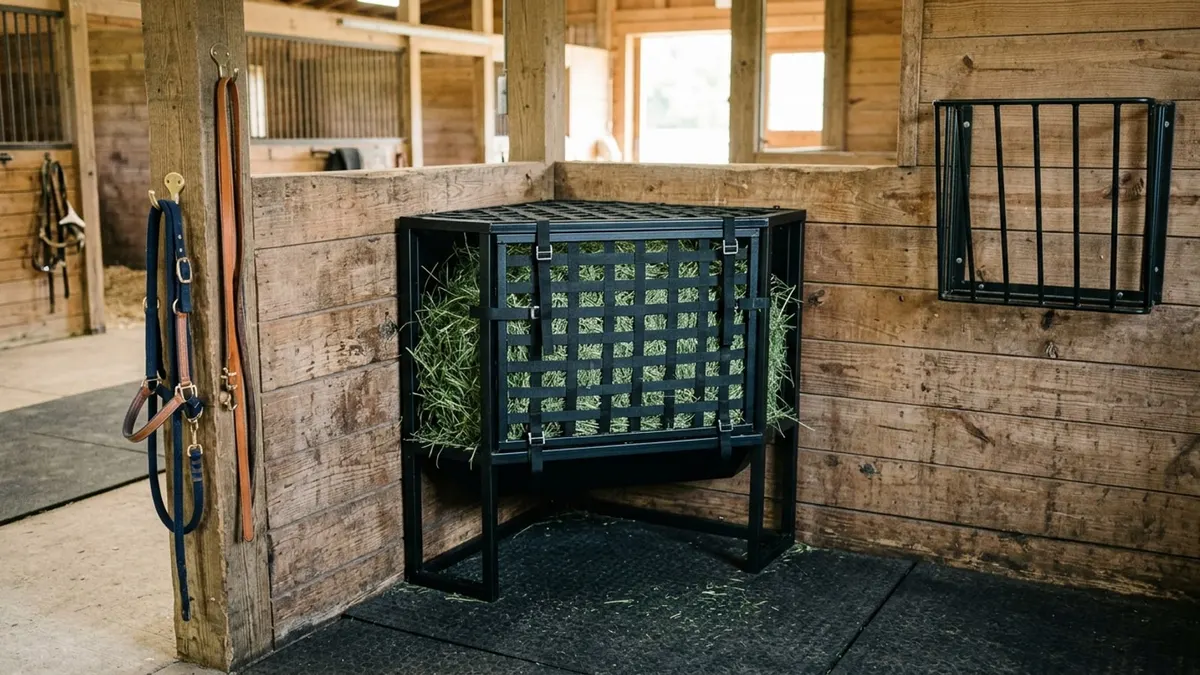
Best Hay Feeders for Horses: Wall Racks, Corner Feeders and Floor Slow Feeders
Five ways to feed flakes off the stall floor, from a steel corner floor feeder with a netted lid to a 2-pack of corner racks, with the waste figures from extension research.
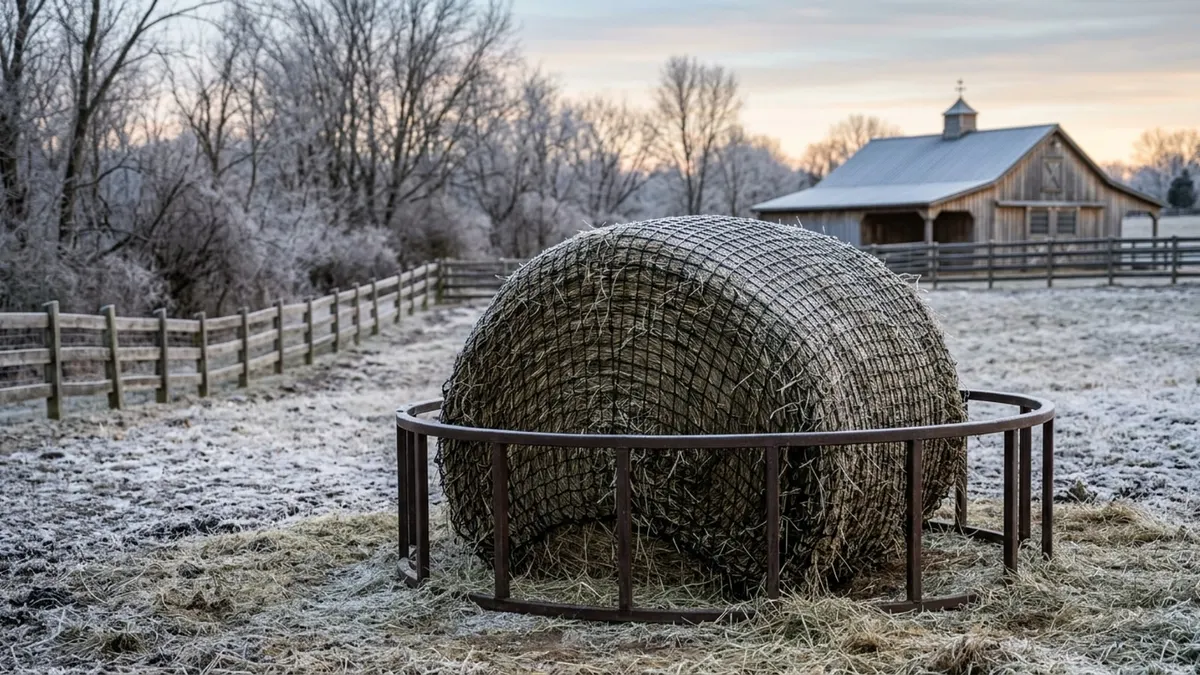
Best Round Bale Hay Nets for Horses (2026): Sized by Bale and Hole
Five round bale nets, from a hand-tied 6 ft Hay Chix to a 4 ft knotless net, sized by bale and by hole, with how to use them with a ring.
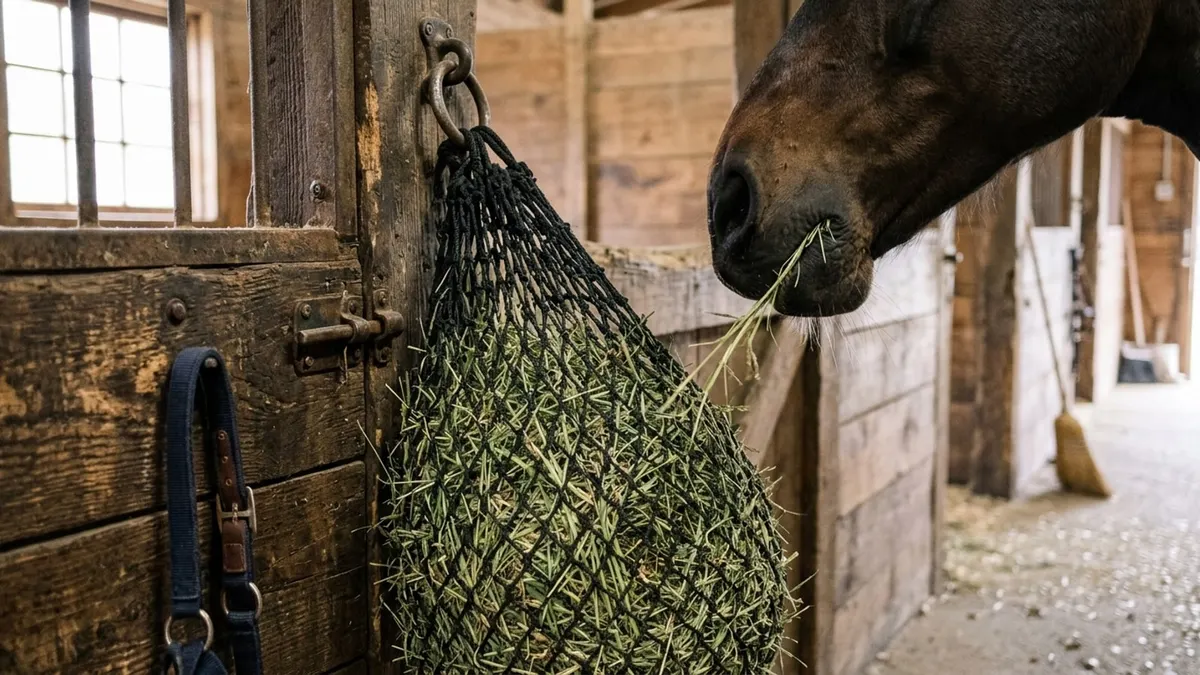
Best Slow Feeder Hay Nets and Bags for Horses (2026)
Five slow feeders, from a half-bale knotted net to a ground-level corner feeder, picked by hole size and capacity, with what the Minnesota hay net study found.