
Best Hay Feeders for Horses: Wall Racks, Corner Feeders and Floor Slow Feeders
The best hay feeder for horses in 2026: a ground-level slow feeder, wall and corner hay racks and a hanging net, compared by capacity, mounting and feeding height.
Affiliate disclosure: product links on this page go to Amazon or to the maker's own store. As an Amazon Associate we earn from qualifying purchases, at no extra cost to you; links to makers' own stores earn us nothing. No retailer or brand sees our picks before they are published or has any say in them. How we choose.
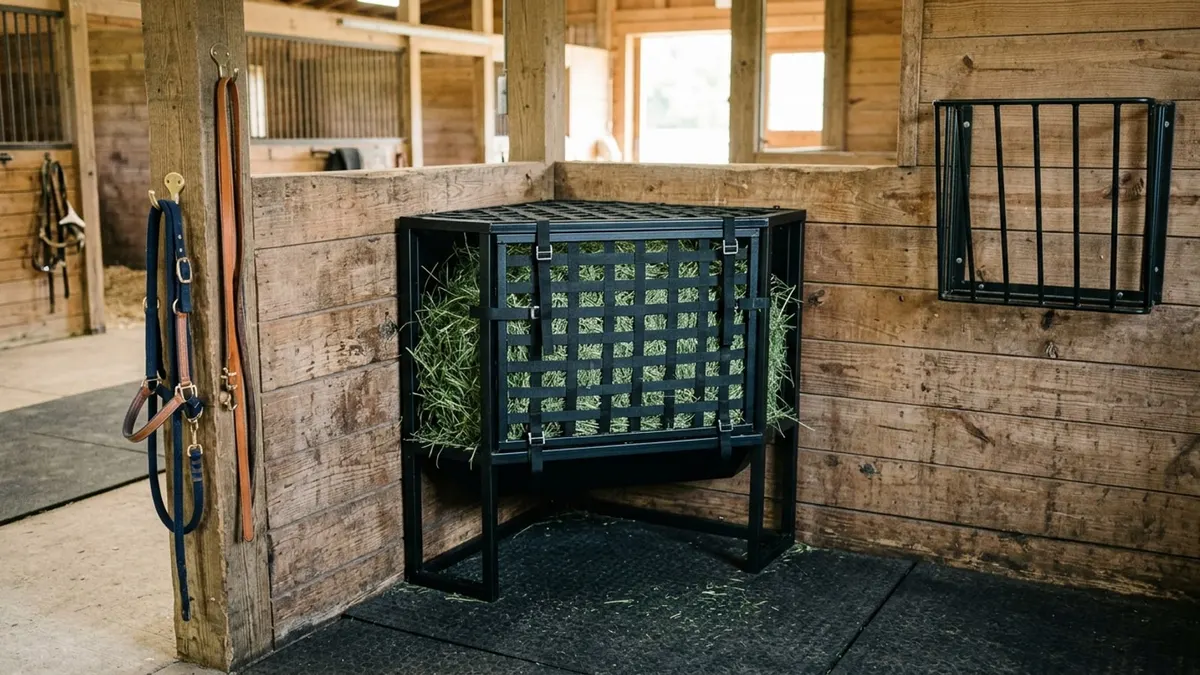
The best hay feeder for horses in a stall is one that lets them eat with their heads down from a soft-mesh lid, and the Schneiders Easy-Up Pro Corner Floor Hay Feeder is the one we would buy. It sits in a stall corner, holds 6 to 8 flakes and has a 1.5 inch webbed lid that drops as hay is eaten (per the Amazon listing), which keeps hay off the bedding and slows a fast eater without metal against the teeth.
It is also expensive. For less money, the Easy-Up Standard Hay Rack and the Country Manufacturing corner rack two-pack get flakes off the floor, and a Hay Chix half-bale net slows eating for a fraction of the price. This guide is for owners feeding small square bales by the flake in stalls, run-ins and dry lots; round bales have their own guide. Picks were chosen on feeding height, capacity, how they mount and the makers' specs.
Our top picks at a glance
- Schneiders Easy-Up Pro Corner Floor Hay Feeder (netted lid)
Type: Corner floor feeder, 1.5 in netted lid · Holds: 6 to 8 flakes (per the Amazon listing) · Mounting: Stall corner, on the floor
- Schneiders Easy-Up Standard Hay Rack
Type: Flat wall rack, 4.5 in bar spacing · Holds: 2 to 3 flakes (per the Amazon listing) · Mounting: Flat wall, four screws included
- Country Manufacturing Corner Hay Rack (2-pack)
Type: Corner rack, steel · Holds: Not stated in the listing · Mounting: Stall corner
- Scenic Road SLW844 Wall Mount Hay Feeder
Type: Flat wall rack · Holds: Not stated in the listing · Mounting: Flat wall
- Hay Chix Half Bale Net (1 3/4 in holes)
Type: Hanging slow feed net, 1 3/4 in holes · Holds: 4 to 6 flakes (per the Amazon listing) · Mounting: Tie ring, fence or trailer
| Pick | Type | Holds | Mounting | Buy |
|---|---|---|---|---|
| Schneiders Easy-Up Pro Corner Floor Hay Feeder (netted lid)Best overall | Corner floor feeder, 1.5 in netted lid | 6 to 8 flakes (per the Amazon listing) | Stall corner, on the floor | Amazon |
| Schneiders Easy-Up Standard Hay RackBest wall rack | Flat wall rack, 4.5 in bar spacing | 2 to 3 flakes (per the Amazon listing) | Flat wall, four screws included | Amazon |
| Country Manufacturing Corner Hay Rack (2-pack)Best corner rack | Corner rack, steel | Not stated in the listing | Stall corner | Amazon |
| Scenic Road SLW844 Wall Mount Hay FeederBest larger wall rack | Flat wall rack | Not stated in the listing | Flat wall | Amazon |
| Hay Chix Half Bale Net (1 3/4 in holes)Best hanging slow feeder | Hanging slow feed net, 1 3/4 in holes | 4 to 6 flakes (per the Amazon listing) | Tie ring, fence or trailer | Amazon |
A ground-level corner feeder with a slow-feed webbed lid: the closest thing to grazing posture you can put in a stall.
- Type
- Corner floor feeder, 1.5 in netted lid
- Holds
- 6 to 8 flakes (per the Amazon listing)
- Mounting
- Stall corner, on the floor
- Warranty
- 7 years on the feeder panel (per the Amazon listing)
Pros
- Feeds at ground level, which Penn State Extension says better matches natural posture than a net or rack above head height
- The lid is webbing, not metal grating, which Penn State advises against because teeth that rub metal wear
- Holds enough for a night, and the lid keeps a horse from tossing hay into the bedding
Cons
- The most expensive feeder here by a wide margin, and heavy to ship
- Takes up a stall corner and is bolted in place; it does not move to the paddock
Most stall hay racks hang at or above head height, so the horse eats with its head up and pulls hay down and out. Penn State Extension notes that feeding above head height changes a horse's posture, while feeding at or below head level is closer to grazing, and that nets at ground level can catch a leg or a shoe. A steel floor feeder with a soft lid gets the posture without loose mesh at hoof height.
Schneiders, whose house brand is Easy-Up, describes the feeder as reinforced steel with a rust-resistant Black Armor coating, a webbed lid with 1.5 inch openings that slides down as the hay level drops, and room for 6 to 8 flakes (per the Amazon listing). The 7 year warranty covers the feeder panel. Penn State also recommends soft mesh over metal grating for restricted-access feeders, which this lid meets.
Skip it if you share stalls between horses that change often or need to move the feeder to a run-in shed; a rack or a net is easier to relocate. If price rules it out, the corner racks below plus a slow feeder net inside the rack give a similar effect for much less.
Best wall rack
Schneiders Easy-Up Standard Hay Rack
A flat steel rack for 2 to 3 flakes that mounts on any stall wall with four screws and comes with a 5 year warranty.
- Type
- Flat wall rack, 4.5 in bar spacing
- Holds
- 2 to 3 flakes (per the Amazon listing)
- Mounting
- Flat wall, four screws included
- Material
- 3/8 in solid steel rod, powder coated
Pros
- Rounded corners and solid 3/8 inch rod, per the listing
- Mounts flat on a wall, so it suits stalls without a usable corner
- 5 year warranty, per the listing
Cons
- 4.5 inch bar spacing lets hay out quickly; it holds hay off the floor but does not slow eating
- 2 to 3 flakes is a single meal, not a night's hay
This is the simplest way to get hay off a stall floor. Schneiders lists 3/8 inch solid steel rods with a black powder coat, 4.5 inch spaced bars, rounded corners and four mounting screws, with a 5 year warranty (per the Amazon listing). It takes 2 to 3 flakes depending on how thick they are.
Mount it so your horse eats at about head height or lower rather than reaching up, and high enough that a pawing hoof cannot reach it. If your horse eats a meal in an hour, put a slow feeder net inside the rack; the rack holds the net still and keeps it out of pawing range.
Best corner rack
Country Manufacturing Corner Hay Rack (2-pack)
Two heavy steel corner racks, made in the USA, for owners outfitting two stalls or a stall and a run-in.
- Type
- Corner rack, steel
- Holds
- Not stated in the listing
- Mounting
- Stall corner
- Pack
- 2 racks
Pros
- Two racks per order
- Doubles as a blanket holder off season, per the listing
Cons
- The listing gives no capacity or dimensions; we could not find a maker spec page to confirm them
- Open bars, so it does not slow eating on its own
Country Manufacturing sells these as a pair of heavy-duty steel corner racks, made in the USA, that also work as blanket holders (per the Amazon listing). A corner rack keeps hay off the bedding and out of the middle of the stall.
The listing does not give a flake capacity or dimensions, so measure your stall corners before ordering. As with any open rack, it holds hay off the floor rather than slowing eating; pair it with a net if that is the goal.
Best larger wall rack
Scenic Road SLW844 Wall Mount Hay Feeder
A bigger flat rack, 25 by 27 inches, for owners who want more hay per fill than a standard rack holds.
- Type
- Flat wall rack
- Holds
- Not stated in the listing
- Mounting
- Flat wall
- Size
- 25 in H x 27 in W x 10 in D (per the Amazon listing)
Pros
- 3/8 inch steel rods with a powder coat, per the listing
- Made in the USA, per the listing
- Deeper than the Easy-Up Standard, so it takes more hay per fill
Cons
- The listing gives no flake capacity
- Marketed for goats, sheep and pigs as well as horses, so check that the bar spacing suits your horse
Scenic Road lists the SLW844 at 25 inches high, 27 inches wide and 10 inches deep, built from 3/8 inch American steel rods with a powder-coated finish (per the Amazon listing). It is the pick when a 2 to 3 flake rack is too small for the time between feedings.
We could not find a Scenic Road spec page for this model, so the figures are the listing's. Mount it on a solid wall or framing; a horse leaning on a full rack puts real load on the screws.
Best hanging slow feeder
Hay Chix Half Bale Net (1 3/4 in holes)
A half-bale knotted net with 1 3/4 inch holes for owners who want to slow eating without bolting anything to the wall.
- Type
- Hanging slow feed net, 1 3/4 in holes
- Holds
- 4 to 6 flakes (per the Amazon listing)
- Mounting
- Tie ring, fence or trailer
- Material
- UV-treated nylon, fixed knots
Pros
- 1 3/4 inch is the opening the Minnesota hay net study found practical: slower eating, ration still finished
- Moves between stall, paddock and trailer
- Far cheaper than any steel feeder
Cons
- Hay Chix limits use with shod horses unless the net hangs out of pawing range or sits in a ground-level ring
- A hanging net puts the horse's head up unless it is hung low
A net is a hay feeder too, and the cheapest way to slow a fast eater. Hay Chix's half-bale net holds half a small square bale with 1 3/4 inch openings, the medium size from the University of Minnesota study, which slowed eating while horses still finished most of their hay. Our slow feeder hay net guide covers hole sizes and the alternatives in detail.
How we chose
We looked for feeders that do three things for a horse eating small square bales: keep hay off the stall floor or dirt, put the horse's head at a height close to grazing, and hold enough hay for the time between your feedings. We compared feeder type, capacity, bar or mesh size, mounting and the warranty, from the makers' pages and the makers' own Amazon listings (marked where we used them).
Do hay feeders actually save hay?
Yes, and the numbers are best documented outdoors. New Mexico State University's guide to hay feeding costs summarizes a Minnesota study of small square bales fed in dry-lot paddocks: hay fed on the ground had 13% waste, while three commercial feeders had 1%, 3% and 5%, and the feeders paid for themselves in 9 to 12 months. Penn State Extension reports the same Minnesota figures. In stalls, the effect was smaller: one study of stalled horses fed alfalfa flakes found a feeder cut waste by 6% compared with the stall floor. Round bales are where the stakes are largest: the University of Minnesota's round bale feeder study measured 57% waste with no feeder.
| Setting | No feeder | In a feeder |
|---|---|---|
| Small square bales, dry-lot paddock | 13% | 1% to 5% |
| Round bales, outdoor paddock | 57% | 5% to 33% |
| Alfalfa flakes, stall | Stall floor | Waste cut by 6% |
Penn State also found, in a survey of Pennsylvania horse farms, that 56% of horses were fed hay on the ground. If that is your barn, any feeder here is an improvement. To work out how many flakes your horse needs between feedings, use our hay per day calculator.
Types of hay feeder
| Type | Feeding height | Slows eating? | Best for |
|---|---|---|---|
| Flat wall rack | Usually head height or above | No (open bars) | Stalls without a usable corner |
| Corner rack | Usually head height | No (open bars) | Stalls, run-in sheds |
| Corner floor feeder with lid | Ground level | Yes (netted lid) | Stalls, fast eaters |
| Hanging net or bag | Wherever you hang it | Yes (by hole size) | Stalls, paddocks, trailers |
What to look for
Feeding height
Penn State Extension notes that hay nets hung above head height change how a horse holds its back, while feeding at or below head level better matches natural posture, at the cost that legs or shoes can get caught in a low net. The same logic applies to racks: mount them so hay sits low, not overhead.
Bars, grates and teeth
Penn State advises avoiding feeders where the teeth contact metal grating, because it can wear the teeth, and choosing soft mesh for restricted-access slow feeders. A lid of webbing or a net slows eating without metal against the teeth.
Capacity against your schedule
Count the hours between your evening and morning feedings and the flakes your horse eats in that time. A 2 to 3 flake rack suits one meal; a 6 to 8 flake floor feeder or a half-bale net suits a night.
Mounting and inspection
Mount into solid framing with the hardware the maker supplies, and check feeders for bent bars and sharp edges; Penn State lists regular inspection and cleaning to prevent mold and injuries from damaged feeders.
One feeder per horse in groups
New Mexico State notes that dominant horses may guard small feeders and keep timid horses from eating. In a shared paddock, put out more feeding stations than horses, spaced apart. For groups on large bales, see our round bale feeder guide.
What to skip
- Racks mounted high above the horse's head. They pull the head up, against the posture advice above.
- Metal grate slow feeders where the horse has to work its teeth against steel, per Penn State's tooth-wear warning.
- Feeding on the ground in a dry lot if you can avoid it: 13% waste against 1% to 5% in a feeder in the Minnesota study.
- Feeders without a capacity or size listed, unless you can measure your stall and work out the fit yourself.
Frequently asked questions
What is the best type of hay feeder for a horse in a stall?
A feeder that keeps hay off the bedding and lets the horse eat with its head low. Penn State Extension notes that feeding at or below head level better matches natural posture than racks or nets above head height. A ground-level corner feeder with a soft lid does both; a wall rack mounted low is the budget version.
How much hay do horses waste without a feeder?
In a Minnesota study of small square bales fed in dry lots, hay on the ground had 13% waste, against 1% to 5% for three commercial feeders, and the feeders paid for themselves in 9 to 12 months. In stalls the difference was smaller, about 6% in one study.
How high should a hay rack be mounted?
Low enough that the horse is not eating above its head. Penn State Extension says feeding above head height changes posture and at or below head level is closer to grazing. Also make sure the rack cannot be reached with a pawing hoof.
Are metal hay feeders bad for horses' teeth?
Penn State Extension advises avoiding feeders where the teeth contact metal grating, because it can wear the teeth, and choosing soft mesh for slow feeders. A webbed lid or a net slows eating without metal contact.
How many hay feeders do you need for a group of horses?
More feeding stations than horses. New Mexico State University notes that dominant horses can guard small feeders and keep timid ones from eating. Spread feeders apart so a horse at one cannot guard the next.
Sources
- Hay Feeders and the Potential to Reduce Hay Waste, Penn State Extension
- Hay Feeding Management Strategies as Cost-control Measures on Horse Farms (Guide B-721), New Mexico State University
- Selecting a Round-Bale Feeder for Use During Horse Feeding, University of Minnesota Extension (hosted by University of Nebraska-Lincoln)
Cover image: Illustration: Barn Gear Review (AI-generated)
Related guides
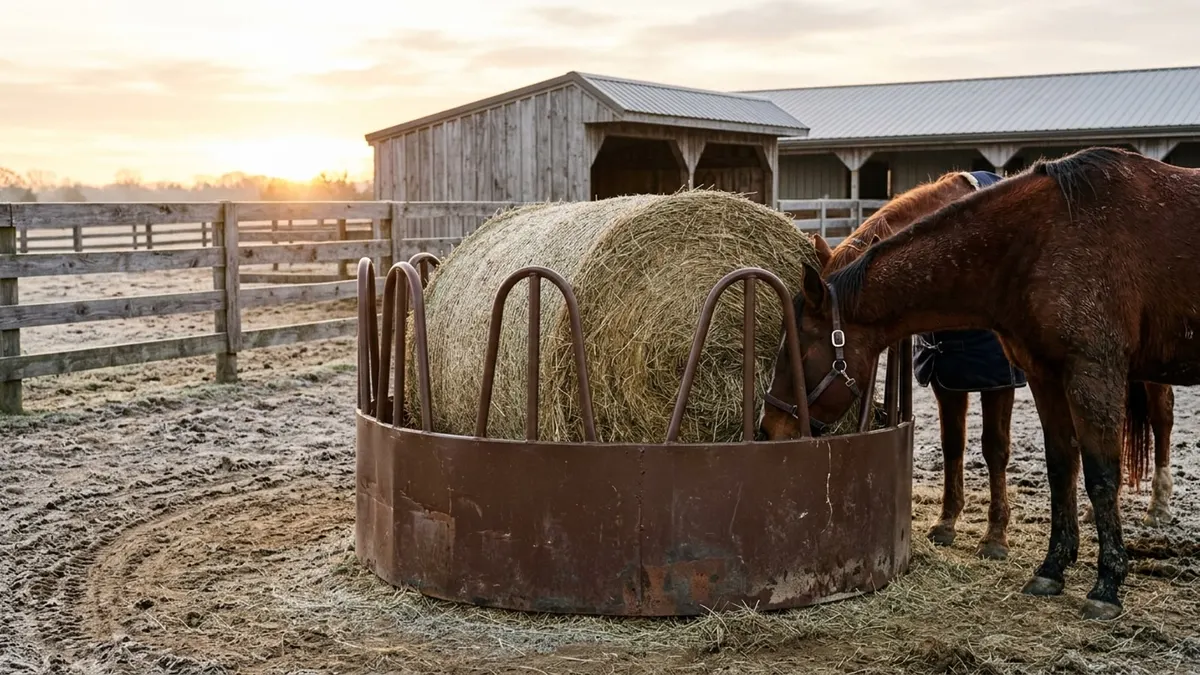
Best Round Bale Feeders for Horses (2026): Horse-Rated Rings and Nets
Four horse-rated round bale feeders from Tarter, Behlen Country and Priefert, plus a net that cuts waste further, with the Minnesota study's waste and payback numbers.
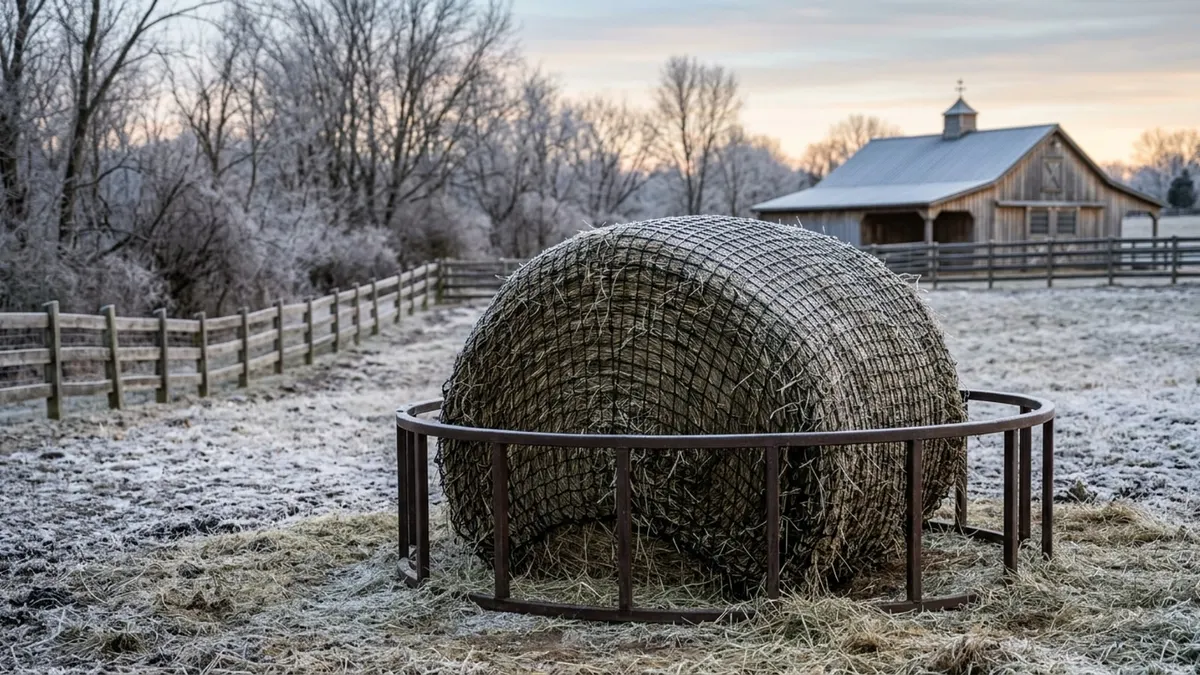
Best Round Bale Hay Nets for Horses (2026): Sized by Bale and Hole
Five round bale nets, from a hand-tied 6 ft Hay Chix to a 4 ft knotless net, sized by bale and by hole, with how to use them with a ring.
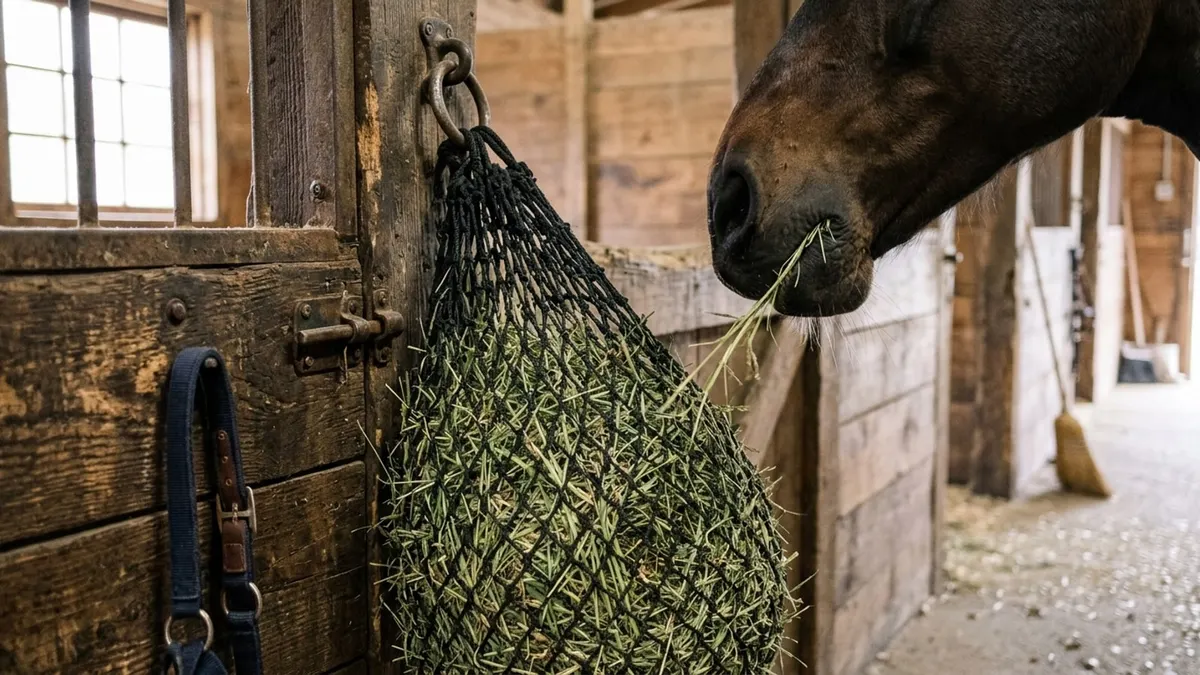
Best Slow Feeder Hay Nets and Bags for Horses (2026)
Five slow feeders, from a half-bale knotted net to a ground-level corner feeder, picked by hole size and capacity, with what the Minnesota hay net study found.