
Best Horse Blankets for Turnout (2026): Fill, Denier and Fit Compared
The best horse blanket for winter turnout in 2026, compared on outer denier, fill weight in grams, waterproof ratings, neck style and closures.
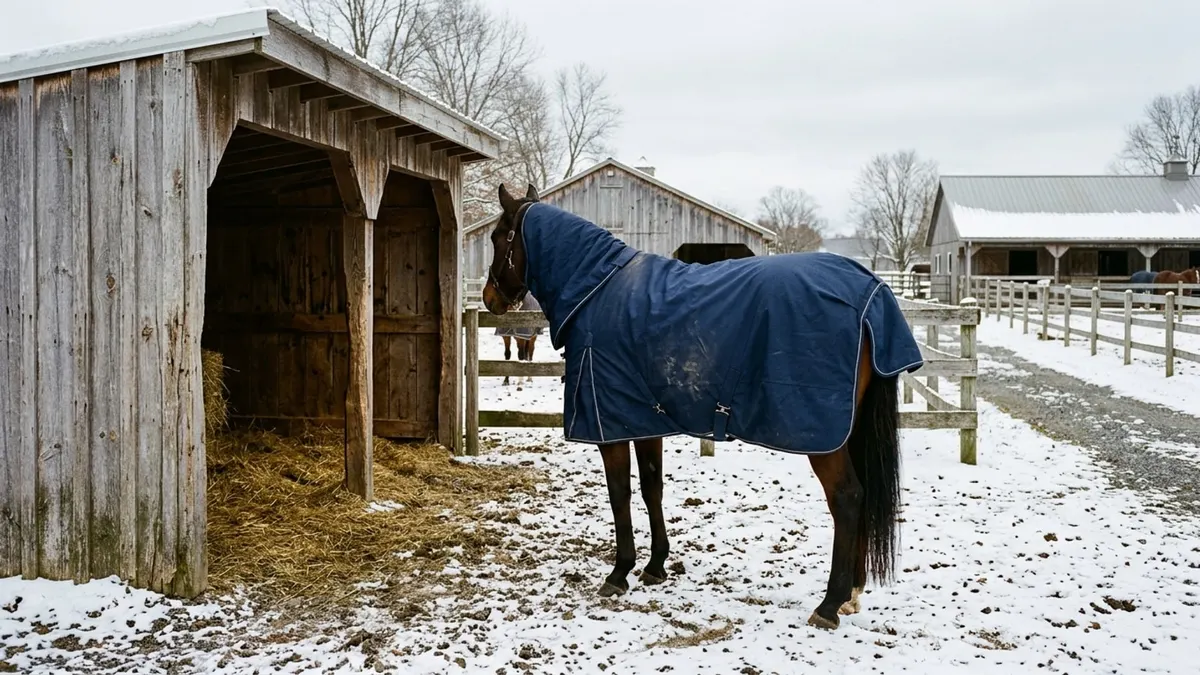
Affiliate disclosure: product links on this page go to Amazon or to the maker's own store. As an Amazon Associate we earn from qualifying purchases, at no extra cost to you; links to makers' own stores earn us nothing. No retailer or brand sees our picks before they are published or has any say in them. How we choose.
The Saxon Defiant 1200D Combo Neck 200g is the turnout blanket we would buy for most horses that need one through a US winter. It pairs a 1200 denier ripstop shell with 200 grams of fill, inside the 150 to 300 g medium band in the University of Maine's blanketing bulletin, and its neck cover is sewn on, so wind and sleet have no gap at the withers. WeatherBeeta lists it at $109.99 (prices change).
For a horse that needs more warmth, the same blanket with 300 g of fill is the heavyweight pick. If you layer, or your winters are mild, the WeatherBeeta ComFiTec Essential 100g is the lightweight to start with. Gallopoff's 200 g blanket is the budget medium, and Hilason's 300 g blanket adds a belly wrap.
Picks are based on the makers' spec pages and listings and on extension-service guidance on fill weight and fit. Not sure your horse needs a blanket at all? Start with when to blanket a horse.
Our top picks at a glance
- Saxon Defiant 1200D Combo Neck 200g
Outer: 1200D ripstop · Fill: 200 g · Neck: Combo (sewn on) · Leg straps: None (tail cord)
- Saxon Defiant 1200D Combo Neck 300g
Outer: 1200D ripstop · Fill: 300 g · Neck: Combo (sewn on) · Leg straps: None (tail cord)
3. Best lightweight for layering
WeatherBeeta ComFiTec Essential Turnout 100gOuter: 1200D ripstop, Guard-Tec · Fill: 100 g · Neck: Standard · Leg straps: Removable
- Gallopoff 1200D Turnout Blanket 200g
Outer: 1200D ripstop (per the Amazon listing) · Fill: 200 g · Neck: Standard · Leg straps: Adjustable
- Hilason 1200D Turnout Blanket with Belly Wrap (300g)
Outer: 1200D ripstop polyester (per the Amazon listing) · Fill: 300 g · Neck: Standard, D-rings for a hood · Leg straps: Removable
| Pick | Outer | Fill | Neck | Leg straps | Buy |
|---|---|---|---|---|---|
| Saxon Defiant 1200D Combo Neck 200gBest overall | 1200D ripstop | 200 g | Combo (sewn on) | None (tail cord) | Amazon |
| Saxon Defiant 1200D Combo Neck 300gBest heavyweight | 1200D ripstop | 300 g | Combo (sewn on) | None (tail cord) | Amazon |
| WeatherBeeta ComFiTec Essential Turnout 100gBest lightweight for layering | 1200D ripstop, Guard-Tec | 100 g | Standard | Removable | Amazon |
| Gallopoff 1200D Turnout Blanket 200gBest budget medium | 1200D ripstop (per the Amazon listing) | 200 g | Standard | Adjustable | Amazon |
| Hilason 1200D Turnout Blanket with Belly Wrap (300g)Best with a belly wrap | 1200D ripstop polyester (per the Amazon listing) | 300 g | Standard, D-rings for a hood | Removable | Amazon |
Best overall
Saxon Defiant 1200D Combo Neck 200g
A medium-weight 1200D turnout with an attached neck, sized from 48 to 87 inches, from WeatherBeeta's value brand.
- Outer
- 1200D ripstop
- Fill
- 200 g
- Neck
- Combo (sewn on)
- Leg straps
- None (tail cord)
Pros
- 1200 denier ripstop outer bonded to a waterproof, breathable membrane, PFC-free, per WeatherBeeta
- Neck cover is permanently attached and closes with two touch-tape straps
- 14 sizes from 48 to 87 inches in 3 inch steps
Cons
- No leg straps listed: it stays put with low cross surcingles and a tail cord
- The neck cannot come off on a mild afternoon
- WeatherBeeta's 3 year warranty banner names WeatherBeeta turnouts; the page does not say whether it covers the Saxon line
Saxon is a WeatherBeeta brand, sold on WeatherBeeta's own US site, and the Defiant 1200D is its heavy-shell turnout. WeatherBeeta describes the outer as 1200 denier ripstop bonded with a waterproof, breathable membrane, lined with 210T fabric to cut rubbing, and closed at the chest with twin surcingles and touch tape. The Amazon listing gives the shell ratings as 2,000+ hydrostatic pressure and 3,000+ moisture vapor, the same figures WeatherBeeta prints for its own ComFiTec Essential turnout.
Two hundred grams sits inside the University of Maine's medium band of 150 to 300 g. In that bulletin's chart, a light or midweight blanket covers a full-coated horse from 15 to 24°F and a clipped horse from 25 to 39°F. That makes 200 g the one weight most owners reach for most often, which is why it is the pick.
Skip the combo neck if your horse sweats easily or you want to take the neck off on warmer days; a standard-neck medium such as the Gallopoff 200g leaves the neck free.
Best heavyweight
Saxon Defiant 1200D Combo Neck 300g
The same 1200D combo-neck build with 300 g of fill, for horses that need a heavyweight in the coldest weeks.
- Outer
- 1200D ripstop
- Fill
- 300 g
- Neck
- Combo (sewn on)
- Leg straps
- None (tail cord)
Pros
- 300 g of polyfill, the point where UMaine's chart moves from medium to heavy
- WeatherBeeta lists it at $109.99, the same as the 200 g version (prices change)
- Attached neck with two touch-tape closures for wind and sleet
Cons
- Heavier to carry and hang: the Amazon listing gives 8.5 lb against 6 lb for the 200 g (per the Amazon listing)
- UMaine's chart calls for a heavyweight on a full-coated horse only below 15°F
- No leg straps listed
WeatherBeeta builds this blanket exactly like the 200 g pick, with the same 1200 denier ripstop shell, 210T lining, attached neck, twin chest surcingles and adjustable tail cord, and adds 100 g of polyfill. Its page pitches it for cold conditions and gives no temperature rating, so lean on an extension chart instead.
UMaine's bulletin calls for a heavyweight on a full-coated horse from 0 to 14°F, and on a clipped horse from 15 to 24°F. Below 0°F for a full coat, or below 15°F for a clipped horse, it adds a liner and a hood on top. If your horse lives in that range for weeks at a time, this is the blanket to own alongside a medium, not instead of one.
Best lightweight for layering
WeatherBeeta ComFiTec Essential Turnout 100g
A 100 g turnout with published waterproof and breathability ratings, leg straps and a liner system to build warmth on top.
- Outer
- 1200D ripstop, Guard-Tec
- Fill
- 100 g
- Neck
- Standard
- Leg straps
- Removable
Pros
- WeatherBeeta rates the shell at 2,000 mm+ hydrostatic pressure and 3,000 g/m² moisture vapor
- Works with WeatherBeeta's liner system, so one shell can cover several temperature bands
- 3 year warranty on WeatherBeeta turnouts (waterproofing and breathability on the outer shell)
Cons
- Lists at $139.99, more than the Saxon medium (prices change)
- 100 g alone is a lightweight: too little for a clipped horse in hard cold
- Sizes start at 60 inches, so small ponies need another blanket
This is WeatherBeeta's own-brand entry turnout, and it is the only pick here with numbers printed on the maker's page for both waterproofing and breathability: 2,000 mm+ hydrostatic pressure and 3,000 g/m² moisture vapor, from a 1200 denier ripstop shell with a PFC-free Guard-Tec coating. It has a standard neck that stops at the withers, a fleece wither pad, twin low cross surcingles, removable leg straps and a large tail flap.
The reason to buy a 100 g turnout rather than a medium is layering. WeatherBeeta says it works with its liner system, and UMaine's chart lists quilted liners at 100 to 300 g. A light shell plus a liner gives you one waterproof outer for the shoulder seasons and the deep cold. If you would rather own one blanket and never think about liners, the 200 g Saxon is simpler.
Best budget medium
Gallopoff 1200D Turnout Blanket 200g
A standard-neck 200 g turnout with leg straps, for owners who want a medium without the combo neck.
- Outer
- 1200D ripstop (per the Amazon listing)
- Fill
- 200 g
- Neck
- Standard
- Leg straps
- Adjustable
Pros
- Leg straps plus criss-cross belly surcingles (per the Amazon listing)
- Fleece wither pad and a smooth nylon lining against rubs (per the Amazon listing)
- Same model also comes in 0 g and 100 g (per the Amazon listing), so a barn can match shells across weights
Cons
- No maker website or published waterproof rating: every spec comes from the listing
- No warranty terms given on the listing
For this 200 g blanket the Gallopoff listing gives a 1200 denier ripstop outer and a waterproof, breathable shell over a smooth nylon lining, with a fleece wither pad, high shoulder gussets, dual front buckles with hook-and-loop assist, criss-cross belly surcingles, adjustable leg straps and a large tail flap. We could not find a maker website, so none of that is backed by a spec sheet or a stated hydrostatic rating.
What it gets right is the layout of a classic medium: 200 g of fill, a standard neck you can pair with a separate hood, and leg straps for horses that roll. Buy it if price decides and you can check the fit and seams on arrival. If you want published ratings and a known warranty, pay more for the Saxon.
Best with a belly wrap
Hilason 1200D Turnout Blanket with Belly Wrap (300g)
A 300 g standard-neck turnout with a belly wrap, D-rings for a hood or neck cover, and removable leg straps.
- Outer
- 1200D ripstop polyester (per the Amazon listing)
- Fill
- 300 g
- Neck
- Standard, D-rings for a hood
- Leg straps
- Removable
Pros
- Belly wrap closes over the underside, where low cross surcingles leave a gap (per the Amazon listing)
- Dees on both sides take a separate hood or neck cover (per the Amazon listing)
- Double-stitched, taped seams and an insulated tail flap (per the Amazon listing)
Cons
- Warranty is 30 days against manufacturer defects (per the Amazon listing)
- Heaviest pick here at 10 lb (per the Amazon listing)
- No published waterproof or breathability rating
Hilason is a saddle and tack brand. Its listing gives a 1200 denier rip-stop polyester shell, 300 g of poly fill, a taffeta lining, double-stitched and taped seams, a fleece wither, an insulated tail flap, dees on both sides for a hood or neck cover, removable leg straps and a belly wrap.
The belly wrap is the reason to pick it. A wide panel under the barrel keeps snow and wind off the belly and holds the blanket square on a horse that rolls a lot. The trade-off is the 30 day defect warranty given on the listing, short next to WeatherBeeta's 3 years on its own turnouts, and the 10 lb weight. Pick the heavier Saxon instead if you value an attached neck and a longer-lived brand warranty.
How we chose
A turnout blanket has to keep a horse dry, hold the warmth the weather calls for, stay square through rolling and running, and fit. We compared each blanket on outer denier, fill weight in grams, any published waterproof and breathability ratings, neck style, closures and leg straps, sizes and warranty, from the makers' product pages where they exist and the Amazon listing where they do not (marked on each spec).
What to look for in a turnout blanket
Fill weight in grams
Fill is the polyfill between the shell and the lining, quoted in grams. The University of Maine's Winter Blanketing Guide groups blankets this way:
| Type | Fill |
|---|---|
| Stable sheet or liner | 0 g |
| Rain sheet | 0 g |
| Lightweight | 60 to 100 g |
| Medium weight | 150 to 300 g |
| Heavyweight | 300 g and up |
| Quilted liner | 100 to 300 g |
Which band your horse needs depends on its coat, body condition, shelter and the weather, not on a single thermometer reading. Rutgers' Equine Science Center puts it plainly: there are no scientific rules about what temperature calls for a particular blanket. Our blanketing guide lays out UMaine's temperature chart for full-coated and clipped horses.
Outer denier and ripstop
Denier describes the yarn in the outer shell; a 1200D shell is heavier than a 600D one, and every pick here uses 1200D. Ripstop is a grid weave that WeatherBeeta says limits the spread of small tears. A horse that plays rough in a group or lives near fencing gets the most from a heavy ripstop shell.
Waterproof and breathable ratings
A wet coat loses its insulation: Penn State Extension notes that about 0.1 inch of rain can cause cold stress. Look for a stated hydrostatic rating (how much water pressure the shell resists, in millimeters) and a moisture vapor rating (how much sweat vapor escapes, in grams per square meter). WeatherBeeta prints 2,000 mm+ and 3,000 g/m² for the ComFiTec Essential; budget brands often say only "waterproof and breathable". WeatherBeeta also notes its ratings apply to the outer shell fabric, which is why seams and fit still matter.
Neck style
A standard neck stops at the withers. A combo neck is sewn on and covers the neck for wind, rain and horses that rub their manes. A detachable neck clips on and off. If you blanket for a few cold snaps, a standard neck with a separate hood is the more flexible kit; if your horse stands in wind all winter, a combo neck saves a step.
Closures, surcingles and leg straps
Chest closures are buckles, clips or surcingles with touch tape. Under the belly, low cross surcingles are standard, and a belly wrap covers more. Leg straps or a tail cord keep the back end from sliding sideways. The two Saxon picks rely on surcingles and a tail cord, while the WeatherBeeta, Gallopoff and Hilason picks add leg straps.
Size
Order by measurement, not by the size another brand fitted. WeatherBeeta says to measure from the center of the chest to the end of the rump, and UMaine adds that brands fit differently. Our blanket size calculator converts a tape reading into the size to order.
The picks side by side
| Blanket | Fill | UMaine band | Leg straps | Published shell rating |
|---|---|---|---|---|
| Saxon Defiant 1200D Combo Neck 200g | 200 g | Medium | No (tail cord) | 2,000+ / 3,000+ (per the Amazon listing) |
| Saxon Defiant 1200D Combo Neck 300g | 300 g | Medium to heavy | No (tail cord) | 2,000+ / 3,000+ (per the Amazon listing) |
| WeatherBeeta ComFiTec Essential 100g | 100 g | Light | Yes | 2,000 mm+ / 3,000 g/m² (maker) |
| Gallopoff 1200D 200g | 200 g | Medium | Yes | None given |
| Hilason 1200D 300g with belly wrap | 300 g | Medium to heavy | Yes | None given |
What to skip
- A heavyweight "just in case". Rutgers warns that sweating under a blanket is as bad as blanketing a wet horse. If the horse is damp under the blanket, go lighter.
- Blanketing a wet horse. Penn State and UMaine both say to dry the horse first, and to pull a soaked blanket and dry it.
- A stable blanket for turnout. A stable blanket or sheet is made for the barn. UMaine advises checking that a blanket is labeled waterproof before it goes out in the weather.
- Set and forget. Rutgers says to take the blanket off at least once a week to groom and check for rubs and weight change, since a blanket hides both.
For wet days above freezing, a 0 g sheet often does the job a blanket would; see our rain sheet picks.
Fitting the blanket
UMaine's fit check takes a hand: slide it under the blanket at the point of the shoulder and at the withers. If it barely fits, loosen the chest straps or try the next size up. Watch the first few days for rubs at the shoulders and withers, which Rutgers ties to a blanket that is too big or too small.
Frequently asked questions
What weight horse blanket do I need?
The University of Maine's blanketing bulletin groups lightweights at 60 to 100 g of fill, mediums at 150 to 300 g and heavyweights at 300 g and up. In its chart, a full-coated horse needs a light or midweight from 15 to 24°F and a heavyweight from 0 to 14°F, while a clipped horse moves up a band at each step. Coat, body condition and shelter shift those numbers.
What does 1200D mean on a horse blanket?
1200D is the denier of the yarn in the outer shell. A 1200D shell is heavier than a 600D one and is the usual choice for turnout. Most 1200D blankets are also ripstop, a grid weave that WeatherBeeta says limits the spread of small tears.
Should I get a combo neck or a standard neck blanket?
A standard neck stops at the withers and leaves the neck free; a combo neck is sewn on and covers the neck against wind and rain. A standard neck plus a separate hood is more flexible on changeable days. A combo neck suits a horse that stands out in wind all winter or rubs its mane.
How do I measure my horse for a turnout blanket?
WeatherBeeta says to measure from the center of the chest to the end of the rump, in inches. UMaine describes the same line through the point of the shoulder to the center of the tail. Brands fit differently, so check each maker's chart before ordering.
Can I put a blanket on a wet horse?
No. Penn State Extension and the University of Maine both say never to blanket a wet horse: dry it first with towels or a cooler. Take a soaked blanket off promptly and dry it before it goes back on.
How often should I take the blanket off?
Rutgers' Equine Science Center says to remove it at least once a week to groom and check the horse, because a blanket hides weight loss, rubs and skin problems. Penn State adds that it should come off on warm days so the horse does not sweat underneath.
Sources
- Bulletin #1038, Winter Blanketing Guide for Equines in Maine, University of Maine Cooperative Extension
- When to Blanket a Horse, Penn State Extension
- To Blanket or Not To Blanket?, Rutgers Equine Science Center
- Saxon Defiant 1200D Combo Neck 200g, WeatherBeeta
- Saxon Defiant 1200D Combo Neck 300g, WeatherBeeta
- WeatherBeeta ComFiTec Essential Turnout 100g, WeatherBeeta
Cover image: Illustration: Barn Gear Review (AI-generated)
Related guides
Best Fly Masks for Horses (2026): Ears, Nose Covers, UV and Fit
From a no-ears classic with a double-latch closure to a fine-mesh mask with ears, nose and a stated 60%+ UV block.
Best Fly Sheets for Horses (2026): Mesh, UV, Belly Wraps and Necks
Mesh sheets for summer turnout, from a 75%+ UV sheet with a removable neck and belly wrap to a light scrim for show days.
Best Fly Sprays for Horses (2026): Active Ingredients and Labels Compared
Four labeled horse fly sprays compared on what is in the bottle, how often the label says to apply it and who it is not for.