
Best Fly Sprays for Horses (2026): Active Ingredients and Labels Compared
The best horse fly spray in 2026: four sprays compared by active ingredient, percentage, EPA registration number and the label's own directions and limits.
Affiliate disclosure: product links on this page go to Amazon or to the maker's own store. As an Amazon Associate we earn from qualifying purchases, at no extra cost to you; links to makers' own stores earn us nothing. No retailer or brand sees our picks before they are published or has any say in them. How we choose.
Absorbine UltraShield EX is the fly spray we would buy first for most horses. Its EPA-registered label (EPA Reg. No. 1543-15) lists permethrin 0.50%, pyrethrins 0.10% and piperonyl butoxide 1.00%, claims up to 17 days of protection, and gives clear limits: no more than 2 ounces per application, and no use on foals under 12 weeks or animals intended for human consumption.
For horses that sweat hard, Farnam Endure (EPA Reg. No. 270-251) adds a sweat-resistant conditioner to cypermethrin and pyrethrins. Pyranha Equine Spray & Wipe has the highest pyrethrin and synergist content of the four, and Farnam's Repel-X Ready to Use is the low-cost spray that is also labeled for the barn itself.
Every ingredient, interval and limit here comes from the product label, read on the EPA's pesticide label system or the maker's copy. Follow the label on the bottle you buy: it is the legal instruction for use, and it changes.
Our top picks at a glance
- Absorbine UltraShield EX (32 oz)
Active ingredients: Permethrin 0.50%, pyrethrins 0.10%, PBO 1.00% · EPA Reg. No.: 1543-15 · Label interval: 7 to 10 days, then 12 to 17 days · Max per application: 2 oz
2. Best for sweaty, working horses
Farnam Endure Sweat-Resistant Fly Spray (32 oz)Active ingredients: Cypermethrin 0.15%, pyrethrins 0.20%, PBO 1.60%, butoxypolypropylene glycol 5.00% · EPA Reg. No.: 270-251 · Label interval: 5 to 7 days, then 10 to 14 days · Max per application: 11 oz per animal
3. Highest pyrethrin and synergist content
Pyranha Equine Spray & Wipe (32 oz)Active ingredients: Permethrin 0.50%, pyrethrins 0.25%, PBO 2.50% · EPA Reg. No.: 21165-33 · Label interval: 10 to 14 days, or as needed · Max per application: 1 to 2 oz
4. Best budget, also labeled for the barn
Farnam Repel-X Ready to Use (32 oz)Active ingredients: Pyrethrins 0.05%, PBO 0.50%, permethrin 0.10% · EPA Reg. No.: 270-294 · Label interval: Not stated for horses · Max per application: 1 oz per 100 lb body weight
| Pick | Active ingredients | EPA Reg. No. | Label interval | Max per application | Buy |
|---|---|---|---|---|---|
| Absorbine UltraShield EX (32 oz)Best overall | Permethrin 0.50%, pyrethrins 0.10%, PBO 1.00% | 1543-15 | 7 to 10 days, then 12 to 17 days | 2 oz | Amazon |
| Farnam Endure Sweat-Resistant Fly Spray (32 oz)Best for sweaty, working horses | Cypermethrin 0.15%, pyrethrins 0.20%, PBO 1.60%, butoxypolypropylene glycol 5.00% | 270-251 | 5 to 7 days, then 10 to 14 days | 11 oz per animal | Amazon |
| Pyranha Equine Spray & Wipe (32 oz)Highest pyrethrin and synergist content | Permethrin 0.50%, pyrethrins 0.25%, PBO 2.50% | 21165-33 | 10 to 14 days, or as needed | 1 to 2 oz | Amazon |
| Farnam Repel-X Ready to Use (32 oz)Best budget, also labeled for the barn | Pyrethrins 0.05%, PBO 0.50%, permethrin 0.10% | 270-294 | Not stated for horses | 1 oz per 100 lb body weight | Amazon |
Best overall
Absorbine UltraShield EX (32 oz)
A permethrin and synergized pyrethrin spray with the longest re-treatment interval on its label, for horses, dogs and the barn.
- Active ingredients
- Permethrin 0.50%, pyrethrins 0.10%, PBO 1.00%
- EPA Reg. No.
- 1543-15
- Label interval
- 7 to 10 days, then 12 to 17 days
- Max per application
- 2 oz
Pros
- Label claims up to 17 days of protection and names 21 pests for horses, from horse flies to lice
- Labeled for horses, ponies and foals over 12 weeks, dogs over 12 weeks, and as a premise spray
- Contains sunscreens and coat conditioners, including aloe and lanolin, per the label
Cons
- Not for foals under 12 weeks or animals intended for human consumption
- Extremely toxic to aquatic organisms and highly toxic to bees, per the label
UltraShield EX is a ready-to-use, water-based spray or wipe. Its master label (EPA notification dated February 2025) lists permethrin 0.50%, pyrethrins 0.10% and piperonyl butoxide 1.00%, with 98.40% other ingredients. Pyrethrins knock flies down fast, permethrin is the longer-lasting synthetic version, and piperonyl butoxide (PBO) is a synergist that makes both work harder, as the University of Kentucky's insect control guide explains.
The label's directions for horses: brush first, spray or wipe the whole body against the lay of the coat, use a soft cloth on the face, avoid the eyes, nose and mouth, do not wet the skin or apply to the point of dripping, and do not exceed 2 ounces per application. Reapply every 7 to 10 days at first and every 12 to 17 days once protection builds, and again after a bath or heavy rain.
Skip it for a foal under 12 weeks. For a pregnant or nursing mare or a sick horse, ask your vet which product to use.
Best for sweaty, working horses
Farnam Endure Sweat-Resistant Fly Spray (32 oz)
A cypermethrin and pyrethrin spray with a sweat-resistant conditioner that binds to the hair.
- Active ingredients
- Cypermethrin 0.15%, pyrethrins 0.20%, PBO 1.60%, butoxypolypropylene glycol 5.00%
- EPA Reg. No.
- 270-251
- Label interval
- 5 to 7 days, then 10 to 14 days
- Max per application
- 11 oz per animal
Pros
- Conditioner that binds to the hair shaft so it keeps working when the horse sweats, per the label
- Four actives, including the repellent butoxypolypropylene glycol at 5.00%
- Comes in 32 oz, 15 oz continuous spray and 128 oz sizes, per Farnam
Cons
- Shorter re-treatment interval than UltraShield EX on its label
- Not for foals under 12 weeks or horses intended for slaughter
- Extremely toxic to fish and highly toxic to bees, per the label
Endure is registered under EPA Reg. No. 270-251, and the current label (SmartPak's copy matches the EPA-stamped version) lists cypermethrin 0.15%, pyrethrins 0.20%, piperonyl butoxide 1.60% and butoxypolypropylene glycol 5.00%. Farnam markets it on its RepeLock conditioner, which the label says binds to the hair shaft so the spray keeps working in wet or sweaty conditions.
The label says to brush first, shampoo dirty horses and wait until the coat is completely dry, apply liberally against the lay of the coat, use a cloth on the face, and avoid the eyes, nose and mouth. Reapply every 5 to 7 days at first, then every 10 to 14 days as protection builds, and after each bath or heavy rain. Do not use more than 11 ounces per animal.
One thing the shelf does not tell you: Farnam Tri-Tec 14 is listed as an alternate brand name on the same EPA registration, 270-251, with the same four active ingredients and percentages on the EPA-stamped label. If your store has one and not the other, read both labels; the active ingredient box is the part that matters.
Highest pyrethrin and synergist content
Pyranha Equine Spray & Wipe (32 oz)
A water-based permethrin and pyrethrin spray-or-wipe with 2.50% PBO, for horses only.
- Active ingredients
- Permethrin 0.50%, pyrethrins 0.25%, PBO 2.50%
- EPA Reg. No.
- 21165-33
- Label interval
- 10 to 14 days, or as needed
- Max per application
- 1 to 2 oz
Pros
- Highest pyrethrin (0.25%) and PBO (2.50%) figures of the four picks, per the label
- Permethrin at 0.50%, the same as UltraShield EX
- Non-oily, ready-to-use formula for spray or wipe-on use, per the label
Cons
- Horses only: the label says not to use it on dogs, cats or other animals
- Not for foals under 3 months or horses intended for human consumption
- Extremely toxic to fish, per the label
Pyranha's Equine Spray & Wipe (EPA Reg. No. 21165-33, master label December 2024) lists permethrin 0.50%, pyrethrins 0.25% and piperonyl butoxide 2.50%, with 96.75% other ingredients. The University of Kentucky's guide notes that a higher concentration of active ingredients generally gives longer protection, and this is the most concentrated pyrethrin and synergist mix here.
The label directs 1 to 2 ounces per application as a light mist while brushing against the hair, or wiped on with a sponge or cloth, paying attention to the legs, belly, shoulders, neck and face and avoiding the eyes and mucous membranes. Reapply in 10 to 14 days or as needed, and after a bath, heavy sweating or heavy rain.
Its limits are the strictest of the four: horses only, no foals under 3 months. If you have barn cats or dogs that share the aisle, keep the bottle away from them.
Best budget, also labeled for the barn
Farnam Repel-X Ready to Use (32 oz)
A low-concentration ready-to-use spray for horses, dogs and barn premises.
- Active ingredients
- Pyrethrins 0.05%, PBO 0.50%, permethrin 0.10%
- EPA Reg. No.
- 270-294
- Label interval
- Not stated for horses
- Max per application
- 1 oz per 100 lb body weight
Pros
- Labeled for horses, dogs and barns, including surface sprays where flies gather, per the label
- Full strength, no mixing: the label says to use it undiluted on horses
- The label explains resistance management and names its insecticide group (3A)
Cons
- Lowest active-ingredient figures of the four, so expect shorter protection
- Not for animals under 3 months, and the label says do not use on cats
- Extremely toxic to aquatic organisms and highly toxic to bees, per the label
Ready to Use Repel-X (EPA Reg. No. 270-294, label amended March 2025) lists pyrethrins 0.05%, piperonyl butoxide 0.50% and permethrin 0.10%. On horses, the label says to use it full strength as a spray or wipe, at no more than 1 ounce per hundred pounds of body weight, without spraying to the point of run-off.
Its other use is the barn. The label covers surface spraying in horse barns where flies congregate and alight, around doorways, feed rooms, alleys and windowsills, with its own rates and restrictions. That makes it the bottle to keep for the barn as well as the horse, as long as you follow each section of the label for each use.
At these concentrations, it is the spray for light fly pressure, daily touch-ups or a tight budget. For a horse on pasture through peak season, one of the sprays above, with a longer label interval, is the better fit.
How we chose
We picked sprays by their labels. For each, we read the EPA-registered label (on the EPA's pesticide product label system or the maker's own copy) and recorded the active ingredients and percentages, the EPA registration number, the re-treatment interval, the maximum amount per application and the age and species limits. We left out sprays whose current label we could not read, and we do not cover homemade sprays: a homemade mix has no tested directions, limits or registration.
The four labels side by side
| Spray | EPA Reg. No. | Active ingredients | Re-treatment (label) | Age limit | Other animals |
|---|---|---|---|---|---|
| Absorbine UltraShield EX | 1543-15 | Permethrin 0.50%, pyrethrins 0.10%, PBO 1.00% | 7 to 10 days, then 12 to 17 | Foals over 12 weeks | Dogs over 12 weeks; premises |
| Farnam Endure | 270-251 | Cypermethrin 0.15%, pyrethrins 0.20%, PBO 1.60%, butoxypolypropylene glycol 5.00% | 5 to 7 days, then 10 to 14 | No foals under 12 weeks | Horses and ponies |
| Pyranha Equine Spray & Wipe | 21165-33 | Permethrin 0.50%, pyrethrins 0.25%, PBO 2.50% | 10 to 14 days or as needed | No foals under 3 months | Horses only; not dogs or cats |
| Farnam Repel-X Ready to Use | 270-294 | Pyrethrins 0.05%, PBO 0.50%, permethrin 0.10% | Not stated for horses | No animals under 3 months | Dogs; premises; not cats |
What the ingredients do
Pyrethrins
Pyrethrins come from chrysanthemum flowers. The University of Kentucky's guide says they knock flies down very quickly but break down in sunlight, so on their own they protect for only a few hours. That is why every spray here pairs them with something longer-lasting.
Pyrethroids: permethrin and cypermethrin
Permethrin and cypermethrin are synthetic pyrethroids. Kentucky's guide says they are more stable than pyrethrins and typically protect for several days. Three of the picks use permethrin; Endure uses cypermethrin.
Piperonyl butoxide (PBO)
PBO is a synergist: it is added to make the insecticides more effective. Its percentage is often the largest number in the active ingredient box.
Butoxypolypropylene glycol
Endure is the only pick with this repellent ingredient, at 5.00%.
Why a spray stops working
All four sprays rely on pyrethrins and pyrethroids. The Repel-X label calls these Group 3A insecticides and warns that flies naturally resistant to the group can come to dominate if it is used over and over; it advises rotating with insecticides from a different group. The University of Georgia reports moderate to high resistance to permethrin in stable and house flies, and recommends rotating active ingredients and adding non-chemical methods. Kentucky's entomologists likewise advise against using the same chemical class repeatedly in one season.
The non-chemical side is where most of the gain is. Kentucky's guide calls removing breeding sites the key to fly control: clean stalls and pens weekly, spread manure thinly or compost it, and fix wet spots. Kentucky's entomologists put that ahead of any spray, which makes a good manure fork part of your fly control. Add a fly mask for the eyes, which every spray label here says to keep product out of, and a fly sheet for the body. Kentucky also lists screens, downward-directed fans and traps; see our barn fan picks.
Applying fly spray by the label
- Read the whole label first. The UltraShield EX and Repel-X labels state that it is a violation of federal law to use the product in a manner inconsistent with its labeling.
- Brush first, and start dry. The Endure and Pyranha labels say to shampoo very dirty horses and let the coat dry before applying.
- Spray against the lay of the hair. Pay attention to the legs, belly, shoulders and neck. Kentucky says stable flies bite the flanks and below the knee.
- Wipe the face. Use a cloth or mitt on the face and keep spray out of the eyes, nose and mouth, as every label here directs.
- Stay within the maximum. 2 oz for UltraShield EX, 11 oz for Endure, 1 to 2 oz for Pyranha, 1 oz per 100 lb for Repel-X.
- Reapply on the label's schedule, and after baths or heavy rain.
- Keep it out of water. The labels call these products extremely toxic to fish or aquatic organisms. Do not spray near troughs, ponds or drains.
- Watch for a reaction. Kentucky's guide says to bathe a horse that shows sensitivity with a mild, non-insecticidal shampoo, rinse well, and call a veterinarian if signs persist.
What to skip
- Homemade recipes. They carry no registration, no tested directions and no limits.
- Dog or cattle sprays on a horse unless the label lists horses.
- Doubling up to make it last. Applying more than the label's maximum is use inconsistent with the label.
- Using horse spray on the barn cat. The Pyranha and Repel-X labels say not to use them on cats.
Frequently asked questions
What is the best fly spray for horses?
For most horses, Absorbine UltraShield EX: its label lists permethrin 0.50%, pyrethrins 0.10% and PBO 1.00%, claims up to 17 days and gives the longest re-treatment interval of the sprays we compared. For a horse that sweats heavily, Farnam Endure's label adds a conditioner that binds to the hair.
How often should I spray my horse for flies?
As often as the label on your bottle says, and no more. UltraShield EX says every 7 to 10 days at first, then every 12 to 17 days. Endure says every 5 to 7 days, then every 10 to 14. Pyranha says every 10 to 14 days or as needed. All say to reapply after a bath or heavy rain.
Can I use fly spray on my horse's face?
Only as the label allows. The Endure and UltraShield EX labels say to apply it to the face with a cloth rather than spraying, and every label we read says to keep it out of the eyes, nose and mouth. A fly mask covers the eyes.
Are Farnam Endure and Tri-Tec 14 the same?
They share EPA Reg. No. 270-251: the EPA-stamped label lists Tri-Tec 14 as an alternate brand name, with the same active ingredients and percentages as Endure (cypermethrin 0.15%, pyrethrins 0.20%, PBO 1.60%, butoxypolypropylene glycol 5.00%). Read the label on each bottle to confirm.
Why is my horse fly spray not working?
Common reasons are sweat, rain or a bath washing it off, applying it less often than the label says, and fly resistance. The University of Georgia reports moderate to high resistance to permethrin in stable and house flies, and the Repel-X label advises rotating insecticide groups.
What does piperonyl butoxide do in fly spray?
Piperonyl butoxide (PBO) is a synergist: the University of Kentucky's insect control guide says it is added to make the insecticides more effective. It is listed in the active ingredient box with its percentage, from 0.50% to 2.50% in the sprays we compared.
Can I use horse fly spray on my dog?
Only if the label lists dogs. UltraShield EX is labeled for dogs and puppies over 12 weeks, and Repel-X lists dogs. Pyranha Equine Spray & Wipe says not to use it on dogs or cats. Pyranha's and Repel-X's labels both say not to use them on cats.
Sources
- Absorbine UltraShield EX master label, EPA Reg. No. 1543-15, US EPA
- Farnam Crash Fly Spray label (alternate brand names Endure, Tri-Tec 14), EPA Reg. No. 270-251, US EPA
- Endure Sweat-Resistant Fly Spray for Horses product label, Farnam (via SmartPak)
- Pyranha Equine Spray & Wipe master label, EPA Reg. No. 21165-33, US EPA
- Ready to Use Repel-X label, EPA Reg. No. 270-294, US EPA
- Endure Sweat-Resistant Fly Spray for Horses, Farnam
- Insect Control for Horses, Horse Barns, and Stables (ENTFACT-513), University of Kentucky Entomology
- Buzz Off: Smart Strategies for Summer Insect Control in Horses, University of Georgia Equine Program
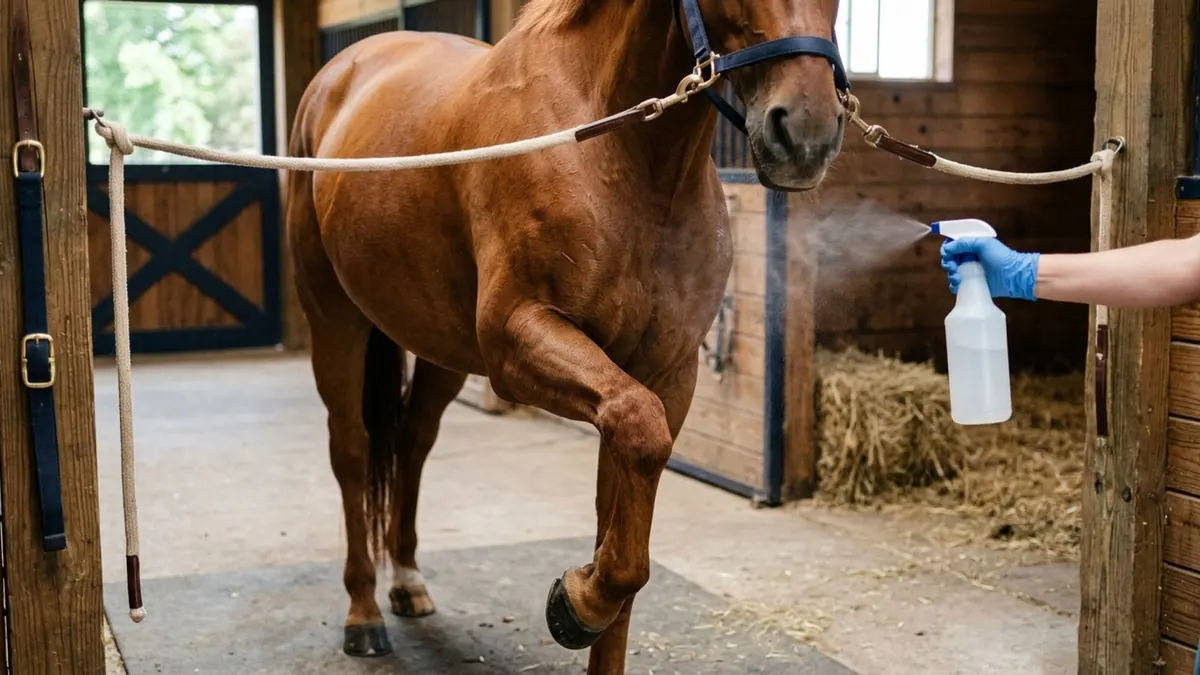
Cover image: Illustration: Barn Gear Review (AI-generated)
Related guides
Best Fly Masks for Horses (2026): Ears, Nose Covers, UV and Fit
From a no-ears classic with a double-latch closure to a fine-mesh mask with ears, nose and a stated 60%+ UV block.
Best Fly Sheets for Horses (2026): Mesh, UV, Belly Wraps and Necks
Mesh sheets for summer turnout, from a 75%+ UV sheet with a removable neck and belly wrap to a light scrim for show days.
Best Horse Blankets for Turnout (2026): Fill, Denier and Fit Compared
Five waterproof turnout blankets from 100 to 300 grams of fill, chosen on the makers' specs and an extension-service fill chart.