
Best Rain Sheets for Horses (2026): 0 g Waterproof Turnout Sheets
The best rain sheet for horses in 2026: five 0 g waterproof turnout sheets compared on denier, waterproof and breathability ratings, closures and leg straps.
Affiliate disclosure: product links on this page go to Amazon or to the maker's own store. As an Amazon Associate we earn from qualifying purchases, at no extra cost to you; links to makers' own stores earn us nothing. No retailer or brand sees our picks before they are published or has any say in them. How we choose.
The Gallopoff 1200D 0g is the rain sheet we would buy first: a 1200 denier ripstop sheet with leg straps, criss-cross belly surcingles and a fleece wither pad (per the Amazon listing). What it lacks is a published waterproof or breathability rating. If you want those figures in writing, the Saxon Defiant 1200D Standard Neck 0g prints both on the maker's own page (2,000+ waterproof, 3,000+ breathability), comes in sizes from 48 to 87 inches and lists at $89.99 from WeatherBeeta (prices change). WeatherBeeta sells it from its own store, so that pick links to the maker.
The Tough1 600D Turnout Sheet is the budget pick. SteeDear adds reflective trim, and LEAFOREST's sheet is the one with machine-wash instructions on the listing.
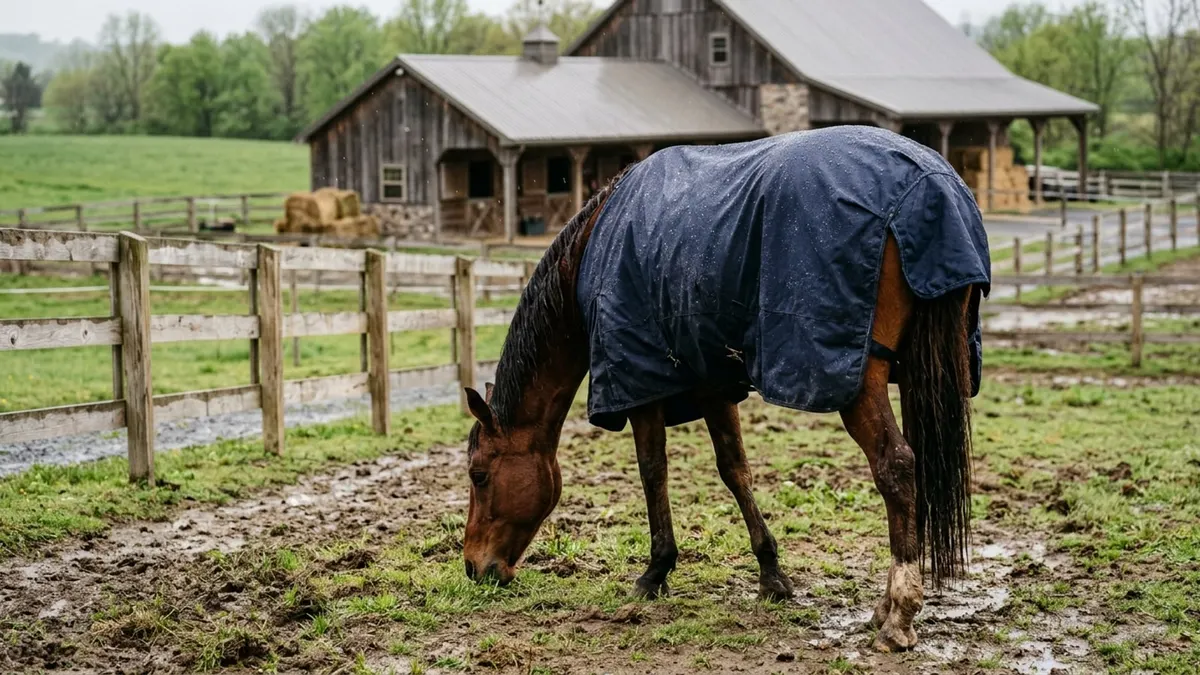
A rain sheet is a waterproof turnout with no fill (0 g). Picks are based on the makers' pages and listings and on extension-service guidance on when a sheet is enough.
Our top picks at a glance
- Gallopoff 1200D Turnout Rain Sheet 0g
Outer: 1200D ripstop (per the Amazon listing) · Front closure: Dual buckles, hook and loop · Leg straps: Adjustable · Shell rating: None given
2. Best with published ratings
Saxon Defiant 1200D Standard Neck 0gOuter: 1200D ripstop · Front closure: Twin surcingles, touch tape · Leg straps: None (tail cord) · Shell rating: 2,000+ waterproof / 3,000+ breathability
- Tough1 600D Turnout Sheet
Outer: 600D waterproof ripstop · Front closure: Double buckle, quick grip tab · Leg straps: Elastic, replaceable · Shell rating: Waterproof, no rating
- SteeDear 1200D Turnout Sheet 0g
Outer: 1200D ripstop (per the Amazon listing) · Front closure: Buckles on wide nylon straps · Leg straps: Removable · Shell rating: 3,000 mm / 3,000 MVP (per the Amazon listing)
- LEAFOREST 1200D Turnout Sheet 0g
Outer: 1200D ripstop (per the Amazon listing) · Front closure: Two stainless steel buckles · Leg straps: Detachable, adjustable · Shell rating: None given
| Pick | Outer | Front closure | Leg straps | Shell rating | Buy |
|---|---|---|---|---|---|
| Gallopoff 1200D Turnout Rain Sheet 0gBest overall | 1200D ripstop (per the Amazon listing) | Dual buckles, hook and loop | Adjustable | None given | Amazon |
| Saxon Defiant 1200D Standard Neck 0gBest with published ratings | 1200D ripstop | Twin surcingles, touch tape | None (tail cord) | 2,000+ waterproof / 3,000+ breathability | Saxon |
| Tough1 600D Turnout SheetBest budget | 600D waterproof ripstop | Double buckle, quick grip tab | Elastic, replaceable | Waterproof, no rating | Amazon |
| SteeDear 1200D Turnout Sheet 0gBest for visibility | 1200D ripstop (per the Amazon listing) | Buckles on wide nylon straps | Removable | 3,000 mm / 3,000 MVP (per the Amazon listing) | Amazon |
| LEAFOREST 1200D Turnout Sheet 0gBest for home washing | 1200D ripstop (per the Amazon listing) | Two stainless steel buckles | Detachable, adjustable | None given | Amazon |
Best overall
Gallopoff 1200D Turnout Rain Sheet 0g
A 1200D ripstop sheet with leg straps, criss-cross surcingles and a fleece wither pad.
- Outer
- 1200D ripstop (per the Amazon listing)
- Front closure
- Dual buckles, hook and loop
- Leg straps
- Adjustable
- Shell rating
- None given
Pros
- Leg straps and criss-cross belly surcingles for a horse that rolls (per the Amazon listing)
- Smooth nylon lining and a fleece wither pad (per the Amazon listing)
- Same shell comes in 100 g and 200 g, so one fit works across a set (per the Amazon listing)
Cons
- No published hydrostatic or breathability rating
- No maker website, so every spec comes from the listing
Gallopoff's listing describes a 1200 denier ripstop outer with a waterproof, breathable shell, a smooth nylon lining, a fleece pad at the withers, high shoulder gussets, dual front buckles with hook-and-loop assist, criss-cross belly surcingles, adjustable leg straps and a large tail flap. That is the full layout of a proper turnout sheet, at a heavier denier than the budget pick.
What it lacks is proof: there are no test ratings on the listing and no maker site to check. Buy it for the 1200D shell and leg straps, inspect the seams when it arrives, and keep the Saxon in mind if you want published ratings.
Best with published ratings
Saxon Defiant 1200D Standard Neck 0g
A 1200D ripstop sheet with published waterproof and breathability ratings, from WeatherBeeta's Saxon line.
- Outer
- 1200D ripstop
- Front closure
- Twin surcingles, touch tape
- Leg straps
- None (tail cord)
- Shell rating
- 2,000+ waterproof / 3,000+ breathability
Pros
- Waterproof (2,000 plus) and breathability (3,000 plus) ratings on the maker's own page
- Ripstop weave that WeatherBeeta says limits the spread of tears
- 14 sizes from 48 to 87 inches, so ponies and big horses share one model
Cons
- Sold from WeatherBeeta's own store, so the link goes to the maker
- No leg straps: low cross surcingles and a tail cord hold it in place
- WeatherBeeta's page does not state the units for its ratings
WeatherBeeta lists this sheet with a 1200 denier ripstop outer, 0 g polyfill, a smooth lining, boa fleece at the withers, twin chest surcingles with touch tape, low cross surcingles, a standard tail flap and an adjustable tail cord. It is the only sheet here whose maker prints both a hydrostatic rating (2,000 plus) and a moisture vapor rating (3,000 plus), the same figures WeatherBeeta gives in millimeters and grams per square meter for its own ComFiTec turnouts.
Breathability matters more on a sheet than on a heavy blanket, because a sheet goes on in the shoulder seasons, when a horse can warm up and sweat during the day. Rutgers' Equine Science Center says sweating under a blanket is as undesirable as blanketing a wet horse.
The Gallopoff above is the closest match in shell and layout.
Best budget
Tough1 600D Turnout Sheet
A 600D waterproof ripstop sheet for light use or as a spare to swap in when the first sheet is soaked.
- Outer
- 600D waterproof ripstop
- Front closure
- Double buckle, quick grip tab
- Leg straps
- Elastic, replaceable
- Shell rating
- Waterproof, no rating
Pros
- Elastic leg straps that Tough1 says are adjustable and replaceable
- Large shoulder gussets, crossed surcingles with elastic ends, fleece wither protection, per Tough1
Cons
- 600D shell, lighter than the 1200D picks
- Tough1's page makes no breathability claim
- Guarantee is 90 days against defects (per the Amazon listing)
Tough1, a brand of JT International, describes this sheet as a 600 denier waterproof ripstop outer with large shoulder gussets, a double buckle front closure with a quick grip tab, crossed surcingles with elastic ends, elastic replaceable leg straps, a tail flap and fleece wither protection. It comes in several colors and sizes (per the Amazon listing).
It is the sheet to buy as a spare, for a horse that is easy on its clothes, or for occasional wet days. Note the wording: Tough1 sells this as waterproof, and also sells a separate 420D sheet it calls only water-resistant. For a horse that lives out in cold rain, a 1200D sheet with a breathability claim is the better daily choice.
Best for visibility
SteeDear 1200D Turnout Sheet 0g
A 1200D sheet with reflective strips at the chest and tail and stated 3,000 mm waterproof and 3,000 MVP ratings.
- Outer
- 1200D ripstop (per the Amazon listing)
- Front closure
- Buckles on wide nylon straps
- Leg straps
- Removable
- Shell rating
- 3,000 mm / 3,000 MVP (per the Amazon listing)
Pros
- Reflective strips on the chest and tail area for dusk turnout and night checks (per the Amazon listing)
- Stated 3,000 mm waterproof and 3,000 MVP breathable PU coating (per the Amazon listing)
- Rubber rings on the hooks to cut metal noise (per the Amazon listing)
Cons
- Only five sizes, 66 to 81 inches (per the Amazon listing)
- No maker website to confirm the ratings
- No warranty terms on the listing
SteeDear's listing gives a 1200 denier rip-stop polyester shell with a thickened PU coating rated 3,000 mm waterproof and 3,000 MVP breathable, a standard neck, adjustable cross belly straps, removable leg straps, wide nylon front straps with polished buckles, and reflective strips on the chest and tail.
Those are the highest numbers among the Amazon picks, but they are the listing's claims with no maker page behind them. The reflective trim is the practical reason to choose it if you turn out or bring in after dark. Check the five-size range first; horses outside 66 to 81 inches need another sheet.
Best for home washing
LEAFOREST 1200D Turnout Sheet 0g
A 1200D standard-neck sheet whose listing gives cold-water machine-wash instructions, for owners who wash sheets at home.
- Outer
- 1200D ripstop (per the Amazon listing)
- Front closure
- Two stainless steel buckles
- Leg straps
- Detachable, adjustable
- Shell rating
- None given
Pros
- Care instructions on the listing: machine wash cold, gentle cycle, blanket wash, air dry or no-heat dry
- Stainless steel front buckles and heavy nylon binding (per the Amazon listing)
- 210T taffeta lining with shoulder lining against rubs (per the Amazon listing)
Cons
- No waterproof or breathability rating published
- No maker website to check specs against
LEAFOREST's listing describes a 1200D ripstop polyester shell with a 210T taffeta lining, two stainless steel buckles at the chest, a low cross surcingle, detachable adjustable leg straps, a standard neck and a fleece wither. It is waterproof and breathable by the listing's own description, with no numbers attached.
The washing instructions are why it is here. A rain sheet collects mud all season, and a sheet you can put through a large machine on cold with a blanket wash is cheaper to keep clean than one that has to go out. Follow the label on the sheet you receive.
When a rain sheet is the right layer
A wet coat stops insulating. Penn State Extension says even about 0.1 inch of rain can cause cold stress, and that rain, ice and freezing rain are more of a problem than snow. A 0 g sheet keeps the coat dry without adding warmth, so the horse's own coat keeps working.
The University of Maine's blanketing bulletin puts the rain sheet here:
| Horse | Temperature | UMaine suggests |
|---|---|---|
| Full winter coat | 25 to 39°F | No blanket, or a rain sheet if raining |
| Clipped | 40 to 50°F | Rain sheet or lightweight |
Schneider Saddlery's retailer chart is similar for full-coated horses (a no-fill turnout sheet as needed for rain or wind) and suggests one for fully clipped horses from 50 to 65°F. Below those ranges, step up to a filled turnout; our guide to when to blanket a horse has the full chart, and our turnout blanket picks cover 100 to 300 g.
How we chose
We compared 0 g turnout sheets on outer denier, published waterproof and breathability ratings, closures, surcingles, leg straps, sizes and warranty, from the makers' pages where they exist and the Amazon listings where they do not.
What to look for in a rain sheet
Waterproof, not water-resistant
Makers use the two words differently. Tough1, for example, sells a 600D sheet it calls waterproof and a 420D sheet it calls water-resistant. For a horse that lives out in rain, buy a sheet labeled waterproof, and prefer one with a hydrostatic rating in millimeters: WeatherBeeta prints 2,000 mm+ for its ComFiTec turnouts.
Breathability
A moisture vapor rating (in grams per square meter) says how much sweat vapor escapes through the shell. WeatherBeeta's 3,000 g/m² figure is the benchmark among the picks here. Sheets go on in changeable weather, so a horse that warms up by midday needs a shell that lets moisture out.
Denier
Rain sheets come in 600D and 1200D shells. The 1200D sheets here use heavier yarn in a ripstop weave; the 600D Tough1 is lighter and costs less. For a horse in a group or a horse that is hard on its clothes, start at 1200D.
Leg straps and surcingles
A sheet with no fill is light, so it can slide on a horse that rolls. Leg straps (Gallopoff, Tough1, SteeDear, LEAFOREST) or a tail cord (Saxon) keep the back end square; criss-cross belly surcingles keep it centered.
Size
Rain sheets are sized like blankets: WeatherBeeta measures from the center of the chest to the end of the rump. Our blanket size calculator turns a tape reading into the size to order.
Rain sheet, stable sheet or fly sheet?
| Sheet | Fill | Shell | Made for |
|---|---|---|---|
| Rain (turnout) sheet | 0 g | Waterproof turnout fabric | Turnout in rain and wind |
| Stable sheet | 0 g | Indoor fabric | Inside the barn |
| Fly sheet | None | Open mesh | Summer turnout against flies and sun |
A mesh fly sheet is not a rain layer; see our fly sheet picks for summer.
What to skip
- Leaving a soaked sheet on. UMaine says to remove saturated blankets and dry them. A spare sheet saves a cold night.
- Sheeting a wet horse. Penn State and UMaine both say never blanket a wet horse; dry it first.
- A sheet for warmth. A 0 g sheet blocks wind and rain but adds no insulation. A clipped horse in the 20s needs fill, per UMaine's chart.
- Never looking underneath. Rutgers says to remove the blanket at least once a week to groom and check the horse.
Frequently asked questions
What is a rain sheet for horses?
A rain sheet is a waterproof turnout sheet with no fill (0 g). It keeps the coat dry in rain and wind without adding warmth, so the horse's own coat keeps insulating. The University of Maine's blanketing bulletin lists rain sheets at 0 g.
At what temperature should I use a rain sheet?
The University of Maine's chart suggests a rain sheet for a full-coated horse from 25 to 39°F when it is raining, and a rain sheet or lightweight for a clipped horse from 40 to 50°F. Below those ranges, it calls for a filled blanket.
Is a rain sheet the same as a turnout sheet?
Yes. Makers sell rain sheets as turnout sheets, no-fill turnouts or 0 g turnouts. They differ from stable sheets, which are made for the barn, and from fly sheets, which are mesh.
Should a horse wear a rain sheet all the time?
Only when the weather calls for it. Penn State Extension says to take blankets off on warm days so the horse does not sweat underneath, and Rutgers says to remove the blanket at least once a week to groom and check for rubs.
What does 2,000 mm waterproof mean on a horse sheet?
It is a hydrostatic rating: the height of a column of water, in millimeters, the fabric holds back before it leaks. WeatherBeeta rates its ComFiTec turnouts at 2,000 mm+ and notes the rating applies to the outer shell fabric.
Sources
- Saxon Defiant 1200D Standard Neck 0g, WeatherBeeta
- WeatherBeeta ComFiTec Essential Turnout 100g, WeatherBeeta
- Tough1 600D Turnout Sheet, Tough1
- Sheets, Tough1
- Bulletin #1038, Winter Blanketing Guide for Equines in Maine, University of Maine Cooperative Extension
- When to Blanket a Horse, Penn State Extension
- To Blanket or Not To Blanket?, Rutgers Equine Science Center
- How to Know When to Blanket Your Horse: A Temperature Guide, Schneider Saddlery
Cover image: Illustration: Barn Gear Review (AI-generated)
Related guides
Best Fly Masks for Horses (2026): Ears, Nose Covers, UV and Fit
From a no-ears classic with a double-latch closure to a fine-mesh mask with ears, nose and a stated 60%+ UV block.
Best Fly Sheets for Horses (2026): Mesh, UV, Belly Wraps and Necks
Mesh sheets for summer turnout, from a 75%+ UV sheet with a removable neck and belly wrap to a light scrim for show days.
Best Fly Sprays for Horses (2026): Active Ingredients and Labels Compared
Four labeled horse fly sprays compared on what is in the bottle, how often the label says to apply it and who it is not for.