
Horse Stall Flooring: The Base, Mats vs Tiles, and Mats per Stall
Horse stall flooring done right: the stone dust base and its depths, 4 x 6 mats vs interlocking tiles, and how many mats a 10 x 10 to 14 x 14 stall takes.
Affiliate disclosure: product links on this page go to Amazon or to the maker's own store. As an Amazon Associate we earn from qualifying purchases, at no extra cost to you; links to makers' own stores earn us nothing. No retailer or brand sees our picks before they are published or has any say in them. How we choose.
The best horse stall flooring for a home barn is a level, compacted base of stone dust or road base mix over a drained gravel layer, covered wall to wall with 3/4 inch rubber mats and then bedded. Penn State Extension's figures for the base are 4 to 5 inches of road base mix over 6 to 8 inches of sand or small gravel, with the finished floor at least 12 inches above the ground outside. A 12 x 12 stall then takes six 4 x 6 ft mats with no cutting; a 10 x 10 takes five, three of them cut.
This guide covers the base, the choice between 4 x 6 mats and interlocking tiles, and the mat count for every common stall size with the arithmetic shown. For which mat to buy, see our best horse stall mats.
Build the base first
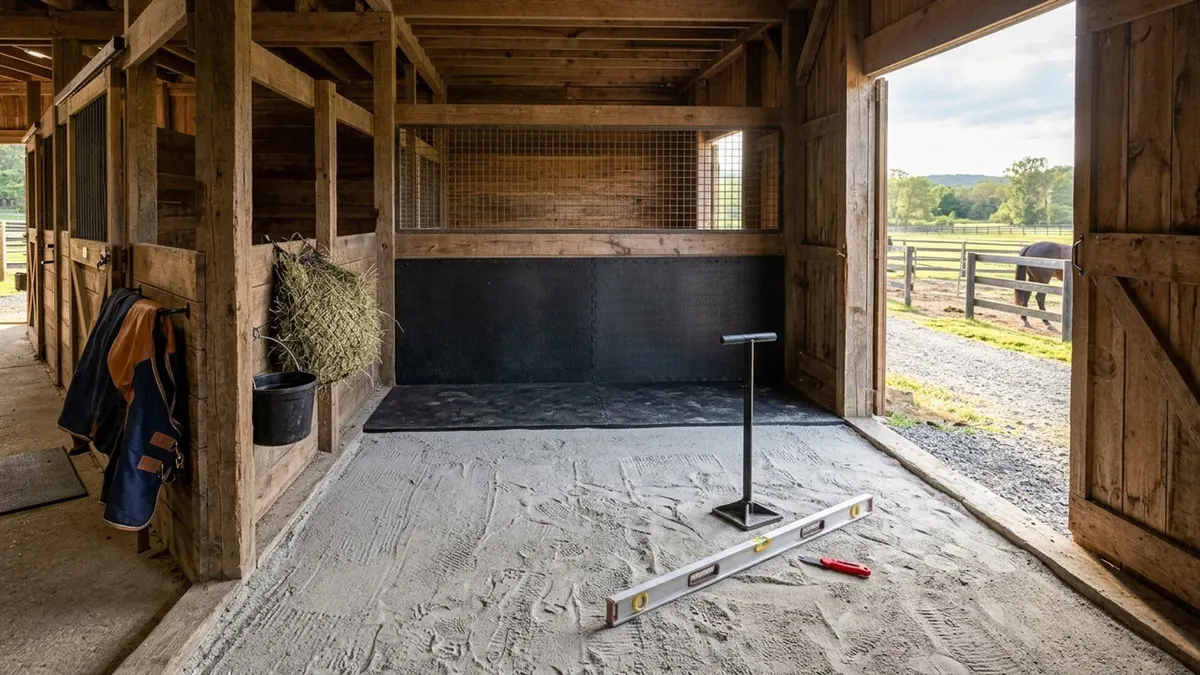
Mats are only as flat as what is under them. Penn State Extension's stall flooring guide says to place rubber mats on an even, compacted surface, such as 4 to 5 inches of road base mix or concrete. On soft or uneven dirt a mat rocks, urine collects in the low spots underneath, and the high spots wear through.
| Layer | What it is | Depth |
|---|---|---|
| Subsoil | Native soil with vegetation, roots, stones and topsoil removed, then compacted (avoid high-clay subsoil) | Whatever is left after stripping |
| Drainage layer | Sand or small gravel | 6 to 8 in |
| Floor layer | Road base mix (stone dust), compacted | 4 to 5 in |
| Mats | Rubber, laid tight wall to wall | 1/2 to 3/4 in |
| Bedding | Pellets, shavings or straw | Enough to absorb and cushion |
Penn State also asks for three things around the stall. Raise the top of the stall floor at least 12 inches above the outside ground, slope the ground outside 5 percent away from the barn, and divert surface water and groundwater away from the building. If you do slope a stall floor toward the door, keep it gentle: about 1 inch in 5 feet, since steeper floors strain tendons. Never put a drain in the middle of a stall, where bedding clogs it.
What to ask for at the quarry
Stone dust goes by several names. Penn State lists limestone dust, quarry waste, washed sand and stone dust among them. Road base mix is stone dust with small stone in it, and Penn State says it is easy to level and drains somewhat. Ask for the mix with the fewest and smallest stones, as Penn State advises, because a large stone left near the surface becomes a lump under the mat.
Compacting it
Spread the floor layer in two or three thinner layers and compact each one with a hand tamper or a rented plate compactor before adding the next. Check it with a long level in both directions. Penn State stresses a level, evenly compacted floor; any soft spot left under a mat will sink.
Laying mats over concrete instead
Concrete gives the flattest base and needs no yearly releveling. Penn State calls for at least 4 inches of concrete under stalls with little vehicle traffic. Its stall design guide notes that concrete has no give, and that rubber mats or deep bedding are what offset its hardness, so choose 3/4 inch mats over concrete rather than 1/2 inch.
4 x 6 mats or interlocking tiles
Both work on a good base. The difference is cost against how well they stay put. Penn State notes that loose mats which neither interlock nor get anchored can walk, letting bedding chaff into the cracks until it pries them apart. Interlocking tiles cannot do that. The prices below are American Floor Mats' list prices for 3/4 inch rubber (prices change).
| 4 x 6 ft mats | 2 x 2 ft interlocking tiles | |
|---|---|---|
| Area per piece | 24 sq ft | 4 sq ft |
| Weight per piece | About 100 lb (Penn State) | About a sixth of a mat, by area |
| Cutting | None for 12 x 12; some for 10 x 10, 10 x 12, 12 x 14 | None for stalls whose sides are an even number of feet |
| Staying put | Relies on weight and a tight fit | Locked joints |
| Surface | Textured top (grip-and-groove) | Smoother, per the maker |
| 12 x 12 stall cost | 6 x $149 = $894 | Set list price $1,188 |
Pick 4 x 6 mats for a standard 12 x 12 and whenever budget leads. Pick tiles for odd-sized stalls, stalls where mats have already walked, or a floor you are laying alone, since each tile is light enough to carry in one hand.
How many stall mats per stall
Start with the floor area and divide by 24 square feet per 4 x 6 mat. That gives the minimum; the layout decides how many you actually buy, because a 6 ft mat does not divide into a 10 ft wall. Penn State Extension's standard stall for a 1,000 pound horse is 12 x 12, it does not recommend stall walls under 10 feet, and its foaling guidance asks for at least 14 x 14 for a foaling stall, so those sizes bracket the table.
| Stall | Area | Area / 24 | 4 x 6 mats to buy | Offcut left over | 2 x 2 tiles |
|---|---|---|---|---|---|
| 10 x 10 ft | 100 sq ft | 100 / 24 = 4.17 | 5 | 20 sq ft | 100 / 4 = 25 |
| 10 x 12 ft | 120 sq ft | 120 / 24 = 5.00 | 5 | 0 | 120 / 4 = 30 |
| 12 x 12 ft | 144 sq ft | 144 / 24 = 6.00 | 6 | 0 | 144 / 4 = 36 |
| 12 x 14 ft | 168 sq ft | 168 / 24 = 7.00 | 7 | 0 | 168 / 4 = 42 |
| 14 x 14 ft | 196 sq ft | 196 / 24 = 8.17 | 9 | 20 sq ft | 196 / 4 = 49 |
The layouts
- 12 x 12: three mats across with their 4 ft ends against the back wall, two rows deep (3 x 4 ft = 12 ft one way, 2 x 6 ft = 12 ft the other). Six mats, nothing to cut.
- 10 x 12: lay mats with their 6 ft sides along the 12 ft wall, two per row, so each row covers 12 x 4 ft. Two rows cover 12 x 8 ft with four mats. Cut the fifth mat lengthwise into two 6 x 2 ft strips for the last 2 ft. Five mats, one cut, no waste.
- 10 x 10: each 4 ft deep row takes one full mat (6 ft) plus a mat cut to 4 x 4 ft (4 ft), which is 10 ft. Two rows use four mats, two of them cut, and leave two 4 x 2 ft offcuts. The last 2 ft strip needs 10 ft of length: a 6 x 2 ft strip from a fifth mat plus one 4 x 2 offcut. Five mats, three cut, 20 sq ft left over.
- 12 x 14: lay the 12 x 12 pattern (six mats), which leaves a strip 12 ft by 2 ft. Cut a seventh mat across into three 4 x 2 ft pieces to fill it. Seven mats, one cut, no waste.
- 14 x 14 (foaling stall): six mats with their 6 ft sides along one wall, two across and three rows deep, cover 12 x 12. One mat cut lengthwise into two 6 x 2 strips fills the 2 ft strip down the side. Two more 6 x 2 strips from an eighth mat and a 2 x 2 piece from a ninth fill the 14 ft strip across the front. Nine mats, 20 sq ft left over.
Keep the offcuts. A 6 x 2 strip is a ready-made mat for the front of a hay feeder or a wash rack step. For prices on each layout at the makers' list prices, see the cost table in our stall mat picks.
Laying the mats
- Check the base with a level one last time and fill any dip with stone dust, tamped flat.
- Start in the back corner and work toward the door, so any cut pieces end up in the front strip.
- Push every mat tight to the wall and to its neighbor. Gaps fill with wet bedding and become where mats start to creep.
- Cut rubber with a sharp utility knife along a straightedge, scoring several times rather than forcing one deep cut.
- Put textured side up and grooves down. Penn State notes untextured mats are slippery when wet, and the grooves underneath are there to channel urine.
- Bed the stall. Mats cut the bedding needed for cushioning but do not replace it for absorbency.
A 4 x 6 mat is a two-person lift. Mat grippers clamp the edge so one person can drag a mat into place.
Once the floor is down, the bedding you put on it changes the weekly work and cost. Pellets and shavings each have a different footprint on mats; our pellets vs shavings comparison shows the numbers, and the manure fork guide covers the fork that suits each.
Stall mats for a home gym
The same 4 x 6 ft rubber mats are popular as garage gym flooring, and the arithmetic is the same: floor area divided by 24 square feet per mat. Two things differ. A gym floor usually goes straight onto a concrete slab, so there is no base to build. And a stall mat's traction pattern is rougher underfoot than gym flooring; American Floor Mats notes that its interlocking tiles have a smoother surface than its stall mats, so tiles may suit a gym better. For the mats themselves, the picks in our horse stall mat guide apply.
Common mistakes
- Mats straight onto dirt. Without a compacted base, mats rock and trap urine. Penn State's base depths are there for a reason.
- A floor level with the ground outside. Penn State asks for the stall floor to sit at least 12 inches above outside grade so rain does not run in.
- A drain in the middle of the stall. Bedding clogs it. If you need drainage, Penn State describes a narrow gravel-filled trench along the wall instead.
- Clay alone. Pure clay packs too tight; Penn State's clay mix is one-third fine stone dust to two-thirds clay, releveled every year. Under mats, stone dust is less work.
Frequently asked questions
What is the best base for horse stall mats?
A compacted, level layer of road base mix or stone dust. Penn State Extension describes 4 to 5 inches of road base mix over 6 to 8 inches of sand or small gravel, or a concrete floor at least 4 inches thick.
How many 4 x 6 stall mats do I need for a 10 x 10 stall?
Five. The floor is 100 square feet, and 100 divided by 24 is 4.17, so four mats are not enough. The layout uses two full mats, two mats cut to 4 x 4 ft and strips from a fifth mat, leaving about 20 square feet of offcuts.
How many stall mats for a 12 x 14 stall?
Seven 4 x 6 mats. Six cover the first 12 x 12 ft with no cuts, and a seventh mat cut into three 4 x 2 ft pieces fills the last 2 ft strip. In 2 x 2 ft interlocking tiles it takes 42.
Can you put stall mats directly on dirt?
Only if the dirt is level and firmly compacted, and most native soil is not. Penn State Extension recommends removing vegetation and topsoil, compacting the subsoil and adding a drainage layer and a compacted stone dust layer before the mats go down.
Are interlocking stall mats worth it?
They stop mats walking apart, which is the main failure of loose 4 x 6 mats, and they fit odd stall sizes without cutting. They cost more: American Floor Mats lists a 3/4 inch 12 x 12 tile set at $1,188 against $894 for six 4 x 6 mats.
Should a horse stall floor slope?
Only slightly, if at all. Penn State Extension suggests about 1 inch per 5 feet toward the door or a gutter, roughly 1.5 to 2 percent, and warns that noticeably steeper floors can strain a horse's tendons.
Sources
- Horse Stable Flooring Materials and Drainage, Penn State Extension
- Horse Stall Design, Penn State Extension
- Foaling Season: Tips for Delivery, Penn State Extension
- Horse Stall Mats (Item No. AHRSM), American Floor Mats
Cover image: Illustration: Barn Gear Review (AI-generated)
Related guides
Best Barn Cameras for Watching Stalls and Foaling (2026)
Four stall cameras for Wi-Fi, wired and no-Wi-Fi barns, compared on night vision, weather rating and the coldest temperature each maker rates it for.
Best Barn Fans for Horse Stalls and Aisles (2026): Enclosed Motors Only
Four stall and aisle fans with totally enclosed or sealed motors, compared on airflow, mounting and power, with the extension guidance on barn fan fires.
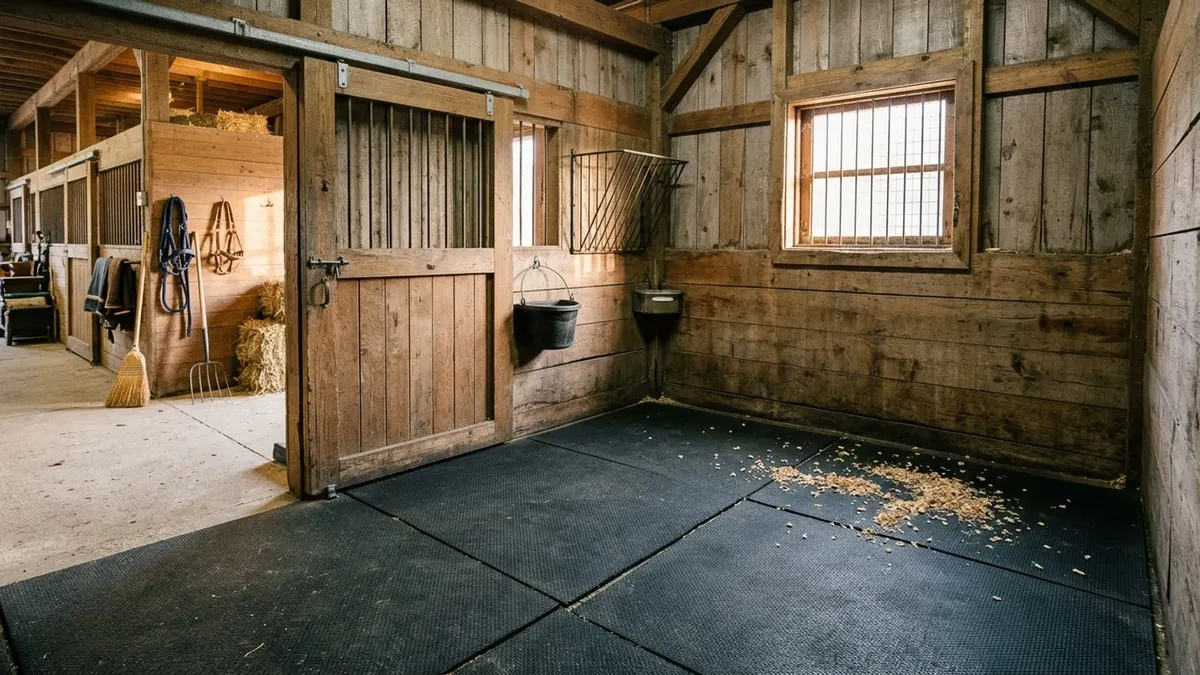
Best Horse Stall Mats of 2026: Thickness, Texture and Cost per Stall
Five stall mats compared on thickness, top and bottom texture, rubber type and what a full stall costs at the makers' list prices.