
Best Barn Cameras for Watching Stalls and Foaling (2026)
The best barn camera for watching horses and foaling mares: Wi-Fi, PoE and 4G cellular picks compared on reach, infrared night vision, weather rating and cold.
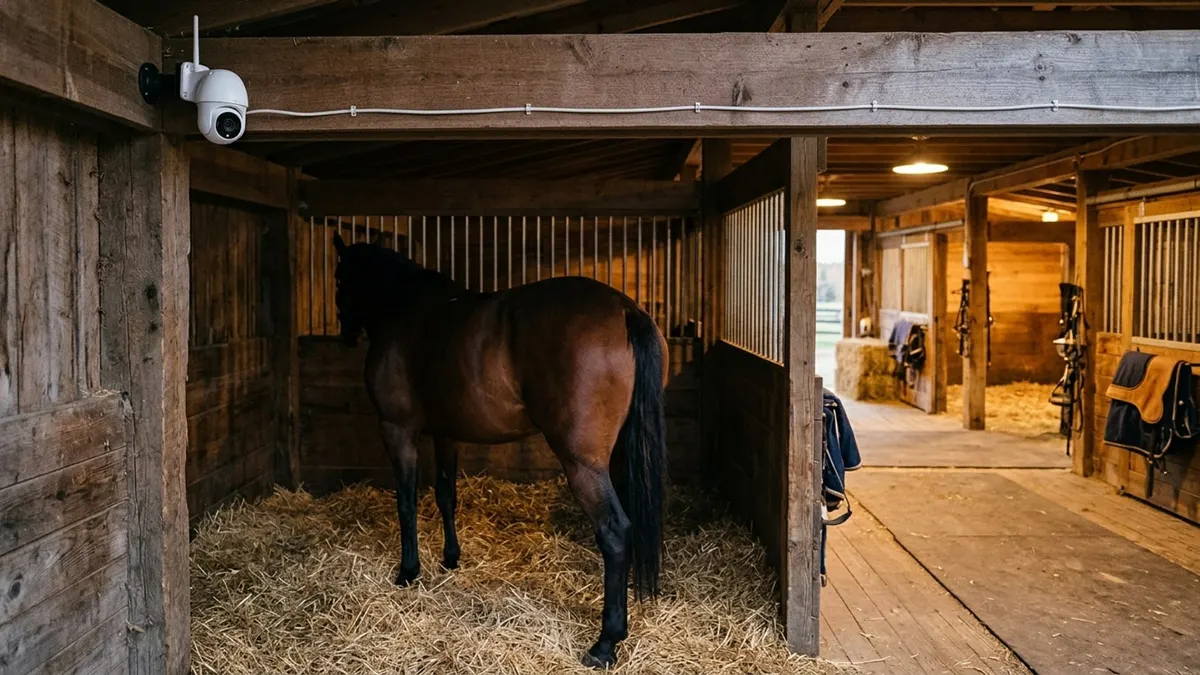
Affiliate disclosure: product links on this page go to Amazon or to the maker's own store. As an Amazon Associate we earn from qualifying purchases, at no extra cost to you; links to makers' own stores earn us nothing. No retailer or brand sees our picks before they are published or has any say in them. How we choose.
The barn camera to buy depends on how the signal gets to your barn. If your Wi-Fi reaches the stalls, the Reolink E1 Outdoor Pro is our pick: 4K video with 3x optical zoom, pan and tilt to follow a mare around a foaling stall, dual-band Wi-Fi 6, an IP65 weather rating and recording to a microSD card with no subscription, per Reolink.
For barns in hard-freezing country, the Tapo C500 is rated by TP-Link down to -22°F, against 14°F for the Reolinks, and costs far less. If no Wi-Fi reaches the barn at all, Reolink's 4G LTE solar pan-tilt camera runs on a cellular data plan, and if you can pull a network cable, the E1 Outdoor SE PoE gets power and data down one wire.
Picks are based on the makers' spec pages (weather rating, operating temperature, infrared range, storage) and Penn State Extension's foaling and barn fire guidance.
Our top picks at a glance
- Reolink E1 Outdoor Pro (4K Wi-Fi 6 PTZ)
Connection: Wi-Fi 6, 2.4 and 5 GHz · Night vision: Infrared to 40 ft, plus spotlights · Weather rating: IP65 · Coldest rated: 14°F (-10°C)
2. Best budget and best for cold barns
TP-Link Tapo C500 Outdoor Pan/Tilt CameraConnection: Wi-Fi, 2.4 GHz only · Night vision: Infrared to 98 ft · Weather rating: IP65 · Coldest rated: -22°F (-30°C)
- Reolink 4K 4G LTE Solar Pan-Tilt Camera (Go series)
Connection: 4G LTE cellular (Nano SIM and data plan) · Night vision: Infrared to 33 ft, plus spotlights · Weather rating: IP64 · Coldest rated: 14°F (-10°C)
- Reolink E1 Outdoor SE PoE (4K pan-tilt)
Connection: PoE (IEEE 802.3af) or 12 V DC · Night vision: Infrared to 40 ft, plus adjustable spotlights · Weather rating: IP65 · Coldest rated: 14°F (-10°C)
| Pick | Connection | Night vision | Weather rating | Coldest rated | Buy |
|---|---|---|---|---|---|
| Reolink E1 Outdoor Pro (4K Wi-Fi 6 PTZ)Best overall | Wi-Fi 6, 2.4 and 5 GHz | Infrared to 40 ft, plus spotlights | IP65 | 14°F (-10°C) | Amazon |
| TP-Link Tapo C500 Outdoor Pan/Tilt CameraBest budget and best for cold barns | Wi-Fi, 2.4 GHz only | Infrared to 98 ft | IP65 | -22°F (-30°C) | Amazon |
| Reolink 4K 4G LTE Solar Pan-Tilt Camera (Go series)Best with no Wi-Fi | 4G LTE cellular (Nano SIM and data plan) | Infrared to 33 ft, plus spotlights | IP64 | 14°F (-10°C) | Amazon |
| Reolink E1 Outdoor SE PoE (4K pan-tilt)Best wired (PoE) | PoE (IEEE 802.3af) or 12 V DC | Infrared to 40 ft, plus adjustable spotlights | IP65 | 14°F (-10°C) | Amazon |
Best overall
Reolink E1 Outdoor Pro (4K Wi-Fi 6 PTZ)
The sharpest stall view here, with real optical zoom and pan-tilt, for any barn your Wi-Fi already reaches.
- Connection
- Wi-Fi 6, 2.4 and 5 GHz
- Night vision
- Infrared to 40 ft, plus spotlights
- Weather rating
- IP65
- Coldest rated
- 14°F (-10°C)
- Video
- 4K, 3x optical zoom, 355° pan, 50° tilt
Pros
- 3x optical zoom lets you read a mare's flank or a foal's nostrils without losing detail
- Records to a microSD card up to 512 GB, a Reolink NVR or FTP, so no monthly fee is required
- Detects animals as well as people and vehicles, and Reolink gives it a two-year limited warranty
Cons
- Rated to 14°F; barns that get colder than that need the Tapo
- Plug-in power: the box has a 1.2 m adapter cable and a 4.5 m extension, so it needs an outlet nearby
- The Amazon listing claims 100 ft of infrared; Reolink's own spec page says 40 ft
Reolink's E1 Outdoor Pro is a pan-tilt dome built for outdoor walls, which makes it a good stall camera: it pans 355 degrees and tilts 50, so one camera in a corner can follow a horse around a 14 x 14 foaling stall. Video is 4K, and the 3x optical zoom is real lens zoom, not cropping. At night it switches to infrared with ten 850 nm LEDs reaching 40 ft, per Reolink, or to color using its four spotlights.
Its Wi-Fi 6 radio works on both 2.4 and 5 GHz. The 2.4 GHz band is the one to use for a barn some distance from the router, because it carries farther through walls than 5 GHz. Recordings go to a microSD card up to 512 GB, a Reolink NVR or an FTP server, and the camera can alert on animal motion as well as people. Reolink rates it IP65 and for operation from 14°F to 131°F, with a two-year limited warranty.
Skip it if your barn regularly drops below 14°F in winter or if no outlet is within reach of the corner you want to mount it in; its adapter cable plus the included 4.5 m extension sets the limit.
Best budget and best for cold barns
TP-Link Tapo C500 Outdoor Pan/Tilt Camera
A low-cost pan-tilt camera rated by its maker to -22°F, with the longest infrared reach here, for barns within 2.4 GHz Wi-Fi range.
- Connection
- Wi-Fi, 2.4 GHz only
- Night vision
- Infrared to 98 ft
- Weather rating
- IP65
- Coldest rated
- -22°F (-30°C)
- Video
- 1080p, 340° pan, 90° tilt (mechanical)
Pros
- TP-Link rates it for -22°F to 140°F, the widest range of any pick
- Infrared reaches 98 ft, per TP-Link, more than enough for a stall or a run-in shed
Cons
- 1080p only, so less detail when you zoom in on a phone
- 2.4 GHz Wi-Fi only; no 5 GHz and no wired option
- Detects motion and people but TP-Link does not list animal detection, so expect alerts for every movement
The Tapo C500 is the cheapest camera here and, for northern barns, the most practical. TP-Link's spec sheet gives an operating range of -22°F to 140°F and an IP65 weather rating, so it carries on through a January night that would be outside the Reolinks' 14°F rating. Its 850 nm infrared reaches 98 ft.
The trade-offs are resolution and network. It records 1080p, so zooming in on your phone shows less than a 4K camera, and it connects on 2.4 GHz Wi-Fi only. That band carries farther than 5 GHz, which suits a barn, but the barn still has to be in range. Storage is a microSD card up to 512 GB or TP-Link's Tapo Care subscription. The mechanical pan is 340 degrees and tilt 90, which TP-Link says covers 360 by 131 degrees of view.
Because it alerts on motion, person and tamper events rather than animals, a stall camera will send an alert every time the horse moves. Turn notifications off and use it as a live view, or set motion zones away from the horse.
Best with no Wi-Fi
Reolink 4K 4G LTE Solar Pan-Tilt Camera (Go series)
A battery and solar pan-tilt camera that sends video over 4G LTE, for barns, run-in sheds and foaling paddocks your Wi-Fi will never reach.
- Connection
- 4G LTE cellular (Nano SIM and data plan)
- Night vision
- Infrared to 33 ft, plus spotlights
- Weather rating
- IP64
- Coldest rated
- 14°F (-10°C)
- Video
- 4K, 355° pan, 140° tilt, 32 presets
Pros
- No Wi-Fi and no outlet needed: a 21.6 Wh battery that Reolink says lasts about two months per charge, topped up by a 6 W solar panel
- 140 degrees of tilt and 32 preset positions, so one camera can cover a stall door, a paddock gate and a water trough
- Detects animals, people and vehicles, with two-way audio
Cons
- Needs a cellular data plan, and video uses data; check coverage at the barn first
- Reolink's spec page says the SIM is not included and lists prepaid T-Mobile and AT&T data; the Amazon listing says a Reolink SIM for those networks is in the box, so check what yours includes
- Local storage is a microSD card of up to 128 GB, a quarter of the other Reolinks
This is the camera for a barn at the back of the property. It connects over 4G LTE rather than Wi-Fi and runs on a rechargeable battery fed by solar, so the only infrastructure it needs is cell coverage and a sunny spot for the panel. The Amazon listing is labelled Go series; its 4K resolution, 355 degree pan, 140 degree tilt and 32 presets match Reolink's Go PT Ultra, whose spec page is the source for the figures here.
Reolink rates it IP64 and for 14°F to 131°F, with infrared reaching 33 ft and two spotlights for color at night. The 21.6 Wh battery lasts about two months per charge by Reolink's estimate, which varies with settings and temperature, and the camera works with Reolink's 6 W Solar Panel 2. Recordings go to a microSD card of up to 128 GB.
Cellular is the cost to plan for. Reolink's page says the camera needs a Nano SIM and a data plan and lists prepaid T-Mobile and AT&T data for the US; the Amazon listing describes a Reolink SIM that works on both networks. Either way you are paying for data, and live-viewing a foaling mare for hours uses it fast. If you can get Wi-Fi or a cable to the barn, the other picks cost less to run.
Best wired (PoE)
Reolink E1 Outdoor SE PoE (4K pan-tilt)
One network cable carries power and video, so there is no Wi-Fi to drop and no plug-in adapter at the stall.
- Connection
- PoE (IEEE 802.3af) or 12 V DC
- Night vision
- Infrared to 40 ft, plus adjustable spotlights
- Weather rating
- IP65
- Coldest rated
- 14°F (-10°C)
- Video
- 4K, 355° pan, 50° tilt, digital zoom
Pros
- No Wi-Fi: the most dependable link for a barn you can reach with a cable
- Records to microSD or to a Reolink NVR, with person, vehicle and animal detection
- Four warm-white 3000K spotlights for color at night, with infrared for nights you want the stall dark
Cons
- Needs a PoE switch or injector at the other end of the cable, not included
- Digital zoom only, unlike the E1 Outdoor Pro
- Rated to 14°F (to 126°F at the top end)
Power over Ethernet sends power and data down one network cable, so the camera end needs no outlet and no Wi-Fi. For a barn you can trench a cable to, or a barn that already has a network switch, it is the most reliable way to watch a stall: no signal to drop on the one night that matters. Reolink's E1 Outdoor SE PoE is the pan-tilt version: 4K, 355 degrees of pan and 50 of tilt, infrared to 40 ft and four warm-white 3000K spotlights.
Reolink's spec table lists IEEE 802.3af PoE and a 12 V DC input as the alternative; its FAQ recommends an 802.3at injector or switch, and none is included, so budget for one. The camera is rated IP65 and for 14°F to 126°F, records to a microSD card or a Reolink NVR, and detects animals as well as people. Reolink gives it a two-year limited warranty.
How we chose
A barn camera has to survive dust, damp and cold, see in the dark, and get its picture back to the house. We compared each camera's weather rating, the operating temperature its maker publishes, infrared range, pan and tilt, storage and how it connects, using the makers' own spec pages. We favored cameras that record locally with no subscription and that can tell an animal from a person.
How to get a picture back from the barn
Decide this first, because it picks the camera for you.
| Your barn | Connection | Pick | Running cost |
|---|---|---|---|
| Strong Wi-Fi in the stalls | Wi-Fi | Reolink E1 Outdoor Pro or Tapo C500 | None with a microSD card |
| Weak Wi-Fi, but you can run a cable | PoE network cable | Reolink E1 Outdoor SE PoE | None; one-time PoE injector or switch |
| No Wi-Fi, no cable, cell coverage | 4G LTE | Reolink 4G solar pan-tilt | A cellular data plan |
Test before you buy: stand in the stall with your phone on your home Wi-Fi and stream a video. If it stutters there, a camera will too. A metal-sided barn or a long run across the yard often needs the cable or cellular route, or a mesh node or outdoor access point to carry Wi-Fi out to the barn.
What matters in a barn camera
Cold rating
Makers publish an operating temperature range, and this is where barn cameras differ most. All three Reolinks are rated to 14°F (-10°C). The Tapo C500 is rated to -22°F (-30°C). In a barn that drops below 14°F in winter, that difference matters.
Weather rating
IP65 means dust-tight and protected against water jets; IP64 means dust-tight and protected against splashing. Either is enough for a stall, where dust is the bigger problem than rain. Avoid indoor-only cameras in an open barn.
Night vision: infrared, not spotlights, for a foaling mare
Every pick has infrared night vision, which lights the stall with infrared LEDs (850 nm on the E1 models and the Tapo) and gives a black-and-white image, and white spotlights for color. Penn State Extension's foaling advice is to monitor the mare but try not to disturb her, so set the camera to infrared at night in a foaling stall and leave the spotlights off. All the infrared ranges here (33 to 98 ft) comfortably cover the 20 ft diagonal of a 14 x 14 stall.
Pan, tilt and zoom
A fixed camera in one corner leaves the corner under it blind. Pan and tilt let you look around the stall from your phone, and presets let you jump between the stall, the door and the water. Optical zoom (the E1 Outdoor Pro) keeps detail when you zoom; digital zoom only enlarges pixels.
Storage and alerts
A microSD card in the camera means no monthly fee. Animal detection matters less than you might think in a stall, since the horse is always there; it is more useful on a camera pointed at a gate or a paddock.
Using a camera for foaling
Penn State Extension suggests using cameras to monitor the mare before and during birthing, and notes that the second stage of labor, the delivery itself, typically happens quickly, usually within 30 minutes. A camera lets you check from the house without walking into the barn and disturbing her. It does not tell you labor has started on its own; Penn State mentions Foal Alert devices, sutured to the mare and set off when labor pulls the suture, while warning that they can come loose early and give false alarms.
Agree with your vet in advance when to call, and keep the vet's number on the phone you watch the camera on. Penn State's foaling stall is at least 14 x 14 ft, bedded with straw rather than shavings; our stall flooring guide counts the mats for that size, and our bedding comparison explains why foaling stalls are the exception to shavings.
Mounting and power
- Mount high in a corner, above the horse's reach, and run the cable up and along beams. Penn State's barn fire guidance says horses must not be able to chew or step on any cord.
- Plug-in cameras need an outlet near the mount. If there is none, have an electrician add one rather than running extension cords down the aisle; our barn fan guide covers the same wiring question.
- Wipe the dome and lens when you knock down cobwebs. Penn State advises regular removal of dust and webs from stalls and rafters, and a webbed lens blurs the infrared image.
The picks side by side
| Camera | Video | Infrared | Rating | Operating range | Storage |
|---|---|---|---|---|---|
| Reolink E1 Outdoor Pro | 4K, 3x optical | 40 ft | IP65 | 14 to 131°F | microSD to 512 GB, NVR |
| Tapo C500 | 1080p | 98 ft | IP65 | -22 to 140°F | microSD to 512 GB |
| Reolink 4G solar pan-tilt | 4K | 33 ft | IP64 | 14 to 131°F | microSD to 128 GB |
| Reolink E1 Outdoor SE PoE | 4K | 40 ft | IP65 | 14 to 126°F | microSD to 512 GB, NVR |
What to skip
- Color spotlights all night in a foaling stall. Use infrared.
- A 5 GHz-only connection to a barn across the yard. Use 2.4 GHz, a cable or cellular.
- Cameras with no published operating temperature. If the maker will not say how cold it works, assume it will not in January.
- Cords and adapters within reach of the stall.
Frequently asked questions
What is the best camera for watching a foaling mare?
A pan-tilt camera with infrared night vision, mounted high in a corner of the foaling stall, so you can watch from the house without disturbing her. The Reolink E1 Outdoor Pro has 4K and optical zoom; the Tapo C500 is cheaper and rated to -22 degrees F.
How do I get Wi-Fi to my barn for a camera?
Test first by streaming video on your phone inside the stall. If it is weak, run a network cable and use a PoE camera, extend Wi-Fi with a mesh node or outdoor access point, or skip Wi-Fi with a 4G cellular camera and a data plan.
Can a barn camera work without Wi-Fi?
Yes. A 4G LTE camera such as Reolink's solar pan-tilt model sends video over a cellular data plan and runs on a battery charged by a solar panel, so it needs only cell coverage at the barn. A PoE camera on a network cable also needs no Wi-Fi.
Do barn cameras work in freezing weather?
Only within the maker's rated range. The Reolink E1 Outdoor Pro, E1 Outdoor SE PoE and 4G Go camera are rated to 14 degrees F, while TP-Link rates the Tapo C500 to -22 degrees F. Check the operating temperature before buying for a northern barn.
Do I need a subscription for a barn camera?
Not with these picks. The Reolinks and the Tapo C500 record to a microSD card in the camera, and the Reolink E1 models can also record to a Reolink NVR. Cloud plans are optional extras. The 4G camera is the exception in a different way: it needs a cellular data plan to send video.
Sources
- Reolink E1 Outdoor Pro, Reolink
- Reolink Go PT Ultra: 4G Solar Camera with 4K Pan & Tilt, Reolink
- Reolink E1 Outdoor SE PoE, Reolink
- Tapo C500 Specifications, TP-Link Tapo
- Foaling Season: Tips for Delivery, Penn State Extension
- Fire Prevention Measures for Equine Facilities, Penn State Extension
Cover image: Illustration: Barn Gear Review (AI-generated)
Related guides
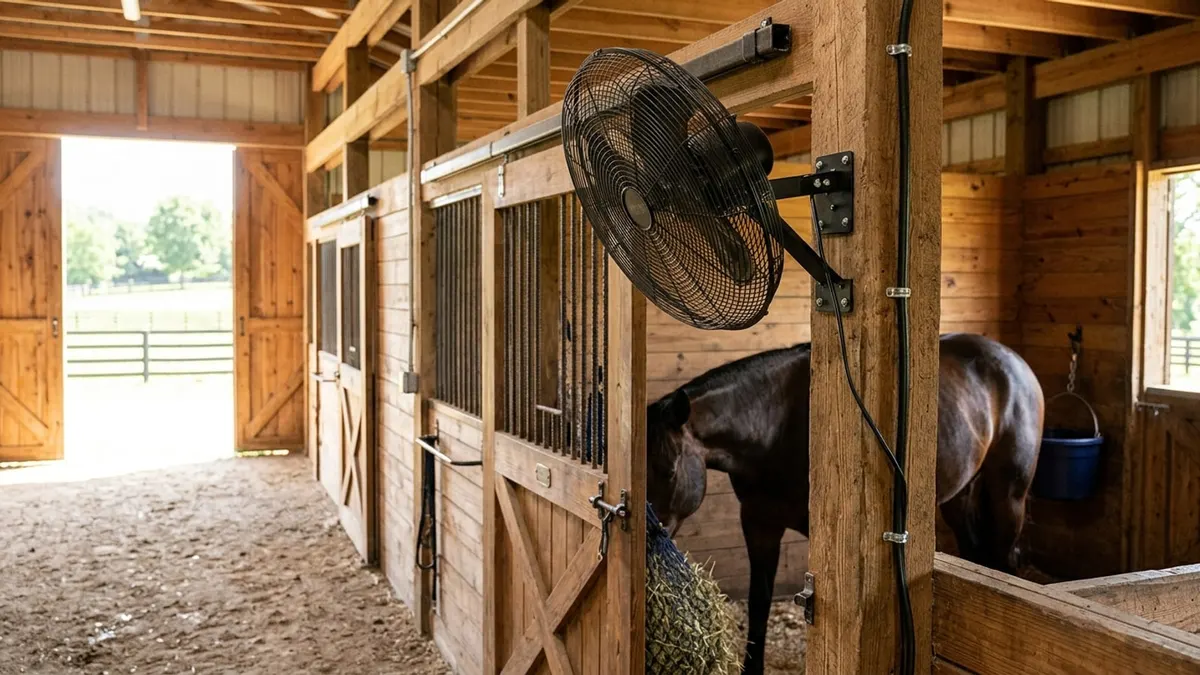
Best Barn Fans for Horse Stalls and Aisles (2026): Enclosed Motors Only
Four stall and aisle fans with totally enclosed or sealed motors, compared on airflow, mounting and power, with the extension guidance on barn fan fires.
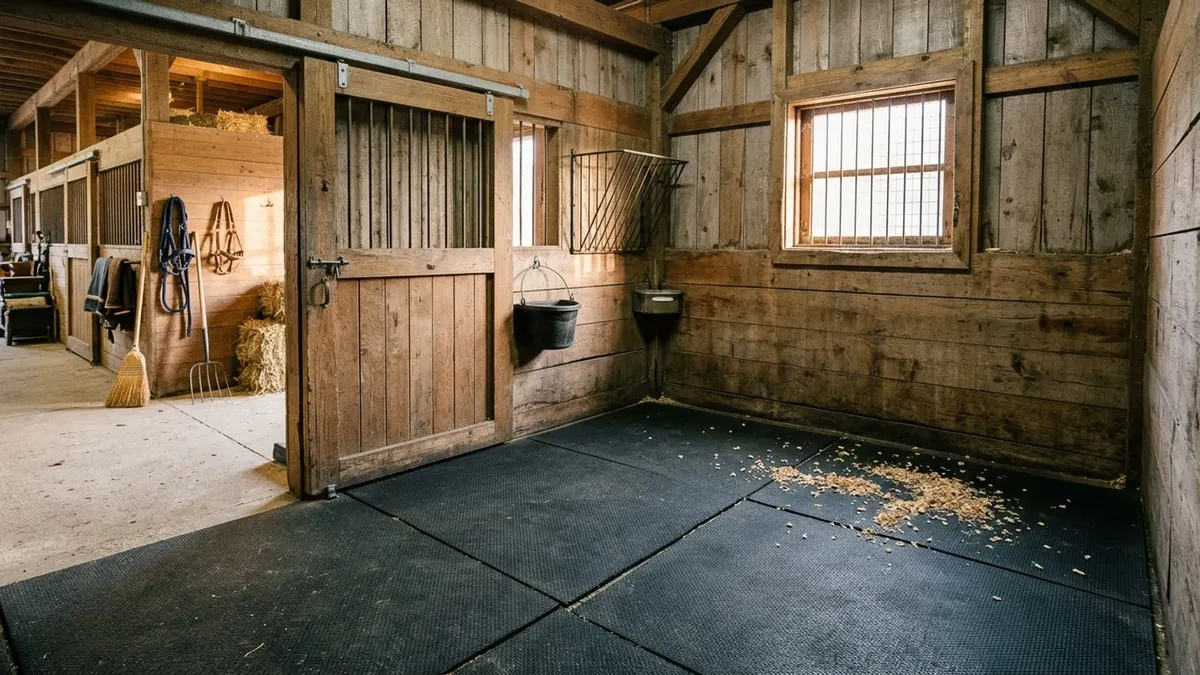
Best Horse Stall Mats of 2026: Thickness, Texture and Cost per Stall
Five stall mats compared on thickness, top and bottom texture, rubber type and what a full stall costs at the makers' list prices.
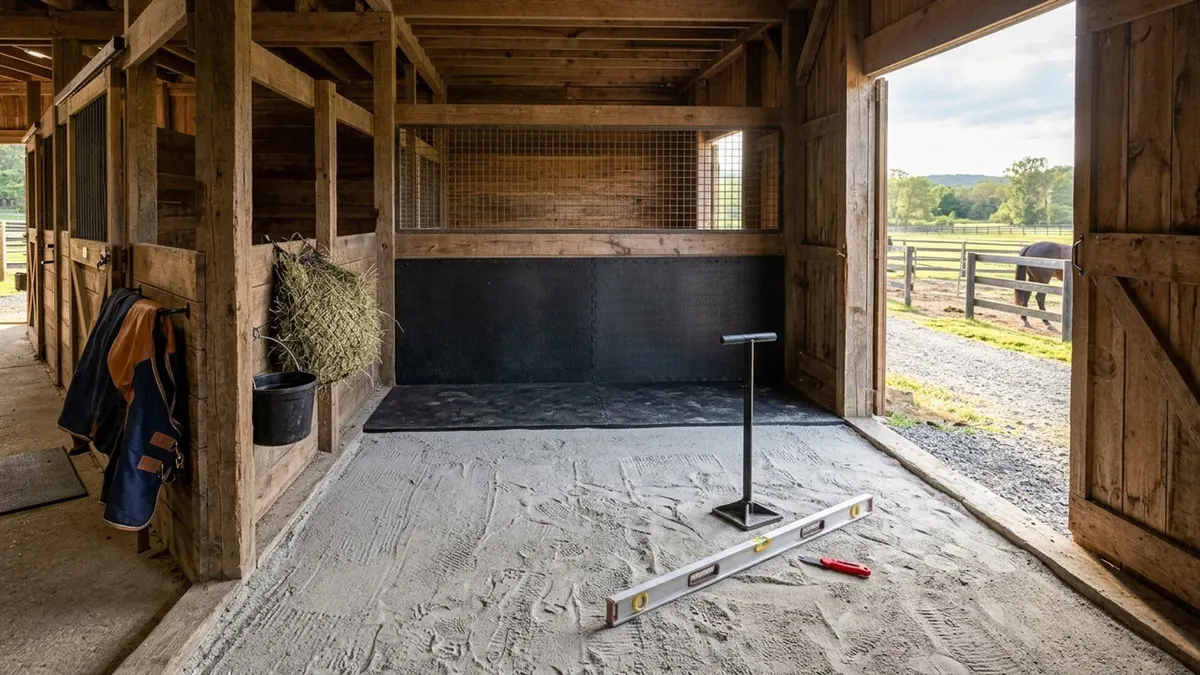
Horse Stall Flooring: The Base, Mats vs Tiles, and Mats per Stall
Build the base Penn State Extension describes, choose mats or tiles, and count exactly how many a 10 x 10, 10 x 12, 12 x 12 or 12 x 14 stall needs.