
Best Horse Stall Mats of 2026: Thickness, Texture and Cost per Stall
The best horse stall mats for a home barn: 3/4 inch 4 x 6 mats vs interlocking tiles, what the texture and rubber mean, and the cost to floor a 12 x 12 stall.
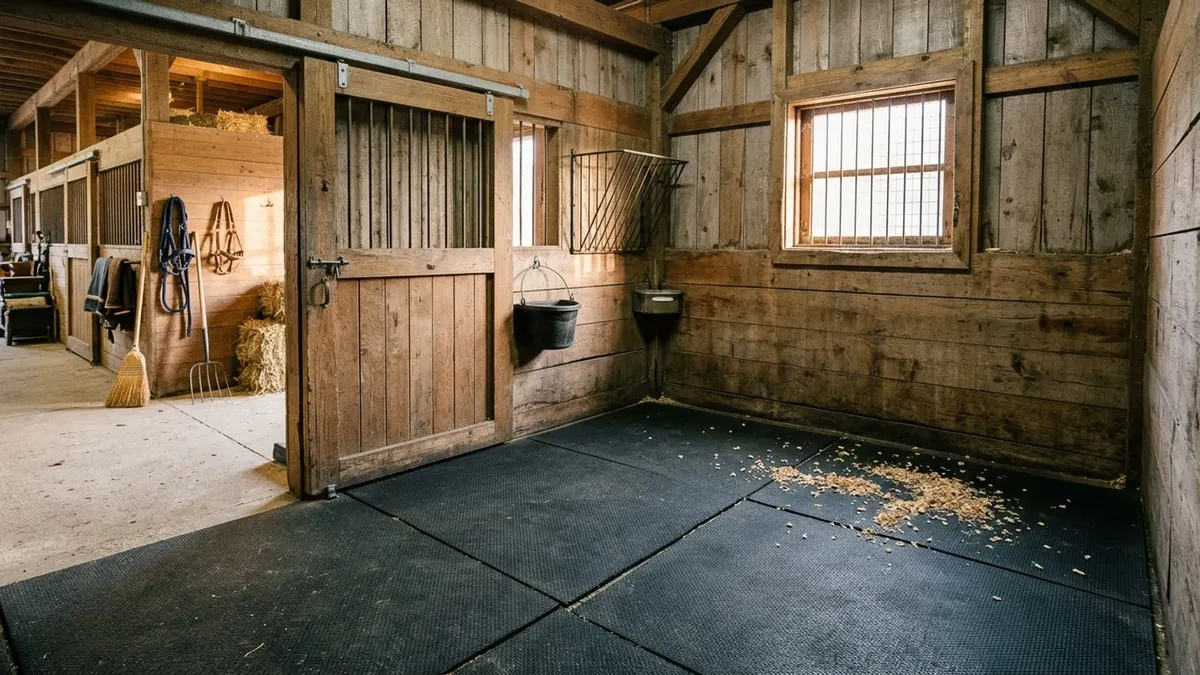
Affiliate disclosure: product links on this page go to Amazon or to the maker's own store. As an Amazon Associate we earn from qualifying purchases, at no extra cost to you; links to makers' own stores earn us nothing. No retailer or brand sees our picks before they are published or has any say in them. How we choose.
For most home barns the stall mat to buy is a solid 3/4 inch, 4 x 6 ft rubber mat with a textured top and a grooved underside, and the American Floor Mats 3/4 inch Horse Stall Mat is our pick. American Floor Mats says it makes the mats in the US from US-sourced rubber with no fillers, gives them a grip-and-groove top, and lists the 4 x 6 at $149 a mat on its own site (prices change). Six of them cover a 12 x 12 stall with no cutting.
If you can wait for freight and want to spend less, Rubber-Cal sells its own 3/4 inch Horse Stall Mat direct for $98 a mat. If your mats keep creeping apart, interlocking 2 x 2 ft tiles stay put but cost about a third more per stall. A 1/2 inch mat is the lighter choice for trailers and wash racks.
This guide is for owners flooring one to a handful of stalls themselves. Picks are based on the makers' product pages and warranty terms and on Penn State Extension's stall flooring guidance.
Our top picks at a glance
- American Floor Mats Horse Stall Mat (3/4 in, 4 x 6 ft)
Thickness: 3/4 in · Size: 4 x 6 ft · Top surface: Grip-and-groove pattern · Rubber: US-made, no fillers (per the maker)
- American Floor Mats Interlocking Stall Tiles (3/4 in, 2 x 2 ft)
Thickness: 3/4 in · Size: 2 x 2 ft tiles (4 sq ft) · Top surface: Smoother than the maker's mats · Rubber: US-made, no fillers (per the maker)
- American Floor Mats Horse Stall Mat (1/2 in, 4 x 6 ft)
Thickness: 1/2 in · Size: 4 x 6 ft · Top surface: Grip-and-groove pattern · Rubber: US-made, no fillers (per the maker)
4. Best for aisles and tack rooms
Rubber-Cal Hammer-Head Heavy-Duty Mat (3/4 in, 4 x 6 ft)Thickness: 3/4 in · Size: 4 x 6 ft (48 x 72 in) · Top surface: Not stated; textured underside (per the Amazon listing) · Rubber: Recycled rubber content (per the Amazon listing)
5. Best value (direct from the maker)
Rubber-Cal Horse Stall Mat (3/4 in, 4 x 6 ft)Thickness: 3/4 in (also 1/2 in) · Size: 4 x 6 ft · Top surface: Cobblestone · Rubber: Natural and reclaimed
| Pick | Thickness | Size | Top surface | Rubber | Buy |
|---|---|---|---|---|---|
| American Floor Mats Horse Stall Mat (3/4 in, 4 x 6 ft)Best overall | 3/4 in | 4 x 6 ft | Grip-and-groove pattern | US-made, no fillers (per the maker) | Amazon |
| American Floor Mats Interlocking Stall Tiles (3/4 in, 2 x 2 ft)Best interlocking | 3/4 in | 2 x 2 ft tiles (4 sq ft) | Smoother than the maker's mats | US-made, no fillers (per the maker) | Amazon |
| American Floor Mats Horse Stall Mat (1/2 in, 4 x 6 ft)Best lighter mat | 1/2 in | 4 x 6 ft | Grip-and-groove pattern | US-made, no fillers (per the maker) | Amazon |
| Rubber-Cal Hammer-Head Heavy-Duty Mat (3/4 in, 4 x 6 ft)Best for aisles and tack rooms | 3/4 in | 4 x 6 ft (48 x 72 in) | Not stated; textured underside (per the Amazon listing) | Recycled rubber content (per the Amazon listing) | Amazon |
| Rubber-Cal Horse Stall Mat (3/4 in, 4 x 6 ft)Best value (direct from the maker) | 3/4 in (also 1/2 in) | 4 x 6 ft | Cobblestone | Natural and reclaimed | Rubber-Cal |
A full-thickness 4 x 6 mat from a US maker: the default choice for a 12 x 12 stall over stone dust or concrete.
- Thickness
- 3/4 in
- Size
- 4 x 6 ft
- Top surface
- Grip-and-groove pattern
- Rubber
- US-made, no fillers (per the maker)
Pros
- 3/4 inch is the top of the 1/2 to 3/4 inch range Penn State Extension calls most common for stall mats
- Textured top for traction, which Penn State says untextured mats lack when wet
- American Floor Mats lists it at $149 a mat, so six mats for a 12 x 12 stall come to $894 at list price
Cons
- The maker's horse mat page gives no weight or warranty term; ask before ordering if the warranty matters to you
- Straight-edged mats can creep apart over time unless the base is level and the mats are fitted tight
A 4 x 6 mat at 3/4 inch is what most extension guidance has in mind when it talks about stall mats. Penn State Extension says the most common mats run 1/2 to 3/4 inch thick and that a 4 x 6 ft mat weighs about 100 pounds, which is why the thicker ones lie still under a horse without glue. American Floor Mats makes this one in the US from US-sourced raw materials and says it contains no fillers, with a grip-and-groove top meant to stop horses and people slipping.
On its own site the maker lists the 3/4 inch 4 x 6 at $149, the 1/2 inch at $129 and the 3/8 inch at $89 (quantities of 1 to 25; prices change). The horse mat page does not state a weight per mat or a warranty, so if you want those in writing, call the maker before you order a full barn's worth.
Skip it if your stalls are an odd size and you hate cutting rubber: a 10 x 10 stall takes five 4 x 6 mats with three of them cut (the layouts are in our stall flooring guide). Interlocking tiles fit those sizes with no cutting, at a higher price.
Best interlocking
American Floor Mats Interlocking Stall Tiles (3/4 in, 2 x 2 ft)
2 x 2 ft tiles that lock together and come in sets sized to the stall, for owners whose loose 4 x 6 mats keep walking.
- Thickness
- 3/4 in
- Size
- 2 x 2 ft tiles (4 sq ft)
- Top surface
- Smoother than the maker's mats
- Rubber
- US-made, no fillers (per the maker)
Pros
- Locked joints stop the creeping that Penn State says lets bedding work into the cracks and pry mats apart
- Every common stall size divides into whole 2 x 2 tiles: 25 for a 10 x 10, 36 for a 12 x 12
- Sets come with corner and border tiles that leave a straight edge along the walls
Cons
- Costs more: the maker lists a 3/4 inch 12 x 12 set at $1,188, against $894 for six 4 x 6 mats
- American Floor Mats says its tiles have a smoother surface than its stall mats, so less grip when wet
Penn State Extension's main complaint about loose stall mats is that they walk: unless they interlock or are anchored, the mats shift, chaff from the bedding works into the cracks, and over time it pries them further apart. These tiles solve that by locking together. American Floor Mats sells them singly (the Amazon listing starts with a corner tile; border and center tiles are the other options) and as sets from 6 x 10 ft to 16 x 20 ft with a straight edge around the outside.
The price is the trade-off. At the maker's list prices a 3/4 inch tile is $33, a 12 x 12 set is $1,188 and a 10 x 10 set is $825, against $894 and $745 for the same stalls in 4 x 6 mats (prices change). The maker also notes that its interlocking tiles have a smoother surface than its stall mats, so bed them as you would any mat; do not stand a horse on bare tiles in a wet wash rack.
Buy tiles for odd-sized stalls, for stalls where mats have already walked, or if you are laying the floor alone: a 2 x 2 tile is a fraction of a 4 x 6 mat's weight to carry.
Best lighter mat
American Floor Mats Horse Stall Mat (1/2 in, 4 x 6 ft)
The same maker's mat at 1/2 inch, for trailers, wash racks, aisles and anyone who has to move mats single-handed.
- Thickness
- 1/2 in
- Size
- 4 x 6 ft
- Top surface
- Grip-and-groove pattern
- Rubber
- US-made, no fillers (per the maker)
Pros
- Still inside the 1/2 to 3/4 inch range Penn State calls most common
- Lighter to lift: Rubber-Cal's figures for its own mats are 67 lb at 1/2 inch against 90 lb at 3/4 inch
- American Floor Mats lists it at $129, $20 less per mat than the 3/4 inch
Cons
- Less cushion over concrete than a 3/4 inch mat, so plan on more bedding in a stall
- No published weight or warranty on the maker's horse mat page
The 1/2 inch version is the same American Floor Mats product at two-thirds the thickness. In a stall over a well-compacted stone dust base it works, and Penn State Extension lists 1/2 inch as the low end of the common range. Where it earns its place is the trailer floor, a wash rack, a grooming bay or an aisle, where a lighter mat is easier to pull up and hose off.
American Floor Mats does not publish mat weights on its horse mat page. As a guide, Rubber-Cal lists its own 4 x 6 mats at 67 lb for 1/2 inch and 90 lb for 3/4 inch, so expect roughly a quarter less weight per mat. Over bare concrete, choose the 3/4 inch for the stall itself; Penn State's stall design guide notes that concrete has no give and that rubber mats or deep bedding are what offset its hardness.
Best for aisles and tack rooms
Rubber-Cal Hammer-Head Heavy-Duty Mat (3/4 in, 4 x 6 ft)
A 3/4 inch 4 x 6 mat from Rubber-Cal's Amazon store, made with recycled rubber: a good fit for aisles, feed rooms and under equipment.
- Thickness
- 3/4 in
- Size
- 4 x 6 ft (48 x 72 in)
- Top surface
- Not stated; textured underside (per the Amazon listing)
- Rubber
- Recycled rubber content (per the Amazon listing)
Pros
- Also made in 4 x 4, 4 x 5 and 2 x 4 ft sizes (per the Amazon listing), handy for filling a short strip without cutting
- Rubber-Cal's published three-year warranty covers all its matting
Cons
- Rubber-Cal says recycled crumb rubber is bonded with adhesive and is slightly more prone to liquid soaking in than solid reclaimed sheet
- We found no maker product page for the Hammer-Head line, so every figure here comes from the listing
The Hammer-Head is a newer Rubber-Cal line. The listing describes 3/4 inch rubber with recycled content, a weighted design and a textured underside to stop it moving, and offers it in eight sizes from 12 x 12 in up to 48 x 72 in. We could not find a product page for it on Rubber-Cal's site, so treat the details as the listing's.
The material is the reason it ranks for aisles rather than stalls. Rubber-Cal's own explainer says recycled rubber is ground crumb bonded with adhesive, which leaves it slightly porous and more prone to liquid getting in than reclaimed rubber, which is a solid sheet. Under a horse that urinates in the same corner every night, a solid mat is the better bet. In an aisle, a tack room, under a feed bin or a wash rack used for hosing legs, that matters far less.
Best value (direct from the maker)
Rubber-Cal Horse Stall Mat (3/4 in, 4 x 6 ft)
The lowest list price per 3/4 inch mat of the makers checked, with a cobblestone top and broad drainage grooves, if you can take a freight delivery.
- Thickness
- 3/4 in (also 1/2 in)
- Size
- 4 x 6 ft
- Top surface
- Cobblestone
- Rubber
- Natural and reclaimed
Pros
- Rubber-Cal lists the 3/4 inch mat at $98 for 1 to 99 mats, so six for a 12 x 12 stall are $588 before shipping
- Rubber-Cal publishes weights: 90 lb for the 3/4 inch mat and 67 lb for the 1/2 inch
- Broad grooves on the underside give urine and wash water a path to drain
Cons
- You order from Rubber-Cal, and its page says free shipping does not apply to this mat
- Rubber-Cal's warranty is three years and excludes mats laid over improperly prepared sub-surfaces
Rubber-Cal sells this mat from its own site in 1/2 and 3/4 inch, both 4 x 6 ft. The top is a cobblestone texture and the bottom has broad grooves, which matches what Penn State Extension recommends: a rippled or bumped top for traction and a grooved base to channel urine. Rubber-Cal gives the 3/4 inch mat as 90 lb (its installation note rounds that to 100 lb), so plan on two people per mat.
At $98 a mat for 1 to 99 mats (prices change), it is the cheapest full-thickness mat among the makers whose list prices we could read. The catch is delivery: the product page says free shipping does not apply, and Penn State's advice to compare delivery costs is aimed at exactly this kind of heavy order. Get a freight quote for your ZIP code before comparing it with the Amazon picks.
Rubber-Cal's warranty covers its matting for three years, and it excludes improper installation and sub-surfaces that were not properly prepared, so the stone dust base described in our flooring guide is part of keeping the warranty, not just the mats, in good shape.
How we chose
We started from what Penn State Extension says a stall mat needs: a thickness of 1/2 to 3/4 inch, a rippled or bumped top for traction, a grooved base to channel urine, and a way to stay in place, either by weight and tight fitting or by interlocking. Then we read each maker's own product page for thickness, size, surface, rubber type, weight, list price and warranty, and left out mats whose maker publishes none of that.
That ruled out the many unbranded "horse stall mat" listings. One maker-direct mat made the list for its published specs, for buyers willing to arrange freight.
What matters in a stall mat
Thickness: 1/2 or 3/4 inch
Both are normal for stalls. The 3/4 inch mat gives more cushion over concrete and more weight to keep it from moving; the 1/2 inch mat is easier to handle and fine for trailers, wash racks and aisles. Thin 3/8 inch mats and the 0.4 inch plastic "interlocking stall mats" sold by unknown brands are thinner than the range Penn State calls most common; keep them for a feed room floor.
Top texture and bottom grooves
Penn State Extension warns that untextured mats are slippery when wet, and its stall design guide adds that rubber mats in general can be slippery when wet, which is one reason stalls are still bedded over mats. Look for a pattern on top (grip-and-groove, cobblestone, raised bubbles) and grooves or channels underneath so liquid can move to the base instead of pooling under the horse. Studded shoes can damage a mat's surface, per the same Penn State guide.
Rubber type
Makers describe their rubber three ways. Vulcanized or reclaimed rubber is a solid sheet. Recycled rubber, per Rubber-Cal's own explainer, is ground crumb bonded with adhesive, so it is slightly porous and lets liquid in more easily. American Floor Mats says its horse mats are made with no fillers. For a stall where urine sits on the mat every night, a solid sheet is the better bet; for aisles it matters less.
4 x 6 mats or interlocking tiles
Straight-edged 4 x 6 mats are cheaper and quicker to lay. Interlocking tiles cost more but cannot creep apart, which Penn State names as the main failure of loose mats. Our stall flooring guide compares the two in detail and shows the base that has to go under either.
Weight, delivery and warranty
Penn State puts a 4 x 6 mat at about 100 pounds and advises comparing delivery costs, since freight on a dozen mats can rival the price of a mat or two. It also notes that many makers offer warranties of 10 years or more; of the makers here, only Rubber-Cal publishes its term (three years), so ask the others before you buy in bulk.
How many mats a stall needs, and what they cost
A 4 x 6 mat covers 24 square feet, and a 2 x 2 tile covers 4. Divide the stall's floor area by those numbers and round up for cuts. The table uses each maker's list price for 3/4 inch mats (prices change, and freight is extra on the direct order).
| Stall | Floor area | 4 x 6 mats | American Floor Mats 3/4 in at $149 | Rubber-Cal 3/4 in at $98 | 2 x 2 tiles (set list price) |
|---|---|---|---|---|---|
| 10 x 10 ft | 100 sq ft | 5 (3 cut) | $745 | $490 | 25 tiles ($825) |
| 10 x 12 ft | 120 sq ft | 5 (1 cut) | $745 | $490 | 30 tiles ($990) |
| 12 x 12 ft | 144 sq ft | 6 (no cuts) | $894 | $588 | 36 tiles ($1,188) |
| 12 x 14 ft | 168 sq ft | 7 (1 cut) | $1,043 | $686 | 42 tiles ($1,386) |
Penn State Extension gives 12 x 12 ft as the standard stall for a 1,000 pound horse, which is why it is the size most mats are planned around: three mats across, two deep, nothing to cut. The cut layouts for the other sizes are drawn out step by step in the flooring guide.
Two tools make laying mats a one-person job: a sharp utility knife with a straightedge for the cuts, and a pair of mat grippers for dragging 90 to 100 pound mats into place.
Bedding still goes on top
Mats cut the bedding you need for cushioning, and Penn State notes that some textured mats can be used without bedding, but most owners still bed for absorbency and to keep the horse from lying on bare, wet rubber. Pellets and shavings behave differently on mats; our pellets vs shavings comparison works out what each costs per stall per week. A fork with close tines makes picking a matted stall faster, covered in our manure fork guide.
What to skip
- Mats on an unprepared floor. Penn State says mats go on an even, compacted surface such as 4 to 5 inches of road base mix, or on concrete. Laid on bumpy dirt they rock, trap urine underneath and wear through at the high spots, and Rubber-Cal's warranty excludes mats installed over improperly prepared sub-surfaces.
- Smooth-top mats in a stall. Untextured rubber is slippery when wet, per Penn State.
- Gaps along the walls. Cut the last row to fit tight. Every gap fills with wet bedding and becomes the place the mats start to move.
- Unbranded listings with no spec sheet. If the seller cannot tell you the thickness in inches, the rubber type and the size, you cannot compare it with the mats above.
Frequently asked questions
What thickness should horse stall mats be?
Penn State Extension says the most common stall mats are 1/2 to 3/4 inch thick. Choose 3/4 inch for a stall, especially over concrete, and 1/2 inch for trailers, wash racks and aisles where a lighter mat is easier to move.
How many stall mats do I need for a 12 x 12 stall?
Six. A 12 x 12 stall is 144 square feet and a 4 x 6 mat covers 24, so three mats across and two deep fill it with no cutting. With 2 x 2 ft interlocking tiles you need 36.
How much does a 4 x 6 horse stall mat weigh?
Penn State Extension puts a 4 x 6 ft mat at about 100 pounds. Rubber-Cal lists its own 4 x 6 mats at 90 lb for 3/4 inch and 67 lb for 1/2 inch, so plan on two people or a pair of mat grippers to move them.
Do you put bedding on top of stall mats?
Usually, yes. Mats reduce the bedding needed for cushioning, but bedding still absorbs urine and stops a horse lying on wet rubber, which can be slippery. Many owners use less bedding over mats than over a dirt floor.
What goes under horse stall mats?
Penn State Extension recommends an even, compacted base such as 4 to 5 inches of road base mix or stone dust over a well-drained gravel layer, or a concrete floor. The base must be level so the mats lie flat and do not rock.
Are interlocking stall mats better than 4 x 6 mats?
They stay put better: Penn State notes that mats which do not interlock or get anchored can walk apart. They also cost more, about $1,188 for a 3/4 inch 12 x 12 set from American Floor Mats against $894 for six of its 4 x 6 mats at list price.
Sources
- Horse Stable Flooring Materials and Drainage, Penn State Extension
- Horse Stall Design, Penn State Extension
- Horse Stall Mats (Item No. AHRSM), American Floor Mats
- "Horse Stall Mat" Heavy-Duty Rubber Mat, Rubber-Cal
- Product Warranty, Rubber-Cal
- Rubber Mats, Rubber-Cal
Cover image: Illustration: Barn Gear Review (AI-generated)
Related guides
Best Barn Cameras for Watching Stalls and Foaling (2026)
Four stall cameras for Wi-Fi, wired and no-Wi-Fi barns, compared on night vision, weather rating and the coldest temperature each maker rates it for.
Best Barn Fans for Horse Stalls and Aisles (2026): Enclosed Motors Only
Four stall and aisle fans with totally enclosed or sealed motors, compared on airflow, mounting and power, with the extension guidance on barn fan fires.
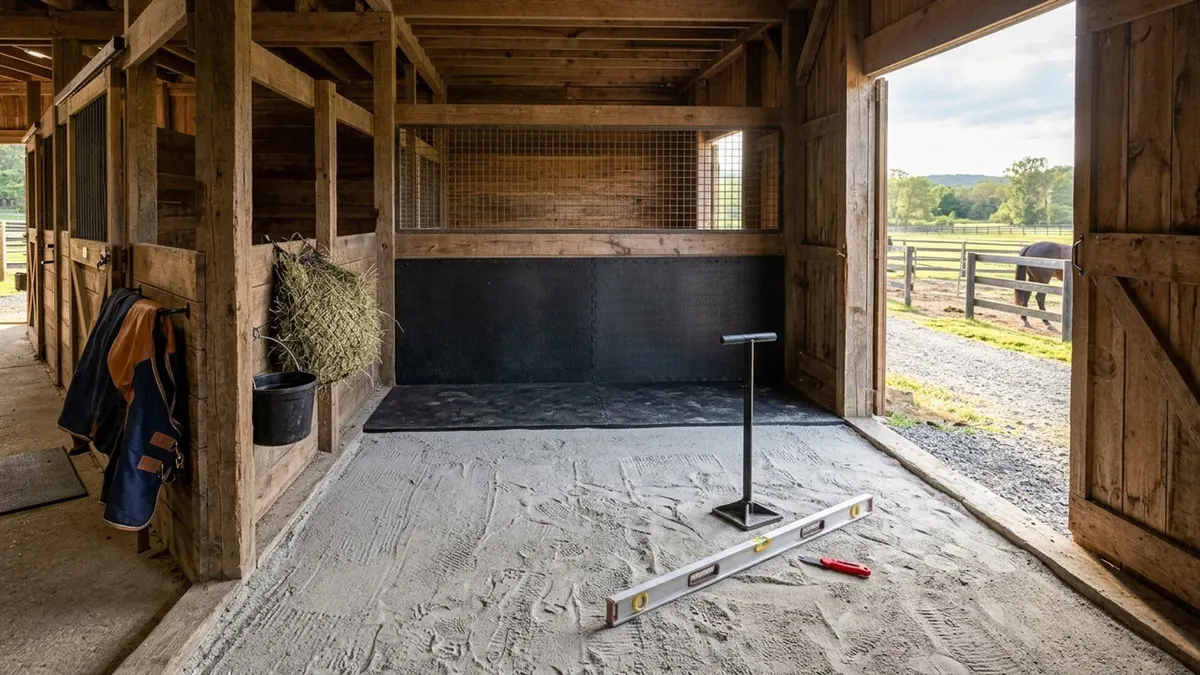
Horse Stall Flooring: The Base, Mats vs Tiles, and Mats per Stall
Build the base Penn State Extension describes, choose mats or tiles, and count exactly how many a 10 x 10, 10 x 12, 12 x 12 or 12 x 14 stall needs.