
Horse Bedding Pellets vs Shavings: Absorbency, Dust and Cost per Week
Horse bedding pellets vs pine shavings: absorbency, dust, waste and the cost per stall per week worked out from extension and maker figures, plus use on mats.
Affiliate disclosure: product links on this page go to Amazon or to the maker's own store. As an Amazon Associate we earn from qualifying purchases, at no extra cost to you; links to makers' own stores earn us nothing. No retailer or brand sees our picks before they are published or has any say in them. How we choose.
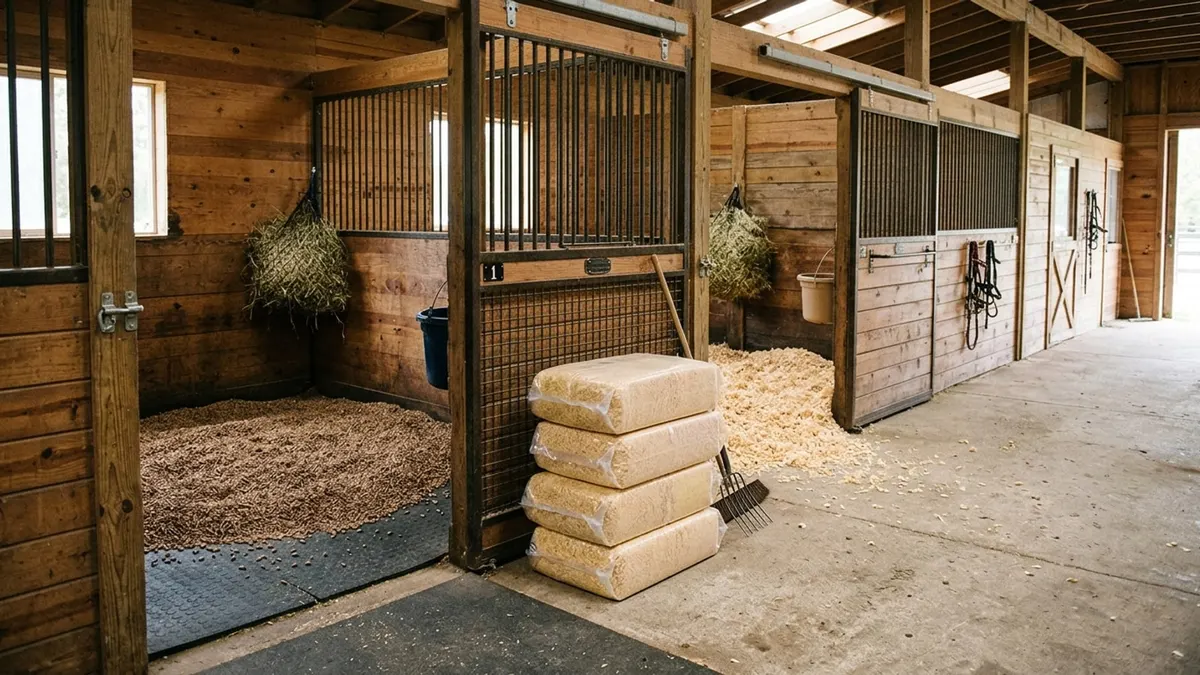
For a matted stall picked daily, horse bedding pellets usually cost less per week and leave less waste to haul than pine shavings. A fact sheet on pellet bedding from the Bay Area Resource Conservation Districts, produced with USDA NRCS, describes a 12 x 12 stall started with 6 to 8 forty-pound bags, wetted with about 4 gallons of water, then topped up with one bag every 5 to 7 days. It equates one bag of pellets to 2 to 2.5 bales of shavings. That makes pellets the cheaper bedding unless a bale of shavings costs less than 40 to 50 percent of a bag of pellets at your feed store.
Shavings win on setup (no water, no waiting for pellets to break down), on a deep, soft bed straight away, and in convenience if your supplier delivers bulk shavings. Neither belongs in a foaling stall: Penn State Extension recommends straw there. The numbers, the dust and the waste are below.
The verdict
- Choose pellets for matted stalls, horses that urinate in one spot, small barns with little room for a manure pile, and anywhere stall waste has to be hauled away or composted.
- Choose shavings if your bale price is under about 40 percent of the pellet bag price, if you want a deep bed without wetting and waiting, or if you buy bulk shavings by the truckload.
- Choose straw for a foaling stall, per Penn State Extension.
Side by side
| Wood pellets | Pine shavings | |
|---|---|---|
| What it is | Wood fiber sorted, compressed, heat-treated and sterilized (RCD fact sheet) | Wood shavings, loose or compressed into bales |
| Starting a 12 x 12 stall | 6 to 8 bags of 40 lb, about 4 gal water (RCD); 5 to 6 bags on mats, 6 to 7 without (Blakeslee) | Spread to depth; no water |
| Topping up | 1 bag every 5 to 7 days (RCD) | About 2 to 2.5 bales for each pellet bag, by the RCD's equivalence |
| Absorbency | Described as three times more absorbent than shavings once fluffed (RCD) | 2.0 lb water per lb (pine); 1.5 lb (hardwood) (Penn State) |
| Stall waste | Users report 40 to 60% less (RCD) | Baseline |
| Dust | Minimal from pure softwood (RCD) | Less than straw (Rutgers) |
| Composting | Breaks down fairly fast (RCD) | Pine breaks down slower than straw (Rutgers) |
| Storage | Plastic bags, shrink-wrapped on pallets, can be stored outdoors (RCD) | Bales or bulk loads |
Cost per stall per week
Prices vary too much by region to quote one, so here is the arithmetic in bags and bales, which you can multiply by your own feed store's prices.
Pellets. After the initial bedding, the RCD fact sheet says one 40 lb bag every 5 to 7 days. Per week that is 7 / 7 = 1.0 bag to 7 / 5 = 1.4 bags, or 40 to 56 lb of pellets. The same sheet gives 50 to 60 bags per horse per year, which is 50 / 52 = 0.96 to 60 / 52 = 1.15 bags a week averaged across the year, starting bags included.
Shavings. The fact sheet equates one bag of pellets to 2 to 2.5 bales of shavings. Applied to the weekly pellet use, that is 1.0 x 2 = 2.0 bales to 1.4 x 2.5 = 3.5 bales a week. As a cross-check, Rutgers' Equine Science Center puts a stalled horse's bedding use at 8 to 15 lb a day, or 56 to 105 lb a week; the pellet figure above, 40 to 56 lb a week, sits below that range, which fits pellets' higher absorbency.
| Bedding | Use per week | Weekly cost |
|---|---|---|
| Pellets | 1.0 to 1.4 bags (40 lb) | 1.0 to 1.4 x your bag price |
| Shavings | 2.0 to 3.5 bales | 2.0 to 3.5 x your bale price |
The break-even follows from the equivalence: if one pellet bag replaces 2 to 2.5 bales, shavings only cost less when a bale is cheaper than 1 / 2.5 = 40 percent to 1 / 2 = 50 percent of a pellet bag. Below 40 percent, shavings win; above 50 percent, pellets win; in between it depends on your horse.
Starting a stall costs more with either. At the RCD's 6 to 8 bags, a pellet stall starts with 240 to 320 lb of pellets. The fact sheet calls this a typical application and says to follow the pellet maker's instructions, so treat the numbers as a starting point and keep a week's tally for your own horse.
Absorbency
Penn State Extension's table of bedding absorbency gives pine shavings 2.0 pounds of water per pound of bedding, pine sawdust 2.5, hardwood shavings and sawdust 1.5 and wheat straw 2.2. Pellets are not in that table. The RCD fact sheet says that once wetted and fluffed, pellets become three times more absorbent than shavings, and that urine soaks into smaller spots that are easier to lift out. Rutgers' fact sheet agrees on the direction, describing pelleted wood products as expanding readily when water is added, absorbent and easy to handle, and adds the general rule that the more absorbent a bedding is, the less of it you use.
Two practical points follow. Pine shavings outperform hardwood shavings on Penn State's numbers, so ask what your shavings are made of. And pellets reach that absorbency only after they are wetted and fluffed, per the RCD sheet, so do not skip the water at setup.
Dust and the horse's airway
Rutgers notes that many owners prefer shavings because they are less dusty than straw, which may mean less respiratory irritation. The RCD fact sheet says pellets made of pure softwood produce minimal fine airborne dust, and that the fluffed bedding does not cling to hair, blankets or clothes the way shavings do. During dry, windy weather it suggests a light misting after cleaning to keep the bedding fluffed.
Whatever you choose, avoid what extension services warn about. Penn State lists black walnut and black cherry wood products, and oat and flax straw, as not recommended for stall bedding, and shavings from a lumber yard can include mixed species, so buy horse bedding from a known supplier. Dust settles on barn fans too; our barn fan guide covers keeping them clean.
Stall waste and the manure pile
Penn State estimates 60 to 70 pounds of manure and soiled bedding removed from each stall every day, about 12 tons a year. The RCD fact sheet reports that pellet users see stall waste fall by 40 to 60 percent, because only the manure and the wet spots come out. On Penn State's estimate of 2.4 cubic feet of stall waste a day, that is roughly 2.4 x 0.4 = 1.0 to 2.4 x 0.6 = 1.4 cubic feet less per stall per day. Smaller loads also mean a smaller muck tub per stall; our muck bucket and cart guide sizes them.
Pellet waste also composts faster, per the fact sheet, because the fine, pre-moistened fibers break down quickly. Rutgers notes that wood products, especially pine, break down more slowly than straw, which matters if you spread or sell compost.
Pellets and shavings on stall mats
Penn State Extension says rubber mats reduce the bedding needed for cushioning. With pellets, one maker, Blakeslee, suggests 5 to 6 bags for a 12 x 12 stall on mats against 6 to 7 without. With shavings, mats mean you can bed shallower and still keep the horse off bare rubber, which can be slippery when wet.
Mats also change the cleaning. A mat does not soak anything up, so the bedding has to hold all the urine; one that absorbs it where it lands, as the RCD sheet describes fluffed pellets doing, keeps the wet spot small. Textured, grooved mats help both; see our stall mat picks.
The fork makes a difference
Picking a pellet stall means lifting manure and wet spots while leaving fine, fluffed bedding behind, so use a plastic fork with many close tines. Shavings sift through the same kind of fork. Straw needs steel. Our manure fork guide matches forks to each bedding.
The foaling stall exception
Penn State Extension recommends straw for foaling stalls and says wood shavings are not advisable there: they raise the risk of respiratory infections from dust, can be a choking or airway hazard for a newborn foal and can get into its eyes. Bed the foaling stall in clean straw and go back to pellets or shavings afterward.
Frequently asked questions
Are pellets or shavings cheaper for horse bedding?
Usually pellets. A Bay Area Resource Conservation Districts fact sheet says one 40 lb bag of pellets replaces 2 to 2.5 bales of shavings, so shavings cost less only when a bale is under 40 to 50 percent of the price of a pellet bag.
How many bags of pellets do I need for a 12 x 12 stall?
To start, 6 to 8 forty-pound bags wetted with about 4 gallons of water, per the RCD fact sheet, or 5 to 6 bags on rubber mats per Blakeslee. After that, about one bag every 5 to 7 days.
Do you have to wet horse bedding pellets?
Most pellet bedding is wetted at setup so it expands into a soft, absorbent layer. The RCD fact sheet describes spraying about 4 gallons over 6 to 8 bags, and Rutgers notes pelleted wood expands readily with water. Follow your brand's bag instructions.
Are pellets less dusty than shavings?
The RCD fact sheet says pellets made of pure softwood produce minimal fine airborne dust, and Rutgers notes shavings are already less dusty than straw. Dust varies by brand, so choose bedding made for horses rather than fuel pellets repackaged as bedding.
Can you use pellets on top of stall mats?
Yes, and mats reduce how much you need. Blakeslee suggests 5 to 6 bags for a 12 x 12 stall on mats against 6 to 7 without, and Penn State Extension notes that mats reduce the bedding needed for cushioning.
What bedding should I use for a foaling stall?
Straw. Penn State Extension recommends straw for foaling stalls and says wood shavings are not advisable, because their dust raises the risk of respiratory infections and they can be a choking hazard for a newborn foal.
Sources
- The Benefits of Wood Pellet Bedding at Horse Facilities, Council of Bay Area Resource Conservation Districts
- Horse Manure Management: Bedding Use (FS537), Rutgers Equine Science Center
- Horse Stable Manure Management, Penn State Extension
- Horse Stable Flooring Materials and Drainage, Penn State Extension
- Foaling Season: Tips for Delivery, Penn State Extension
- Animal Bedding, Blakeslee Pellet Depot
Cover image: Illustration: Barn Gear Review (AI-generated)
Related guides
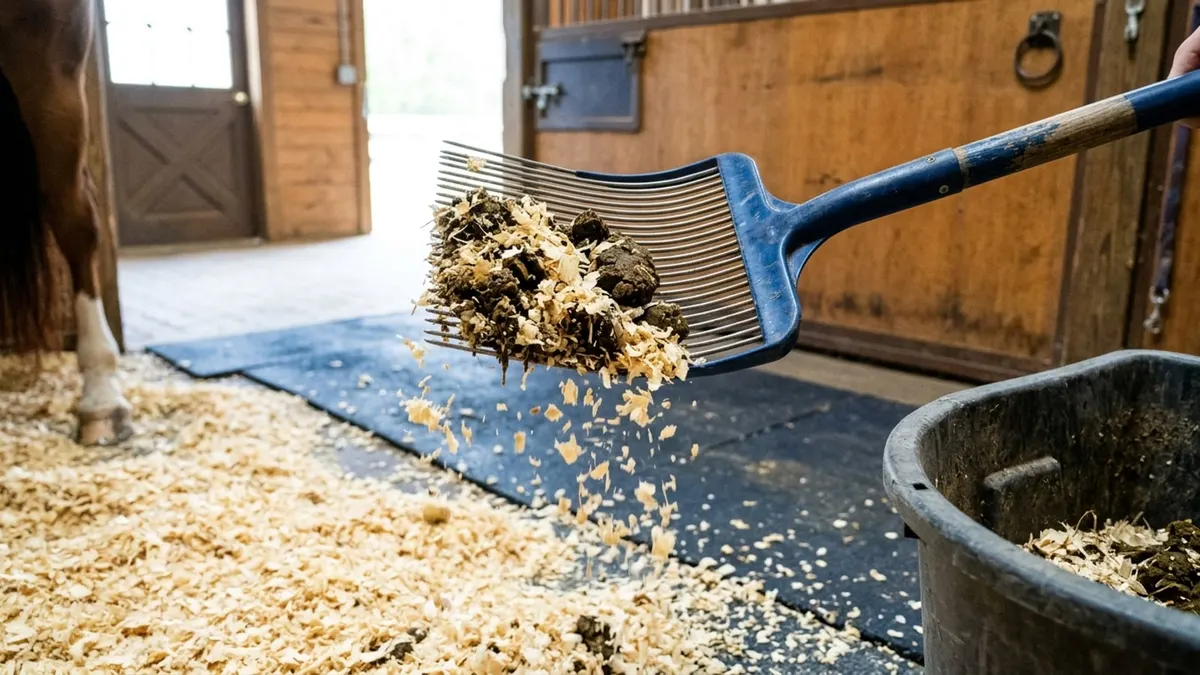
Best Manure Forks for Horse Stalls (2026): Shavings, Pellets and Straw
Four manure forks matched to the bedding you use, compared on head size, tine count and material, handle length and weight.
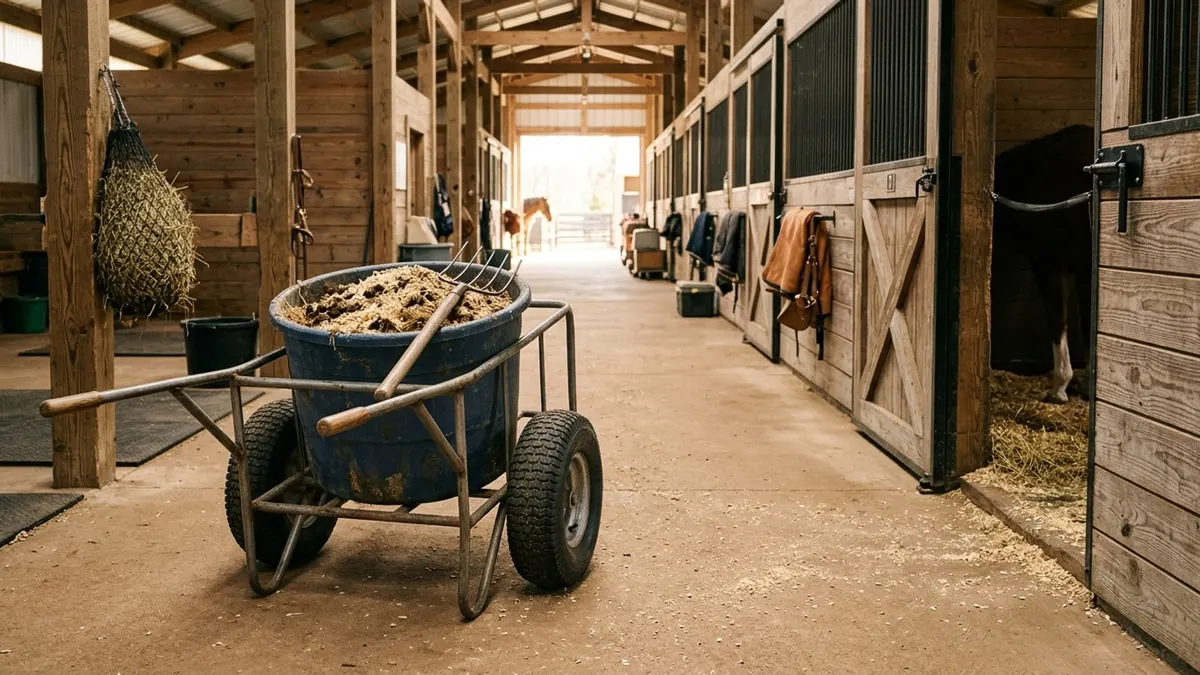
Best Muck Buckets and Muck Carts for Horse Barns (2026)
Muck tubs and carts sized against the 2.4 cubic feet of waste a stall makes each day, with capacity, load rating, wheels and handles compared.
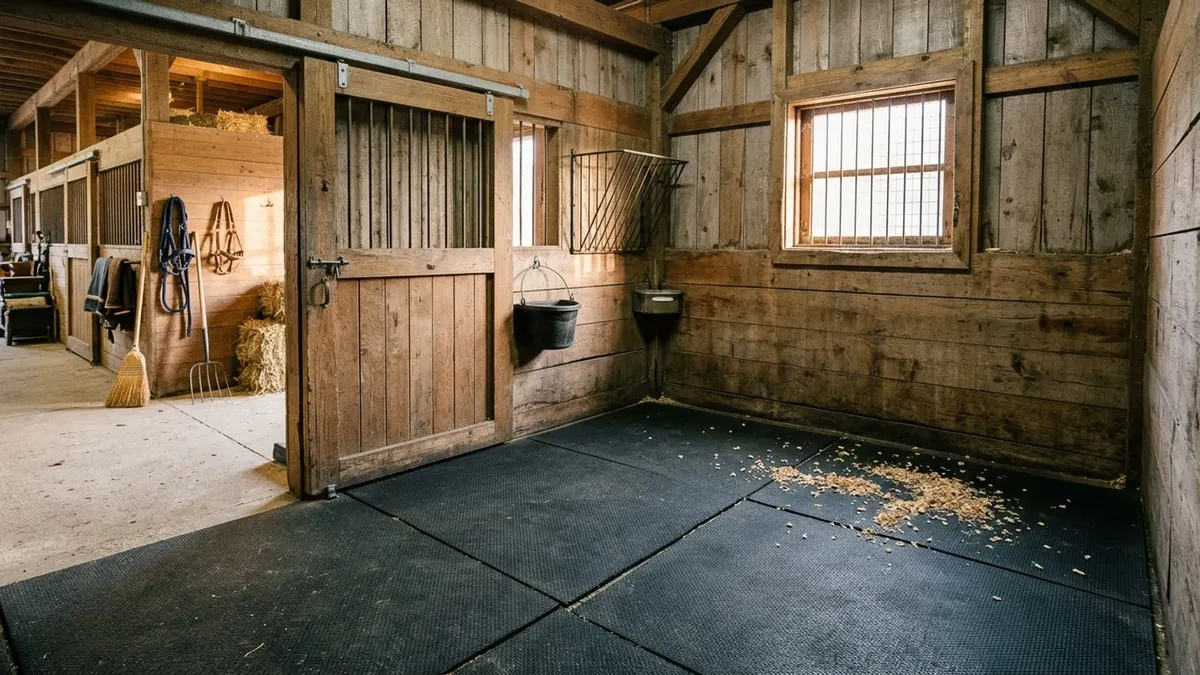
Best Horse Stall Mats of 2026: Thickness, Texture and Cost per Stall
Five stall mats compared on thickness, top and bottom texture, rubber type and what a full stall costs at the makers' list prices.