
Best Hoof Boots for Horses of 2026: Riding, Turnout and Therapy
The best hoof boots for horses in 2026: riding, turnout and therapy boots from Cavallo, EasyCare, Scootboot and Renegade, with each maker's sizing method explained.
Affiliate disclosure: product links on this page go to Amazon or to the maker's own store. As an Amazon Associate we earn from qualifying purchases, at no extra cost to you; links to makers' own stores earn us nothing. No retailer or brand sees our picks before they are published or has any say in them. How we choose.
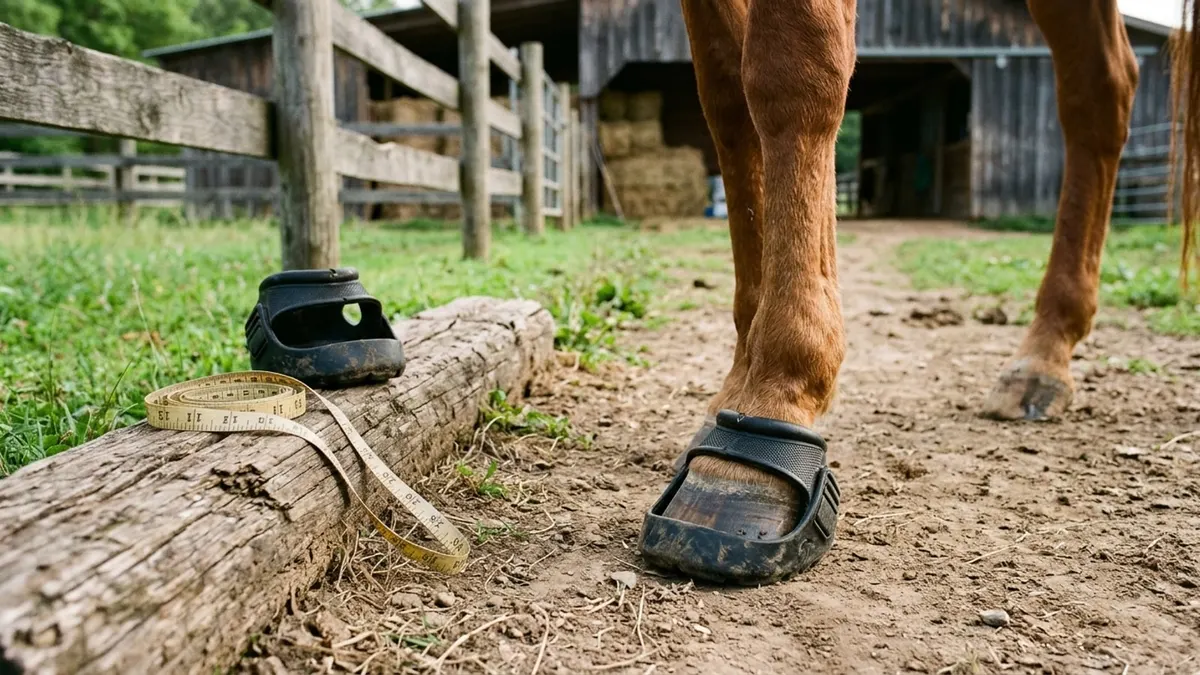
The Cavallo Trek is the hoof boot we would buy first for a barefoot horse that is ridden on trails. Cavallo sells it for both riding and rehab, in sizes 0 to 6 with a regular or slim sole, with replaceable straps and a 180-day guarantee, and it publishes a clear measuring method. For a lower price, Cavallo's ELB uses the same sizing.
If the boot is for a sore or recovering horse rather than for riding, EasyCare's Easyboot Cloud is a therapy boot made for stall rest and light turnout, and EasyCare says plainly it is not for riding. Lameness, abscesses and laminitis are for your veterinarian and farrier to diagnose; a boot is something they may ask you to use, not a treatment you choose alone.
Scootboot and Renegade sell direct, so those two picks link to the makers. We compared boots on each maker's intended use, sizing chart, closure and materials.
Our top picks at a glance
- Cavallo Trek Hoof Boot
Use: Riding, turnout, rehab · Sizing: Sizes 0 to 6, regular or slim sole · Closure: Replaceable Velcro straps · Upper: TPU honeycomb mesh (Pro Mesh)
- Cavallo ELB Entry Level Hoof Boot
Use: Riding (arena, light trail), stall rest · Sizing: Sizes 0 to 6, regular or slim sole · Closure: Replaceable Velcro · Upper: 1680 denier nylon, padded leather heel
- Easyboot Trail
Use: Casual riding, turnout, therapy · Sizing: Regular and narrow sizes by mm chart · Closure: Rear double hook and loop · Upper: Protective shield, padded neoprene band
4. Best therapy boot (not for riding)
Easyboot Cloud Therapy BootUse: Therapy only, stall rest, light turnout · Sizing: EasyCare Cloud chart (Chart 7) · Closure: Fold-down back · Upper: Cordura, padded collar, EVA pad with 2-degree wedge
- Tough 1 Hoof Saver Medicine Boot
Use: Holding medication on the hoof · Sizing: Medium (per the Amazon listing) · Closure: Not stated on the listing · Upper: Triple layered (per the Amazon listing)
6. Best lightweight boot for wet ground
Scootboot ClassicUse: Riding, rehab, barefoot transition · Sizing: Maker sizing service or chart · Closure: No cables or Velcro; pastern strap · Upper: Listed at 250 g; will not get soggy, per Scootboot
7. Best for long-distance riding
Renegade Viper Shield Hoof BootUse: Endurance and trail riding · Sizing: Sizes coded in mm, 120x110 to 150x150 · Closure: Cable system and straps with pivoting heel captivator · Upper: Polyurethane shell
| Pick | Use | Sizing | Closure | Upper | Buy |
|---|---|---|---|---|---|
| Cavallo Trek Hoof BootBest overall | Riding, turnout, rehab | Sizes 0 to 6, regular or slim sole | Replaceable Velcro straps | TPU honeycomb mesh (Pro Mesh) | Amazon |
| Cavallo ELB Entry Level Hoof BootBest budget riding boot | Riding (arena, light trail), stall rest | Sizes 0 to 6, regular or slim sole | Replaceable Velcro | 1680 denier nylon, padded leather heel | Amazon |
| Easyboot TrailBest for easy on and off | Casual riding, turnout, therapy | Regular and narrow sizes by mm chart | Rear double hook and loop | Protective shield, padded neoprene band | Amazon |
| Easyboot Cloud Therapy BootBest therapy boot (not for riding) | Therapy only, stall rest, light turnout | EasyCare Cloud chart (Chart 7) | Fold-down back | Cordura, padded collar, EVA pad with 2-degree wedge | Amazon |
| Tough 1 Hoof Saver Medicine BootBest medicine boot | Holding medication on the hoof | Medium (per the Amazon listing) | Not stated on the listing | Triple layered (per the Amazon listing) | Amazon |
| Scootboot ClassicBest lightweight boot for wet ground | Riding, rehab, barefoot transition | Maker sizing service or chart | No cables or Velcro; pastern strap | Listed at 250 g; will not get soggy, per Scootboot | Scootboot |
| Renegade Viper Shield Hoof BootBest for long-distance riding | Endurance and trail riding | Sizes coded in mm, 120x110 to 150x150 | Cable system and straps with pivoting heel captivator | Polyurethane shell | Renegade Hoof Boots |
Best overall
Cavallo Trek Hoof Boot
A riding and rehab boot with a breathable mesh upper and a published sizing method, for barefoot horses on trails.
- Use
- Riding, turnout, rehab
- Sizing
- Sizes 0 to 6, regular or slim sole
- Closure
- Replaceable Velcro straps
- Upper
- TPU honeycomb mesh (Pro Mesh)
Pros
- Cavallo sells it for trail riding, driving and dressage as well as daily turnout and stall rest
- Regular and slim soles, chosen by comparing hoof width to length
- Replaceable Velcro straps; optional neoprene pastern wraps ($29.95 from Cavallo)
- 180-day quality and workmanship guarantee from a recognized retailer
Cons
- Sold as a single boot at $114.95 from Cavallo (prices change), so a pair of fronts costs twice that
- Cavallo's health claims for rehab come from customer stories, not clinical trials
Cavallo lists the Trek at $114.95 per boot (prices change), in sizes 0 to 6 with a slim or regular sole. The upper is a molded thermoplastic urethane mesh with rustproof hardware, the closure is Velcro straps that can be replaced, and Cavallo sells neoprene pastern wraps in three sizes for $29.95. It guarantees quality and workmanship for 180 days from purchase through a recognized retailer, excluding natural wear and wrong sizing. The listing we link is one size and sole, so order by Cavallo's chart, not by the listing's title.
Sizing is where Cavallo is most useful. Its guide says to measure right after a fresh trim, length from the toe to where the heel buttresses emerge (not the bulbs), width across the widest part, in millimeters or sixteenths of an inch. If width equals length, choose a regular sole; if width is 1/4 inch (6 mm) less than length, choose slim. Cavallo also offers a free sizing check from photos and asks owners not to rely on AI for sizing, which is advice worth passing on.
Cavallo's page lists laminitis, navicular and abscesses among rehab uses. Treat that as a list of situations where your vet or farrier might ask for a boot, not as a reason to skip the call.
Best budget riding boot
Cavallo ELB Entry Level Hoof Boot
Cavallo's lowest-priced boot, in tough nylon with a padded heel, for arena work, light trails and a spare for a lost shoe.
- Use
- Riding (arena, light trail), stall rest
- Sizing
- Sizes 0 to 6, regular or slim sole
- Closure
- Replaceable Velcro
- Upper
- 1680 denier nylon, padded leather heel
Pros
- $84.95 per boot from Cavallo (prices change), $30 less than the Trek
- Cavallo says it can be used barefoot or over metal shoes, so it doubles as a lost-shoe spare
- Same sizing chart and 180-day guarantee as the Trek
Cons
- Nylon upper rather than the Trek's ventilated mesh
- Sold as a single boot
Cavallo calls the ELB its entry level boot and lists it at $84.95 per boot (prices change). The upper is 1680 denier industrial-grade nylon with a padded leather heel bulb, a raised inner rim that Cavallo says relieves pressure on the bars, sole and frog, a drainage outsole and replaceable Velcro. It comes in sizes 0 to 6, slim or regular, with the same 180-day guarantee. The listing we link is one size and sole, so order by Cavallo's chart.
Cavallo lists arena work, light trails, transport, stall rest and a spare for a lost shoe among its uses, and says it can go on a barefoot hoof or over metal shoes. That last point makes it worth keeping one in the trailer even for a shod horse.
Best for easy on and off
Easyboot Trail
A boot that opens all the way for owners who struggle with tight boots, made for casual riding with turnout and therapy use on the side.
- Use
- Casual riding, turnout, therapy
- Sizing
- Regular and narrow sizes by mm chart
- Closure
- Rear double hook and loop
- Upper
- Protective shield, padded neoprene band
Pros
- EasyCare calls it the easiest hoof boot to apply and remove: it opens up completely
- Rear double hook and loop attachment covers the whole hoof wall
- EasyCare says it doubles as a therapy boot and works for extended wear during turnout
Cons
- EasyCare aims it at casual riders, not long or fast rides
- Sold individually
EasyCare describes the Easyboot Trail as the easiest hoof boot in the world to apply and remove, with a tough protective shield, a padded neoprene band and a rear double hook and loop attachment, an aggressive tread and a reversible, replaceable rear strap. It is sold individually, and EasyCare recommends its gaiters as an option. The listing we link is one size, so order by EasyCare's chart.
Its size chart (Chart 4, shared with the Trail Original and Old Mac's G2) comes in regular and narrow widths, both in millimeters. EasyCare tells owners to measure in millimeters when the chart is in millimeters, because converting from inches makes the fit inaccurate, and to measure as soon as possible after a fresh trim.
Best therapy boot (not for riding)
Easyboot Cloud Therapy Boot
A cushioned therapy boot with a wedged EVA pad for stall rest, trailering and light turnout, used on a vet's or farrier's advice.
- Use
- Therapy only, stall rest, light turnout
- Sizing
- EasyCare Cloud chart (Chart 7)
- Closure
- Fold-down back
- Upper
- Cordura, padded collar, EVA pad with 2-degree wedge
Pros
- EVA comfort pad with a 2-degree wedge is included, per EasyCare
- Padded collar and three air vents; rounded seams and edges
- EasyCare says it eases stalling on hard surfaces and trailering
Cons
- EasyCare says it is not for riding or exercise
- EasyCare says not to leave it on longer than 12 hours at a time
EasyCare describes the Easyboot Cloud as a therapy hoof boot for horses with thin soles, abscesses, founder or laminitis, and for recovery after work, shipping and standing on hard surfaces. It has a Cordura upper with rounded seams, a padded collar, three air vents and an EVA comfort pad with a 2-degree wedge, and a back that folds down for fitting. It is sold individually, and the listing we link is one size, so order by EasyCare's chart.
Two of EasyCare's own lines matter more than the rest: the Cloud is not intended for riding or exercise, and it should not be worn for more than 12 hours at a time so the hoof gets air. EasyCare also says that for any hoof or leg injury you should consult your veterinarian or hoof care professional for diagnosis and treatment. Buy it when they recommend it. For a horse on stall rest, good footing helps too; see our stall mat guide.
Best medicine boot
Tough 1 Hoof Saver Medicine Boot
A simple boot that holds a poultice or medication on the hoof in place of a wrap, when your vet asks for one.
- Use
- Holding medication on the hoof
- Sizing
- Medium (per the Amazon listing)
- Closure
- Not stated on the listing
- Upper
- Triple layered (per the Amazon listing)
Pros
- Holds medication on the foot in place of a wrap (per the Amazon listing)
- Small enough to keep in the barn first aid kit
Cons
- No maker page we could find; everything here is from the listing
- Not a riding or turnout boot
Tough 1's Hoof Saver is a medicine boot: the listing says it holds medication against the foot, can replace a wrap and is triple layered, and this size is a medium (per the Amazon listing). We could not find a maker page for it, so treat the listing as the only description.
Keep one in the barn first aid kit for the day your vet tells you to poultice or soak a hoof. Use it for as long and in the way your vet directs, and check the skin around the coronary band each time you take it off.
Best lightweight boot for wet ground
Scootboot Classic
A farrier-designed boot with no cables or Velcro that will not get soggy in mud, for barefoot horses ridden in wet country.
- Use
- Riding, rehab, barefoot transition
- Sizing
- Maker sizing service or chart
- Closure
- No cables or Velcro; pastern strap
- Upper
- Listed at 250 g; will not get soggy, per Scootboot
Pros
- Scootboot lists a weight of only 250 g and says the boot will not get soggy or heavy in mud and water
- Held by parts of the hoof that do not grow, so Scootboot says no adjustment is needed through a trim cycle
- A pair includes four pastern straps, two trail gaiters and spare parts
Cons
- Scootboot lists the pair at $273.00 (prices change)
- Scootboot says the Classic is not guaranteed to stay on some hoof shapes and asks for photos first
Scootboot says the Classic was designed by a farrier for barefoot horses, for all riding disciplines and as a rehab and transition boot. Its page lists a weight of 250 g, no cables or Velcro, drainage and ventilation, and says the boot will not get soggy, heavy or wet in muddy terrain. Scootboot lists a pair at $273.00 (prices change), with four pastern straps, two trail gaiters and spare front straps and hooks included.
Scootboot's sizing advice: measure each hoof within two weeks of a barefoot trim and use its free sizing service, which comes with free exchanges. It is candid that some hoof shapes do not suit the Classic, so send the photos before you order.
Best for long-distance riding
Renegade Viper Shield Hoof Boot
An endurance-bred boot with a pivoting heel captivator and tough polyurethane shell, for riders who log real miles barefoot.
- Use
- Endurance and trail riding
- Sizing
- Sizes coded in mm, 120x110 to 150x150
- Closure
- Cable system and straps with pivoting heel captivator
- Upper
- Polyurethane shell
Pros
- Pivoting heel captivator and cable system that Renegade says are competition-proven
- About 15 percent lighter than Renegade's Classic, per Renegade
- Renegade's sizing team reviews hoof photos and offers a free size swap if it sized your boots
Cons
- Renegade asks for a natural trim with a mustang roll; square, sharp hoof edges can make the boot unstable
- More parts to learn than a Velcro boot
Renegade says the Viper was developed over 20 years for mileage and endurance, with a pivoting heel captivator, a military-grade cabling system, durable straps and an ultra-durable polyurethane shell, and that it weighs around 15 percent less than its Classic boot. Sizes are given as millimeter codes from 120x110 to 150x150.
Renegade's fitting advice is different from the others: measure right after a natural trim with a low heel, short toe and a mustang roll (a rounded edge to the hoof wall), and do not fit the boot tightly, because the heel captivator holds it on and a boot that is snug just after a trim can get too tight as the hoof grows. Ask your farrier about the roll before you measure.
How we chose
A hoof boot has one job at a time: protect a bare hoof while riding, protect it during turnout, or cushion a sore hoof while it recovers. We sorted boots by the job each maker says it is for, then compared sizing methods, closures and materials from the makers' own pages and size charts.
Riding, turnout or therapy
| Job | What the maker says to look for | Picks |
|---|---|---|
| Riding | Secure fit that does not twist; traction; fits through a trim cycle | Cavallo Trek, Cavallo ELB, Scootboot Classic, Renegade Viper |
| Turnout | Comfort for long wear; drainage | Cavallo Trek, Easyboot Trail |
| Therapy | Cushioning pad; not for riding; time limits | Easyboot Cloud |
| Medicine or soaking | Holds a poultice in place as the vet directs | Tough 1 Hoof Saver |
How to measure for hoof boots
Every maker here sizes from the bottom of the hoof, and every one says to measure after a trim. The common method, from Cavallo's and EasyCare's guides:
- Measure right after a fresh trim. Scootboot allows up to two weeks after a barefoot trim; Renegade wants a natural trim with a mustang roll.
- Clean the hoof and stand the horse on flat, clean ground.
- Width: across the bottom of the hoof at the widest point.
- Length: from the toe to the buttress line, the last weight-bearing point of the heel where the hoof wall ends. Do not include the heel bulbs.
- Measure each hoof separately, in the units the size chart uses. EasyCare says converting inches to millimeters makes the fit inaccurate.
- Use that model's own chart. EasyCare notes that each of its boots has a unique size chart.
When length and width disagree
EasyCare says to choose the larger size if length and width fall in different sizes, and that a model is not recommended if they are more than one size apart. Cavallo handles it with two soles: regular if width equals length, slim if width is 1/4 inch (6 mm) less, and a call to its customer service if width is two or more sizes narrower.
Here is part of EasyCare's chart for the Easyboot Trail, to show how a narrow hoof changes the size:
| Size | Regular width (mm) | Narrow width (mm) | Length, both (mm) |
|---|---|---|---|
| 0 | 100 to 110 | 90 to 100 | 105 to 115 |
| 1 | 110 to 120 | 100 to 110 | 115 to 125 |
| 2 | 120 to 130 | 110 to 120 | 125 to 135 |
| 3 | 130 to 140 | 120 to 130 | 135 to 145 |
| 4 | 140 to 150 | 130 to 140 | 145 to 155 |
Source: EasyCare size charts, Chart 4 (Old Mac's G2, Easyboot Trail and Trail Original).
Checking the fit
EasyCare says a boot should be snug before you tighten it, a close fit around the hoof wall after, and should not turn or twist. Renegade, whose heel captivator holds the boot on, says the opposite about the shell: do not fit it tightly, because the hoof grows between trims. Follow your boot's own maker. With any boot, check the heel bulbs and pastern for rubbing every time it comes off, which fits naturally into picking out the feet with the hoof pick in your grooming kit.
When the vet and farrier come first
The American Association of Equine Practitioners says it is important to recognize the signs of laminitis and seek veterinary help immediately. Several makers here list laminitis, abscesses or navicular among the conditions their boots may help with, and EasyCare says to consult your veterinarian or hoof care professional for any hoof or leg injury. Use a therapy or medicine boot as part of the plan they set, not instead of one.
Footing matters for a horse in therapy boots too. Our stall flooring guide covers what goes under stall mats.
What to skip
- Guessing the size from the horse's breed or shoe size. Measure each hoof after a trim and use that model's chart.
- Riding in a therapy boot. EasyCare says the Cloud is not for riding or exercise.
- Leaving boots on around the clock. EasyCare limits the Cloud to 12 hours at a time; follow each maker's turnout guidance.
- Booting a lame horse without a diagnosis. Call the vet first.
Frequently asked questions
How do I measure my horse for hoof boots?
Right after a fresh trim, measure the bottom of each hoof: width across the widest point, and length from the toe to the buttress line at the heel, leaving out the heel bulbs. Then compare both numbers with that boot model's own size chart, in the units it uses.
What if my horse's hoof length and width are different sizes?
EasyCare says to pick the larger size, and that a model is not recommended if the two are more than one size apart. Cavallo offers a slim sole for hooves whose width is about 1/4 inch (6 mm) less than their length.
Can a horse wear hoof boots in turnout?
Some boots are made for it. EasyCare says the Easyboot Trail works for extended wear during turnout, and Cavallo lists daily turnout for the Trek. EasyCare's Cloud therapy boot should not be worn longer than 12 hours at a time. Check the legs for rubbing whenever the boots come off.
Can you ride in therapy hoof boots?
Not in the ones built only for therapy. EasyCare says the Easyboot Cloud is not intended for riding or exercise. Riding boots like the Cavallo Trek and Easyboot Trail can double for some therapy use, but a therapy-only boot should stay a therapy boot.
Do hoof boots help a horse with laminitis?
That is a question for your veterinarian. The AAEP says to seek veterinary help immediately if you suspect laminitis. Some makers sell boots for laminitic horses, and your vet or farrier may recommend one as part of treatment, but a boot is not a treatment on its own.
Can hoof boots be used over horseshoes?
Some can. Cavallo says its ELB boot can be used on a barefoot hoof or over metal shoes, which makes it a handy spare for a lost shoe. Most riding boots are sized for bare hooves, so check the maker's page first.
When should I measure for hoof boots?
Right after a trim. Cavallo and EasyCare both say to measure after a fresh trim, Scootboot allows up to two weeks after a barefoot trim, and Renegade wants a natural trim with a mustang roll before you measure.
Sources
- Cavallo Hoof Boots Size Chart and How to Measure, Cavallo
- Trek Hoof Boot, Cavallo
- ELB Entry Level Hoof Boot, Cavallo
- Easyboot and EasyShoe Size Charts, EasyCare
- Easyboot Trail, EasyCare
- Easyboot Cloud, EasyCare
- Scootboot Classic, Scootboot
- Renegade Viper Shield Hoof Boot, Renegade Hoof Boots
- Renegade Hoof Boot Sizing, Renegade Hoof Boots
- Learn to Recognize the Signs of Laminitis, American Association of Equine Practitioners
Cover image: Illustration: Barn Gear Review (AI-generated)
Related guides
Best Horse Clippers of 2026: Body Clippers, Cordless and Trimmers
Six clippers for horse owners who clip at home, from Andis's T-84 body clipper to two cordless options and a budget trimmer, with the blade sizes extension guides use for each part of the horse.
Best Horse Grooming Kits of 2026
Four grooming kits checked tool by tool against the Kentucky 4-H list, with the order extension guides use to groom and what each kit is missing.
Best Automatic Horse Waterers (2026): Heated, Frost-Free and Float Valve
Four automatic waterers, from a stall-wall Nelson to a no-electricity Bar-Bar-A, compared on heater watts, horses served, installation and what each needs from a plumber and electrician.