
Best Automatic Horse Waterers (2026): Heated, Frost-Free and Float Valve
The best automatic horse waterer for stalls and paddocks in 2026: heated Nelson and Ritchie units, a frost-free Bar-Bar-A and a budget float waterer, compared.
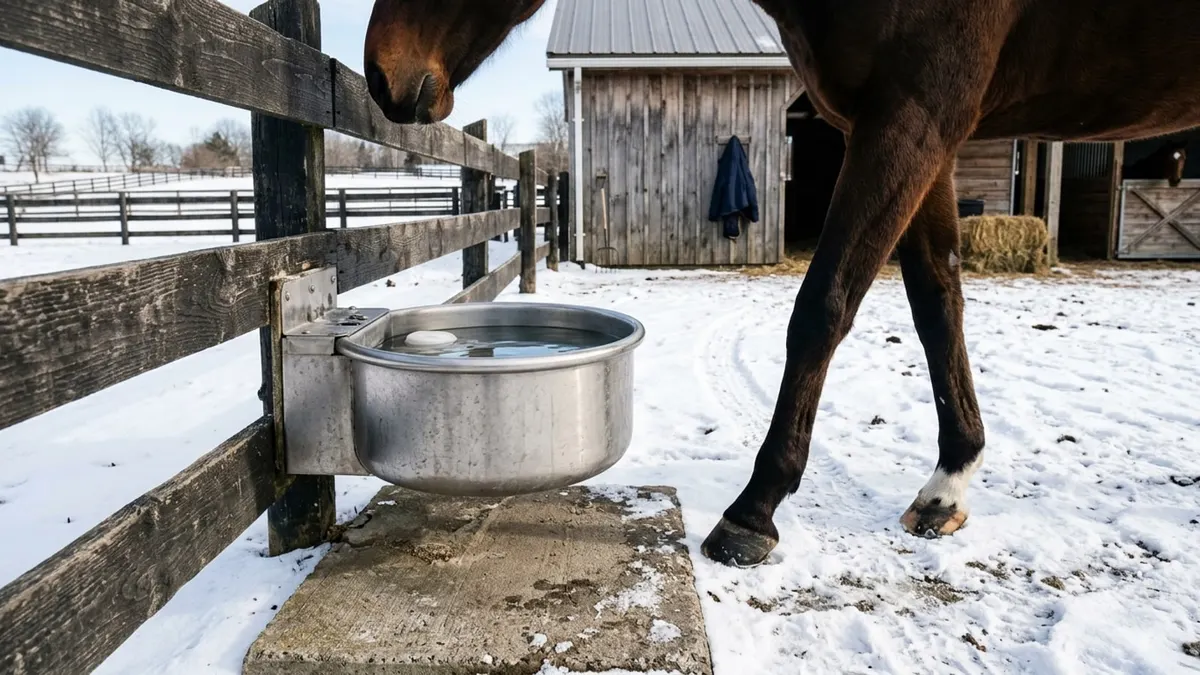
Affiliate disclosure: product links on this page go to Amazon or to the maker's own store. As an Amazon Associate we earn from qualifying purchases, at no extra cost to you; links to makers' own stores earn us nothing. No retailer or brand sees our picks before they are published or has any say in them. How we choose.
For a barn with power and a water line, the automatic horse waterer we would choose is the Nelson 700 Series. It mounts on a concrete pad, in a concrete pipe or on a stall wall, has a removable stainless steel bowl you can take out to clean, and its optional thermostatic heater (250 or 325 watts, per Nelson's manual) keeps the bowl open in a hard winter. Nelson guarantees the waterer for one year and the heater and thermostat for three.
For a herd in a paddock, the Ritchie EcoFount 1 is rated by Ritchie for 30 horses, and if you have no power at the paddock, the Bar-Bar-A horse drinker works like a frost-free hydrant with no electricity at all. These three are sold through their makers and dealers, so the links go to the makers. For a heated barn or warm months, the Little Giant 88ESW is a simple float waterer. We compared heater watts, horses served, installation and warranty from the makers' pages and manuals.
Our top picks at a glance
- Nelson 700 Series Automatic Horse Waterer
Type: Heated, valve opens as the bowl tilts · Heater: Optional, 250 W (730) or 325 W (760) · Serves: Not stated per model by Nelson · Warranty: 1 year; heater and thermostat 3 years
- Ritchie EcoFount 1 Waterer
Type: Heated, insulated poly fountain · Heater: 173 W (1.4 A at 120 V) · Serves: 30 horses (Ritchie's rating) · Warranty: 10 years limited on poly waterers
- Bar-Bar-A Automatic Horse Drinker
Type: Frost-free, paddle operated · Heater: None (no electricity) · Serves: Not stated by Bar-Bar-A · Warranty: See Bar-Bar-A's warranty page
4. Best budget unheated waterer
Little Giant 88ESW Automatic Stock WatererType: Self-filling bowl, unheated · Heater: None · Serves: Not stated in the listing · Warranty: Not stated in the listing
| Pick | Type | Heater | Serves | Warranty | Buy |
|---|---|---|---|---|---|
| Nelson 700 Series Automatic Horse WatererBest overall | Heated, valve opens as the bowl tilts | Optional, 250 W (730) or 325 W (760) | Not stated per model by Nelson | 1 year; heater and thermostat 3 years | Nelson |
| Ritchie EcoFount 1 WatererBest for a herd | Heated, insulated poly fountain | 173 W (1.4 A at 120 V) | 30 horses (Ritchie's rating) | 10 years limited on poly waterers | Ritchie |
| Bar-Bar-A Automatic Horse DrinkerBest with no electricity | Frost-free, paddle operated | None (no electricity) | Not stated by Bar-Bar-A | See Bar-Bar-A's warranty page | Bar-Bar-A |
| Little Giant 88ESW Automatic Stock WatererBest budget unheated waterer | Self-filling bowl, unheated | None | Not stated in the listing | Not stated in the listing | Amazon |
Best overall
Nelson 700 Series Automatic Horse Waterer
A heated stainless or aluminum waterer that mounts in a stall or on a pad, with a bowl that lifts out for cleaning; the one to plumb in once and keep.
- Type
- Heated, valve opens as the bowl tilts
- Heater
- Optional, 250 W (730) or 325 W (760)
- Serves
- Not stated per model by Nelson
- Warranty
- 1 year; heater and thermostat 3 years
Pros
- Eight models with stainless steel or aluminum housings and three mounting options: concrete pad, concrete pipe or stall wall
- Removable stainless drinking bowl, so you can empty and clean it away from the waterer
- Optional water consumption meter that works with all 700 Series waterers, so you can still see how much a horse drinks
Cons
- Nelson's manual calls for a licensed electrician, a dedicated circuit and protection of the water line below frost depth
- Sold direct by Nelson by phone and through dealers; no published prices
The 700 Series works on a balance: the drinking bowl sits on one end of a beam with a weight on the other, and as a horse drinks, the beam tilts and opens the valve to refill the bowl (per Nelson's manual). Nelson lists eight models in stainless steel or aircraft-grade aluminum, mounted on a concrete pad, in concrete pipe or directly on a stall wall, with an optional thermostatically controlled heater. The manual rates the heater at 250 watts (2.1 amps) for model 730 and 325 watts (2.7 amps) for model 760, at 120 volts.
Installation is where the work is. The manual says to use a licensed electrician, who decides the wire, grounding and fusing; that waterers must be on dedicated circuits; that the valve operates between 20 and 80 psi, best at 40 to 60; and that in freezing climates the water line should not come through the back of a wall-mount unit unless the wall backs onto a heated room or a second heated waterer. To find your frost depth, Nelson points you to a concrete contractor, a well driller or your Agricultural Extension Service.
One downside of any automatic waterer is that you no longer see how much a horse drinks. Nelson sells a water consumption meter that fits all 700 Series units; it is worth adding if you want to keep an eye on intake.
Best for a herd
Ritchie EcoFount 1 Waterer
An insulated poly fountain Ritchie rates for 30 horses, with a 173 watt heater and a 10 year limited warranty on the poly body.
- Type
- Heated, insulated poly fountain
- Heater
- 173 W (1.4 A at 120 V)
- Serves
- 30 horses (Ritchie's rating)
- Warranty
- 10 years limited on poly waterers
Pros
- Ritchie rates it for 30 horses from a 3.5 gallon trough
- Fully insulated casing, and only 1.4 amps for the heater
- 20 inch drinking height, 22 by 18 inch footprint, 41 lb, per Ritchie
Cons
- No published price: Ritchie asks buyers to contact it or a dealer for availability and pricing
- Built for herds; more waterer than a one-horse barn needs
Ritchie lists the EcoFount 1 (part 18430) with a 3.5 gallon capacity, a rated herd of 30 horses (or 30 beef cattle, 15 dairy), a 173 watt heater drawing 1.4 amps at 120 volts, a fully insulated casing and a 20 inch drinking height. It measures 22 by 18 by 20 inches and weighs 41 lb, and Ritchie's poly waterers carry a 10 year limited warranty.
The small trough is the point. Manitoba Agriculture's guide to winter watering notes that the larger the open water area, the harder it is to keep ice-free, and Ritchie keeps the open water to a 3.5 gallon trough with a 173 watt heater. Ritchie gives availability and pricing on request, so ask a dealer.
Best with no electricity
Bar-Bar-A Automatic Horse Drinker
A paddle-operated drinker that works like a frost-free hydrant, for paddocks with a water line but no power.
- Type
- Frost-free, paddle operated
- Heater
- None (no electricity)
- Serves
- Not stated by Bar-Bar-A
- Warranty
- See Bar-Bar-A's warranty page
Pros
- No electricity, so no heater to fail and no power line to run to the paddock
- The valve sits below the frost line and the water drains back after each drink, per Bar-Bar-A
- Bar-Bar-A lists it at $559 to $659 depending on model (prices change)
Cons
- The horse has to learn to press the paddle
- Needs a well dug below your frost line and a buried water line; Bar-Bar-A has an installer locator for that reason
Bar-Bar-A says its horse drinkers "are engineered to function like frost-free hydrants": the horse presses a paddle, water rises from a valve housed below the frost line, and it drains back down when the horse lets go, so there is no standing water to freeze. Bar-Bar-A lists the horse, donkey and mule drinker at $559 to $659 depending on the model, and prices change. In its own words, since the drinkers don't use electricity, "there's no need to worry about your animals being shocked."
The installation is the real cost: a deep well below the frost line and a buried supply line. Bar-Bar-A runs an installer locator, which tells you this is not a weekend job for most owners. It is the pick for a paddock far from the barn's power, or for owners who want no heater in the water at all.
Best budget unheated waterer
Little Giant 88ESW Automatic Stock Waterer
A small epoxy-coated steel float waterer for a heated barn, a run-in in mild climates or summer pasture; it has no heater.
- Type
- Self-filling bowl, unheated
- Heater
- None
- Serves
- Not stated in the listing
- Warranty
- Not stated in the listing
Pros
- Connects to 1/2 inch pipe, flex hose or a garden hose (per the Amazon listing)
- Can be mounted at any height to suit the animal (per the Amazon listing)
Cons
- No heater: it will freeze in a cold barn or paddock
- A small bowl, so a group of horses will empty it faster than it refills
Little Giant's 88ESW is a galvanized steel bowl with a nontoxic black epoxy coating that dispenses water automatically based on the bowl's water level, and connects to a 1/2 inch pipe, flex hose or garden hose (per the Amazon listing). It is the low-cost way to stop filling buckets in a heated barn or in the months without frost.
It has no heater, so treat it as a three-season waterer anywhere water freezes. In winter, pair it with a heated bucket or move the horses to a heated waterer; see our heated bucket guide.
How we chose
An automatic waterer is part plumbing, part electrical, part horse management. We compared the type (heated bowl, insulated fountain, frost-free paddle, unheated float), the heater's watts and amps, how many horses the maker rates it for, how it mounts, what the maker's manual asks of your plumber and electrician, and the warranty. Nelson, Ritchie and Bar-Bar-A sell through dealers, so we link to the makers.
Why an automatic waterer
The University of Kentucky's article for the national Extension horse network puts a mature idle horse of about 1,100 lb at 10 to 12 gallons of water a day, doubling in heat or hard work, and says automatic water bowls are useful because they provide a constant supply and cut labor. It also gives 45°F to 65°F as the range drinking water should fall in. A heated waterer refills with water from underground and keeps the bowl open, so the horse is not left with a frozen bucket at night.
Heated, frost-free or float valve
| Type | Needs power? | Winter use | Example |
|---|---|---|---|
| Heated bowl or fountain | Yes, on a dedicated circuit (Nelson) | Yes, with a frost-protected supply line | Nelson 700, Ritchie EcoFount 1 |
| Frost-free paddle | No | Yes, valve below the frost line | Bar-Bar-A |
| Self-filling bowl, unheated | No | Only where water does not freeze | Little Giant 88ESW |
What to look for
Heater watts and the circuit
Heated waterers draw little power next to a tank heater: 173 watts for the Ritchie, 250 or 325 watts for the Nelson. Nelson's manual still requires dedicated circuits and a licensed electrician to decide the wire size, grounding and fusing, and says to turn the power off after the heating season.
The supply line and frost depth
The supply line matters as much as the bowl. Nelson relies on ground heat rising through a deep hole beneath the waterer, plus its insulation sleeve, to keep the riser from freezing, and points you to your extension service for local frost depth. Manitoba Agriculture's guide to winter watering says where the supply line passes up through the frost line is the most likely place for a system to freeze.
Size of the open water
Manitoba also notes that the larger the open water area, the harder it is to keep ice-free. That favors small bowls and fountains over open troughs.
Seeing what a horse drinks
With buckets you can see how much is gone. With an automatic waterer you cannot, unless you add a meter; Nelson sells one for all its 700 Series units. Watch drinking and manure closely for the first weeks after a switch.
Mounting height and cleaning
Nelson's manual says to mount the waterer high enough that horses reach a little to drink, which keeps manure out of the bowl. A removable bowl, like Nelson's, makes the weekly scrub easier.
What to skip
- Cattle-sized fountains for one or two horses in a hard climate, unless the maker rates them for low use. Manitoba warns that some energy-free designs need enough animals drinking to replace the water every day or the water cools and freezes.
- Running the water line through an outside wall to a wall-mount waterer in a freezing climate, which Nelson says almost never works unless the wall backs onto a heated room or a second heated unit.
- DIY wiring. Every heated unit here goes on a circuit an electrician installs.
- An unheated float bowl as the only winter water.
Still on buckets or troughs? See our guides to the best horse water troughs and trough heaters.
Frequently asked questions
Are automatic waterers good for horses?
The University of Kentucky's extension article says automatic water bowls are useful because they provide a constant supply of water and cut labor. The trade-off is that you cannot see how much a horse drinks; Nelson sells a water meter for its 700 Series for that reason.
How much power does a heated horse waterer use?
Less than a tank heater. Ritchie lists 173 watts (1.4 amps at 120 volts) for the EcoFount 1, and Nelson's manual gives 250 or 325 watt heaters for its 700 Series. Nelson still requires a dedicated circuit installed by a licensed electrician.
Do frost-free horse waterers need electricity?
Not the paddle type. Bar-Bar-A says its drinkers work like frost-free hydrants: the valve sits below the frost line, the horse presses a paddle to raise water, and it drains back when released, with no electricity. It needs a well dug below your local frost depth.
How many horses can share one automatic waterer?
It depends on the unit. Ritchie rates its EcoFount 1 for 30 horses. Nelson and Bar-Bar-A do not give a per-model number on the pages we read, so ask the maker. A small unheated float bowl suits one or two horses.
Why does an automatic waterer freeze?
Usually in the supply line. Manitoba Agriculture says the point where the line passes up through the frost line is the most likely place to freeze, and Nelson relies on ground heat from a deep hole under the waterer plus insulation to protect the riser. Ask your extension office for your frost depth.
Sources
- Horse Waterers: 700 Series, Nelson Manufacturing
- Nelson Series 700 Waterers Installation Instructions, Nelson Manufacturing (hosted by System Equine)
- EcoFount 1, Ritchie Industries
- Automatic Horse Drinker (Horse/Donkey/Mule/Miniatures), Bar-Bar-A
- Bar Bar A automatic horse drinkers and livestock waterers (home page), Bar-Bar-A
- Horses and Water, University of Kentucky, Extension Horses
- Remote Winter Watering Systems for Beef Cattle, Manitoba Agriculture
Cover image: Illustration: Barn Gear Review (AI-generated)
Related guides
Best Heated Water Buckets and Bucket Heaters for Horses (2026)
Two heated buckets and two bucket heaters for winter stalls, by watts, gallons and thermostat, with how many buckets a horse needs a day and what to plug them into.
Best Horse Trough Heaters (2026): Floating, Sinking and Drain-Plug De-Icers
Four de-icers for horse troughs from K&H, Farm Innovators and Rubbermaid, sized to your tank, plus what solar trough heaters really are and how to wire a de-icer the way makers ask.
Best Horse Water Troughs (2026): Poly, Galvanized and Rubbermaid Stock Tanks
Five horse troughs from 50 to 300 gallons, with a table of how many days each lasts per horse and what to know about drains, de-icers and poly against galvanized.