
Best Horse Trough Heaters (2026): Floating, Sinking and Drain-Plug De-Icers
The best horse trough heater for each tank: floating, sinking and drain-plug de-icers sized by gallons and watts, with the makers' GFCI and cord rules.
Affiliate disclosure: product links on this page go to Amazon or to the maker's own store. As an Amazon Associate we earn from qualifying purchases, at no extra cost to you; links to makers' own stores earn us nothing. No retailer or brand sees our picks before they are published or has any say in them. How we choose.
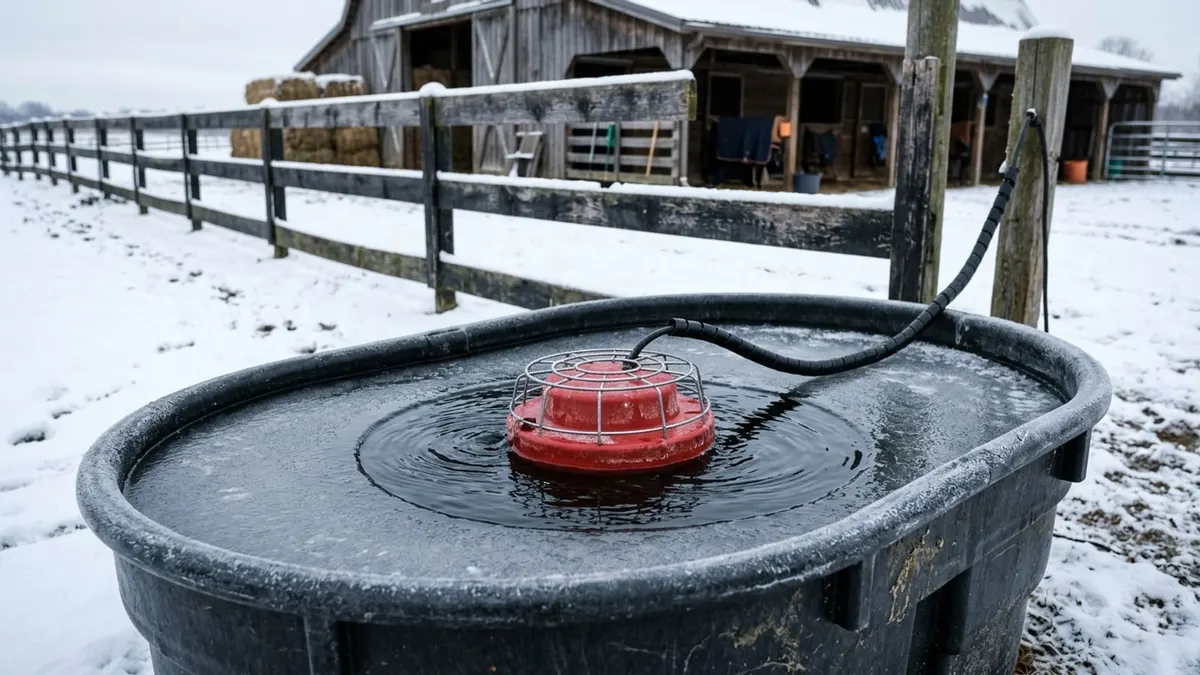
The horse trough heater we would buy for a typical 100 to 150 gallon trough is the K&H Ultimate Stock Tank Deicer (1500 W). It floats, or sinks to the bottom with the float ring removed, comes in a full protective cage with a cord clip, is listed for plastic, rubber and metal tanks, and switches itself on and off (per the Amazon listing). It also comes in 1000 and 500 watt versions for smaller tanks and milder winters.
If you want the heater on the bottom of the tank, out of the way of curious horses, the Farm Innovators H-418C converts from floating to sinking and carries a three year guarantee. For a Rubbermaid tank, Rubbermaid's own drain-plug de-icer installs through the drain hole. This guide is written for horse troughs: sizes from 50 to 300 gallons, horses that play with anything in the water, and barns where the outlet may be a long way from the paddock. Specs come from the makers' pages and listings.
Our top picks at a glance
- K&H Ultimate Stock Tank Deicer (1500 W)
Type: Floating or submersible, full cage · Watts: 1500 W · Tank size: Pick by K&H's zone chart; 100 to 300 gal per API's general guidance · Warranty: 2 years limited (per the Amazon listing)
- Farm Innovators H-418C Convertible Tank De-Icer (1250 W)
Type: Convertible: floating or submergible · Watts: 1250 W · Tank size: Not listed on the maker's page · Warranty: 3 years
- K&H Ultimate Stock Tank Deicer (500 W)
Type: Floating or submersible, full cage · Watts: 500 W · Tank size: Under 70 gal per API's general guidance · Warranty: 2 years limited (per the Amazon listing)
- Rubbermaid Stock Tank De-Icer (drain plug, 1500 W)
Type: Drain plug · Watts: 1500 W · Tank size: 100 to 300 gal · Warranty: 3 years limited
| Pick | Type | Watts | Tank size | Warranty | Buy |
|---|---|---|---|---|---|
| K&H Ultimate Stock Tank Deicer (1500 W)Best overall | Floating or submersible, full cage | 1500 W | Pick by K&H's zone chart; 100 to 300 gal per API's general guidance | 2 years limited (per the Amazon listing) | Amazon |
| Farm Innovators H-418C Convertible Tank De-Icer (1250 W)Best sinking de-icer | Convertible: floating or submergible | 1250 W | Not listed on the maker's page | 3 years | Amazon |
| K&H Ultimate Stock Tank Deicer (500 W)Best for small tanks | Floating or submersible, full cage | 500 W | Under 70 gal per API's general guidance | 2 years limited (per the Amazon listing) | Amazon |
| Rubbermaid Stock Tank De-Icer (drain plug, 1500 W)Best for Rubbermaid tanks | Drain plug | 1500 W | 100 to 300 gal | 3 years limited | Rubbermaid Commercial Products |
Best overall
K&H Ultimate Stock Tank Deicer (1500 W)
A caged floating or sinking de-icer for 100 gallon and larger horse troughs, from the line with the widest choice of wattages.
- Type
- Floating or submersible, full cage
- Watts
- 1500 W
- Tank size
- Pick by K&H's zone chart; 100 to 300 gal per API's general guidance
- Warranty
- 2 years limited (per the Amazon listing)
Pros
- Floats or sinks: the float ring comes off to use it on the tank floor, per the listing
- Full protective cage and a cord clip, both included, per the listing
- Comes in five wattages, so you can match the heater to your tank and climate
Cons
- 1500 watts draws 12.5 amps at 120 volts, most of a standard 15 amp circuit
- Mineral buildup on the element can stop it working or trip a GFCI, K&H warns, so it needs cleaning
K&H's Ultimate Stock Tank Deicer is thermostatically controlled, works as a floating de-icer or a submersible heater, and includes a full cage and a cord clip (per the Amazon listing). K&H lists it for plastic, rubber and metal stock tanks, says the element must stay fully submerged, and is designed to keep water just above freezing rather than heat it. It carries a two year limited warranty.
K&H sizes its heaters with a zone and tank chart. As a general guide, API, which makes competing de-icers, suggests 500 watts for tanks under 70 gallons, 1,000 watts for 70 to 100 gallons and 1,500 watts for 100 to 300 gallons, with more in extreme cold or wind. A 100 gallon or larger horse trough in a cold region is 1500 watt territory; in a milder winter, the 1000 watt version uses less power.
The electrical side matters most. At 1,500 watts the heater draws 12.5 amps on 120 volts, so plan on one heater per circuit, plugged into a GFCI-protected outdoor outlet, as API's instructions for its own de-icers require.
Best sinking de-icer
Farm Innovators H-418C Convertible Tank De-Icer (1250 W)
A cast aluminum de-icer that sits on the trough floor out of reach, or floats if you prefer, with a published thermostat range and a three year guarantee.
- Type
- Convertible: floating or submergible
- Watts
- 1250 W
- Tank size
- Not listed on the maker's page
- Warranty
- 3 years
Pros
- Thermostat on at 35°F and off at 45°F, per Farm Innovators
- Anti-chew cord protector, and rated for plastic tanks (per the Amazon listing)
- Three year guarantee, the longest of the electric picks here
Cons
- Farm Innovators recommends cleaning it every 30 days to prevent lime and mineral buildup
- 1250 watts is about 10.4 amps at 120 volts
Farm Innovators lists the H-418C at 1,250 watts in cast aluminum, converting between a floating and a submergible de-icer, with a heavy-duty anti-chew cord protector, a thermostat that turns on at 35°F and off at 45°F, and a three year guarantee.
A sinking de-icer is the better fit for horses that pick up, push or play with anything floating in their water. API notes that de-icers on the bottom of the tank are less likely to be disturbed by livestock, protecting both the equipment and the animals. Farm Innovators also recommends grounding the tank when using any de-icer, and cleaning every 30 days to keep minerals off the element.
Best for small tanks
K&H Ultimate Stock Tank Deicer (500 W)
The 500 watt K&H for 50 gallon troughs and mild winters: the same caged floating or sinking design at a third of the 1500's power draw.
- Type
- Floating or submersible, full cage
- Watts
- 500 W
- Tank size
- Under 70 gal per API's general guidance
- Warranty
- 2 years limited (per the Amazon listing)
Pros
- About 4.2 amps at 120 volts, so it can share a circuit with a heated bucket or two
- Same cage, cord clip and float-or-sink design as the larger K&H models, per the listing
- Matches API's 500 watt guidance for tanks under 70 gallons
Cons
- Underpowered for a large trough in a hard winter; check K&H's zone chart
- Element must stay fully submerged, so keep the tank topped up
The 500 watt K&H is the same caged, thermostatic, floating or submersible de-icer as the 1500 (per the Amazon listing), sized down for small troughs. For a single horse on a 50 gallon tank in a mild winter, it keeps a drinking hole open at about a third of the power. In colder zones or windy paddocks, K&H's chart and API's guidance both point to more watts.
Best for Rubbermaid tanks
Rubbermaid Stock Tank De-Icer (drain plug, 1500 W)
Rubbermaid's own drain-plug de-icer for its 100 to 300 gallon tanks: nothing floating, and the cord comes out through the drain hole.
- Type
- Drain plug
- Watts
- 1500 W
- Tank size
- 100 to 300 gal
- Warranty
- 3 years limited
Pros
- Installs through the drain plug, which Rubbermaid says reduces the risk of animal burns and melted tank walls
- UL certified, with a thermostat that switches on as water approaches freezing and an LED indicator
- Protected cord sleeve
Cons
- Fits Rubbermaid's 100 to 300 gallon tanks, not a 50 gallon
- Sold through farm stores, so the link goes to Rubbermaid's page
Rubbermaid lists its Stock Tank De-Icer (SKU 2226154) at 1,500 watts for 100 to 300 gallon tanks. It installs through the drain plug "to reduce risk of animal burns and tank walls melting," switches on as water approaches freezing, has an LED indicator and a protected cord sleeve, is UL certified and carries a three year limited warranty.
A drain-plug heater suits horses that pull floating heaters out by the cord, because the cord exits through the drain fitting at the base of the tank. Rubbermaid's 100 gallon tank has an oversized 2 inch drain plug protected by surrounding walls. The cord still has to reach an outlet, so plan its route away from hooves and teeth.
How we chose
We picked de-icers for horse troughs, not cattle tanks: horses play with floating objects and cords, and most horse owners run one to three troughs from a barn circuit. We compared type (floating, sinking or drain plug), watts against tank size, the thermostat, cord protection, warranty and the maker's electrical instructions. Specs come from the makers' pages and, for K&H, from the K&H listing.
Why keep a trough open
The University of Kentucky's article for the national Extension horse network puts a mature idle horse of about 1,100 lb at 10 to 12 gallons of water a day and gives 45°F to 65°F as the range drinking water should fall in. The University of Tennessee notes that colder water reduces how much horses drink and that snow and ice are not adequate water sources. A de-icer does not warm the water to that range; it keeps a hole open so horses keep drinking.
Floating, sinking or drain plug
| Type | Where it sits | Best for | Watch for |
|---|---|---|---|
| Floating | On the surface, cord over the rim | Keeping the whole tank ice-free, per API | Horses that grab or push floating objects |
| Sinking (submergible) | On the tank floor | Horses that play with heaters | Element must stay covered |
| Drain plug | Through the drain hole | Poly tanks with a drain, cords out of reach | Fits only tanks with a matching drain; API's need a 3/4 inch hole or larger |
API explains why heaters switch on above freezing: once water drops below about 40°F it gets lighter and stays at the surface, so the top can freeze while the water a few inches down is still 40°F. That is why API sets its de-icers to come on above 40°F.
Sizing watts to your trough
| Tank size | Watts | Amps at 120 V (our arithmetic) |
|---|---|---|
| Under 70 gal | 500 W | 4.2 A |
| 70 to 100 gal | 1,000 W | 8.3 A |
| 100 to 300 gal | 1,500 W | 12.5 A |
K&H uses its own zone chart, matching your climate zone to tank size; check it for the K&H models. Manitoba Agriculture's winter watering guide notes that the larger the open water area, the harder it is to keep it ice-free, so a big shallow trough in a windy paddock needs the top of the range.
Wiring and cords: what the makers ask
- A GFCI-protected, grounded outlet next to the tank. API's instructions for its de-icers ask for a qualified electrician to install a properly grounded outdoor receptacle immediately next to where the heater is used, on a GFCI-protected circuit.
- No extension cords, per API. Farm Innovators allows only a heavy gauge, three-conductor outdoor cord, as short as possible.
- Cords out of reach. API says to route the cord where livestock cannot damage it; K&H and Rubbermaid supply a cord clip and a cord sleeve for the same reason.
- Keep the element covered and clean. API and K&H both require the element to stay submerged, and both warn that mineral buildup stops heaters working; K&H adds it can trip a GFCI.
- Ground the tank, which Farm Innovators recommends with any de-icer.
- Floating heaters in plastic tanks. API requires a metal guard for some of its floating models in plastic or Rubbermaid tanks; K&H says its caged model needs no extra parts. Follow your own heater's manual.
If a horse stops drinking from a heated trough, unplug the heater, offer water in a bucket and have an electrician check the heater, outlet and grounding before plugging it back in.
Solar trough heaters
Search for a solar trough heater and you mostly get ordinary plug-in de-icers and small solar pumps, not a solar panel that runs a heating element. We did not find a solar trough heater with published specs from a maker. The arithmetic explains why: a 500 watt heater running for 10 hours uses 5 kilowatt-hours, overnight, when no panel is producing. Manitoba Agriculture's remote watering systems use solar power to run small DC pumps, with batteries that must be protected from the cold, and keep water open with ground heat and insulation instead. If your trough is far from power, a frost-free drinker that needs no electricity is the practical route; see our automatic waterer guide.
What to skip
- Bucket and utility heaters in a trough. API's 742G bucket heater, for example, heats water toward boiling and is not intended to de-ice water.
- An undersized heater in a big trough. Match watts to gallons and climate.
- Extension cords across the paddock, which API rules out for its de-icers.
- A heater left in an empty or low tank. The element must stay under water.
Choosing the trough itself? See our horse water trough guide. For stalls, a heated water bucket uses a fraction of the power.
Frequently asked questions
What size trough heater do I need for a horse trough?
Match watts to the tank and your winter. API's general guidance is 500 watts under 70 gallons, 1,000 watts for 70 to 100 gallons and 1,500 watts for 100 to 300 gallons, with more for extreme cold or wind. K&H publishes its own zone chart for its models.
Is a floating or sinking trough heater better for horses?
A sinking heater sits on the tank floor, where API says it is less likely to be disturbed by livestock, which suits horses that play with floating objects. A floating heater keeps the surface open and is easy to check. Some models, like the K&H and Farm Innovators H-418C, convert between the two.
Do trough heaters need a GFCI outlet?
API's instructions for its de-icers require a circuit protected by a ground fault circuit interrupter and a properly grounded outdoor outlet installed by a qualified electrician next to the tank. Follow your own heater's manual, and have barn wiring done by an electrician.
How many amps does a 1500 watt trough heater draw?
About 12.5 amps at 120 volts, since amps equal watts divided by volts. That is most of a standard 15 amp circuit, so plan on one 1500 watt heater per circuit and do not add other heaters to it.
Are there solar powered trough heaters?
We did not find one with published specs from a maker. A 500 watt heater running 10 hours overnight uses 5 kilowatt-hours with no sun. Solar is used on remote waterers to run small pumps; for troughs far from power, a frost-free drinker that needs no electricity is the practical option.
Can you use a trough heater in a plastic or Rubbermaid tank?
Some yes, with conditions. K&H lists its caged de-icer for plastic, rubber and metal tanks, Farm Innovators rates the H-418C for plastic tanks, and Rubbermaid makes a drain-plug de-icer for its own tanks. API requires a metal guard for some of its floating models in plastic tanks.
Sources
- API De-Icers: What's the Difference?, Miller Manufacturing
- What Temperature Triggers The Deicer To Turn On?, Miller Manufacturing
- 3 in 1 De-Icer, Item # DT15 and # DTS15: Instructions, Miller Manufacturing (API)
- Convertible Stock Tank De-Icer, Farm Innovators
- Stock Tank De-Icer, Rubbermaid Commercial Products
- BRUTE Stock Tanks, Rubbermaid Commercial Products
- Horses and Water, University of Kentucky, Extension Horses
- Winter Management, University of Tennessee, UT Horse
- Remote Winter Watering Systems for Beef Cattle, Manitoba Agriculture
- Bucket Heater, Item # 742G: Setup and Operation, Miller Manufacturing (API)
Cover image: Illustration: Barn Gear Review (AI-generated)
Related guides
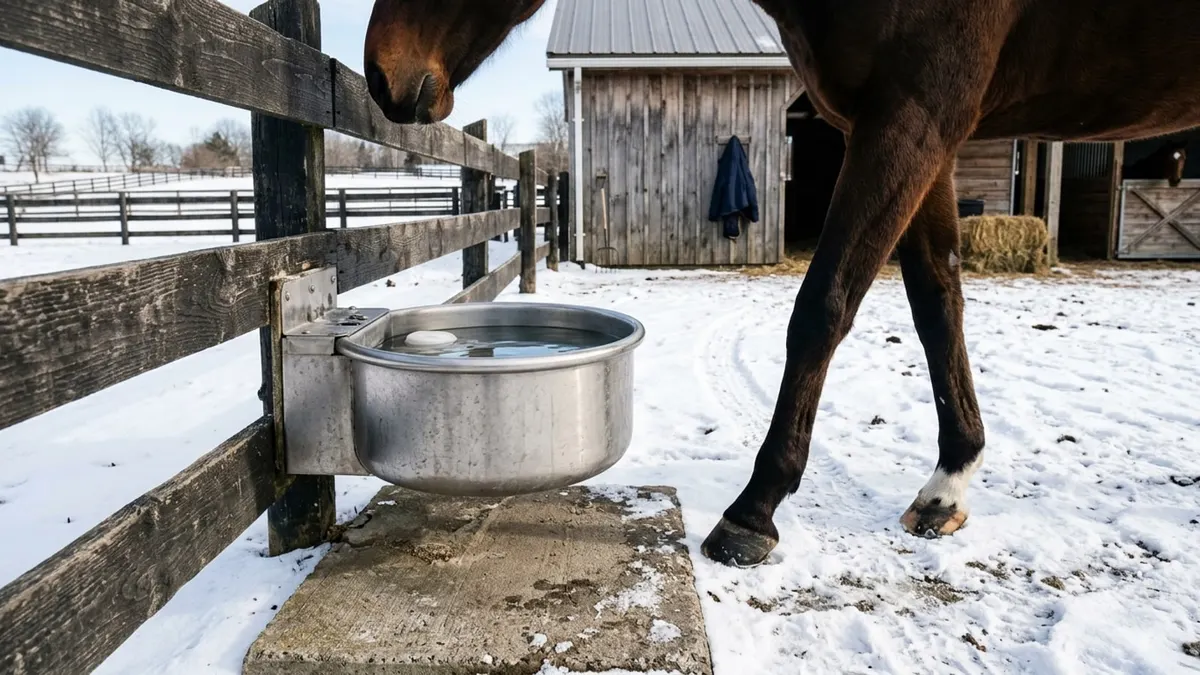
Best Automatic Horse Waterers (2026): Heated, Frost-Free and Float Valve
Four automatic waterers, from a stall-wall Nelson to a no-electricity Bar-Bar-A, compared on heater watts, horses served, installation and what each needs from a plumber and electrician.
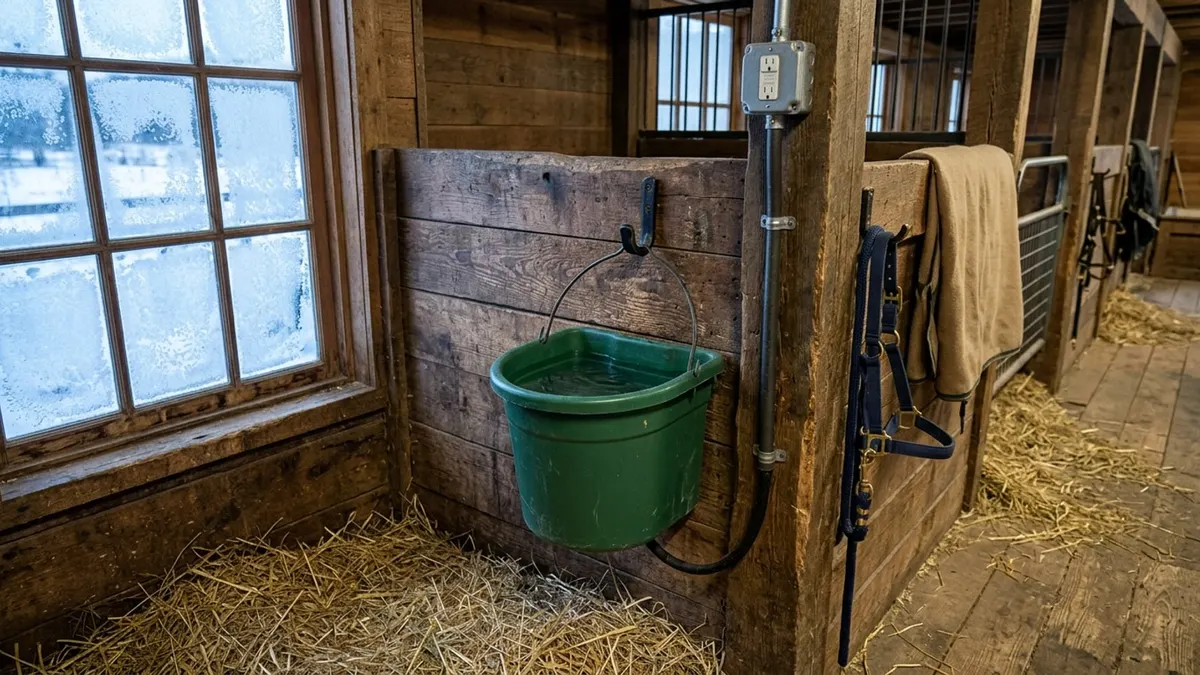
Best Heated Water Buckets and Bucket Heaters for Horses (2026)
Two heated buckets and two bucket heaters for winter stalls, by watts, gallons and thermostat, with how many buckets a horse needs a day and what to plug them into.
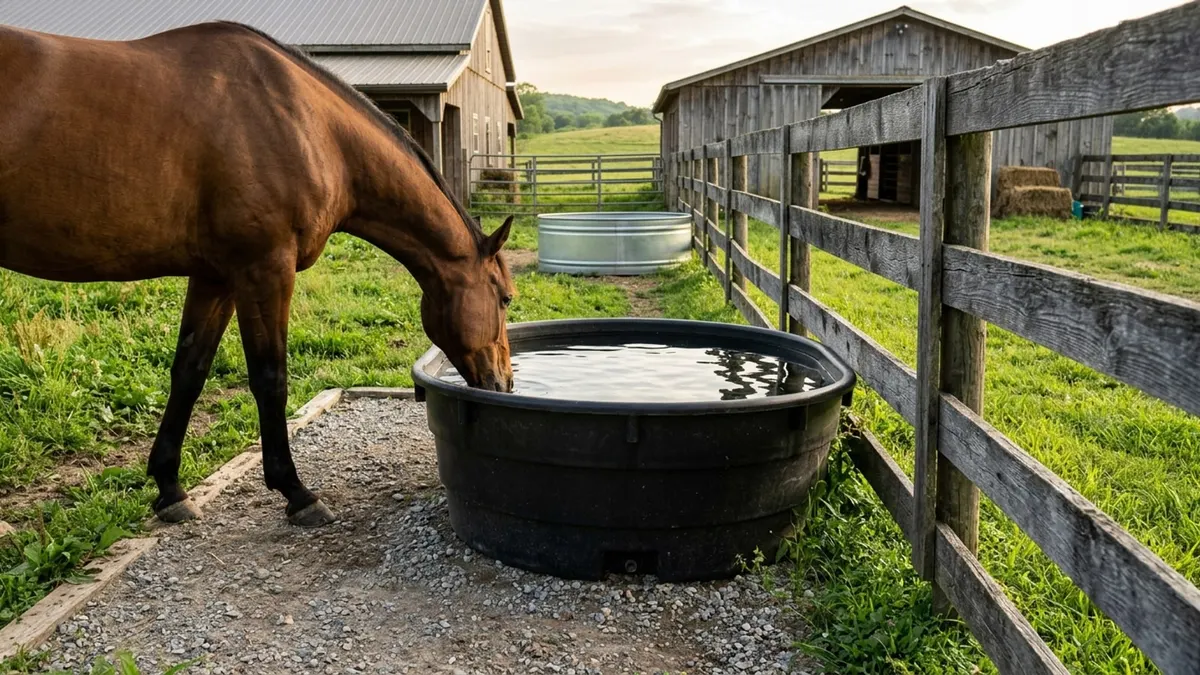
Best Horse Water Troughs (2026): Poly, Galvanized and Rubbermaid Stock Tanks
Five horse troughs from 50 to 300 gallons, with a table of how many days each lasts per horse and what to know about drains, de-icers and poly against galvanized.